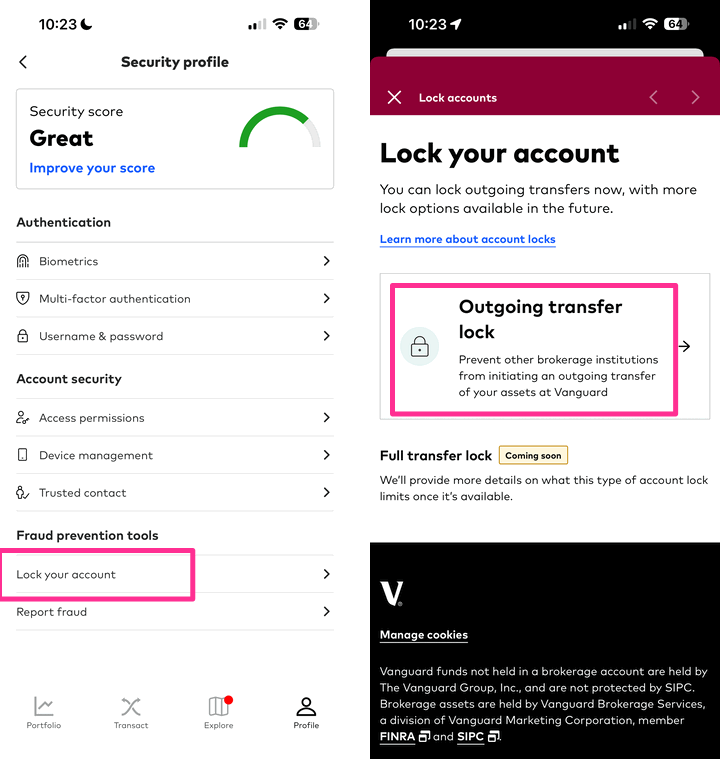
Vanguard Outgoing Transfer Lock (New): Block Fraudulent ACAT Transfer Brokerage Scams

Vanguard recently rolled out a new “Security Score” that encourages folks to activate all of the various security features they have available, and included is a new feature called “Outgoing Transfer Lock”. This is an important and useful option that I think all Vanguard customers should activate immediately.

Background on ACAT transfer scams. Instead of hacking your Vanguard account directly, a thief will obtain enough of your personal information to open a new brokerage account somewhere else, say E*Trade, and then they will request an ACAT transfer of the entire contents of your existing brokerage account (ex. Vanguard) to that new fake E*Trade account which they control. At this point, they can quickly liquidate the account and send the money elsewhere. The key here is that they just need to be able to open an empty, new brokerage account in your name plus find your Vanguard account numbers from somewhere. They don’t need your Vanguard username and password (or pass two-factor authentication, etc).

This loophole, ironically, comes from FINRA Rule 11870, which was created to protect consumers from a broker not letting you leave them. If you request a transfer, the old broker has one business day to validate the authenticity, and then they only have 3 business days to complete the transfer. If they don’t complete the transfer in a timely manner, the old broker gets into trouble with the regulatory agency FINRA. Thus, the pressure is actually on your old broker to approve it quickly. They are not even required to notify you of the transfer. In fact, with nearly every legitimate ACAT transfer I’ve completed, the old broker never made a peep.

Fidelity was the first major brokerage to create a Money Transfer Lockdown feature in response, where you can opt-in to an extra layer of verification to prevent unauthorized transfers (both ACAT and certain bank transfers). Vanguard’s “Outgoing Transfer Lock” applies to ACATs only, with a different option called “Full Transfer Lock” that includes bank transfers coming later. Here’s the wording taken directly from the Vanguard website:

What is an outgoing transfer lock?
An outgoing transfer lock prevents ACAT, or Automated Customer Account Transfer. This is a standard system brokerages use to transfer assets between institutions. Another brokerage institution should only initiate ACAT after you’ve opened an account with them and asked them to transfer your assets from Vanguard.

Locking your accounts for outgoing transfers protects your assets from being moved to an outside brokerage institution without your consent—a common type of fraud. It doesn’t apply to bank transfers you initiate, so you still have access to your money.

What is a full transfer lock? (Coming soon)
A full transfer lock prevents all money movement into and out of your account, including fund transfers to and from other brokerage institutions. Additional details about specific limitations will be provided once this account lock is available.

Essentially, this means that for someone to steal your assets, they would also need to be able to log into your brokerage account and disable the transfer lock. You can still move your assets when you really want to, it’s just harder to fake. Therefore, I believe this is should be turned on by basically everyone.

Activation instructions. Here’s how to find it on the website:

  • Log in at Vanguard.com
  • Click on “Profile” at the top-right corner, and then “Security Profile”
  • Scroll down to “Outgoing transfer lock” and click on “Manage”
  • Enable for all or selected accounts.

This also works in the app:

  • Log into your Vanguard app
  • Click on “Profile” at the bottom-right corner, and then “Security Profile”
  • Scroll down to “Fraud Prevention Tools” and click on “Lock your account”
  • Enable for all or selected accounts.

While you’re there, you can review all of your other security settings as well.

Best Interest Rates on Cash: Bank Accounts, Treasury Bills, Money Markets, ETFs – July 2026

Here’s my monthly survey of the best interest rates on cash as of July 2026, roughly sorted from shortest to longest maturities. Banks and brokerages love taking advantage of idle cash, and you can often earn more interest while keeping the same level of safety by moving to another FDIC-insured bank or NCUA-insured credit union. Check out my Ultimate Rate-Chaser Calculator to see how much extra interest you could earn from switching. Rates listed are available to everyone nationwide. Rates checked as of 7/1/26.

TL;DR: Savings account interest rates dropped slightly overall. You can get 4.4% APY if you accept certain hoops/restrictions, but most are under 4% now. Short-term T-Bill rates ~3.7%. Top 5-year CD rates are ~4.1% APY, while the 5-year Treasury rate is also ~4.1%.

High-yield savings accounts*
Since the huge megabanks still pay essentially zero interest, everyone should at least have a separate, no-fee online savings account to piggy-back onto your existing checking account. The interest rates on savings accounts can drop at any time, so I list the top rates as well as competitive rates from banks with a history of competitive rates and solid user experience. Some banks will bait you with a temporary top rate and then lower the rates in the hopes that you are too lazy to leave.

  • The top saving rate at the moment: Pibank at 4.40% APY (no min), but they have some weird restrictions; you can only use wire/Plaid to deposit and wire transfers to withdraw funds?! Elevault (no min) is at 4.34% APY, a division of Southern Bancorp Bank.
  • SoFi Bank is at 3.10% APY (new customers can get up to $475 in bonuses with qualifying direct deposit. You must maintain a direct deposit of any amount (even $1) each month for the higher ongoing APY. SoFi has historically competitive rates and full banking features.
  • Here is a limited survey of high-yield savings accounts. They aren’t the top rates, but a group that have historically kept it relatively competitive such that I like to track their history. This month they start at 3.00% APY on up.

Short-term guaranteed rates (1 year and under)
A common question is what to do with a big pile of cash that you’re waiting to deploy shortly (plan to buy a house soon, just sold your house, just sold your business, legal settlement, inheritance). My usual advice is to keep things simple and take your time. If not a savings account, then put it in a flexible short-term CD under the FDIC limits until you have a plan.

  • No Penalty CDs offer a fixed interest rate that can never go down, but you can still take out your money (once) without any fees if you want to use it elsewhere. Marcus has a 13-month No Penalty CD at 3.80% APY ($500 minimum deposit). Farmer’s Insurance FCU has a 9-month No Penalty CD at 4.00% APY ($1,000 minimum deposit). USALLIANCE Financial CU has a 11-month No Penalty CD at 3.85% APY ($500 minimum deposit).
  • E-Trade Bank has a 12-month CD at 4.10% APY (no minimum deposit). Early withdrawal penalty is 90 days of interest.
  • Farmer’s Insurance FCU has a 12-month CD at 4.00% APY with new money required. $1,000 minimum to open. Early withdrawal penalty is 90 days of interest.

Money market mutual funds
Many brokerage firms that pay out very little interest on their default cash sweep funds (and keep the difference for themselves). Note: Money market mutual funds are highly-regulated, but ultimately not FDIC-insured, so I would still stick with highly reputable firms.

  • Vanguard Federal Money Market Fund (VMFXX) is the default sweep option for Vanguard brokerage accounts, which has a 7-day SEC yield of 3.58% (changes daily, but also works out to a compound yield of 3.64%, which is better for comparing against APY). Odds are this is much higher than your own broker’s default cash sweep interest rate.
  • Vanguard Treasury Money Market Fund (VUSXX) is an alternative money market fund which you must manually purchase, but the interest will be mostly (100% for 2025 tax year) exempt from state and local income taxes because it comes from qualifying US government obligations. Current 7-day SEC yield of 3.63% (compound yield of 3.69%).

Treasury Bills and Ultra-short Treasury ETFs
Another option is to buy individual Treasury bills which come in a variety of maturities from 4-weeks to 52-weeks and are fully backed by the US government. You can also invest in ETFs that hold a rotating basket of short-term Treasury Bills for you, while charging a small management fee for doing so. T-bill interest is exempt from state and local income taxes, which can make a significant difference in your effective yield.

  • You can build your own T-Bill ladder at TreasuryDirect.gov or via a brokerage account with a bond desk like Vanguard and Fidelity. Here are the current Treasury Bill rates. As of 7/1/26, a new 4-week T-Bill had the equivalent of 3.63% annualized interest and a 52-week T-Bill had the equivalent of 3.98% annualized interest.
  • The iShares 0-3 Month Treasury Bond ETF (SGOV) has a 3.54% 30-day SEC yield (0.09% expense ratio) and effective duration of 0.10 years. The Vanguard 0-3 Month Treasury Bill ETF (VBIL) has a 3.57% 30-day SEC yield (0.06% expense ratio) and effective duration of 0.10 years.

US Savings Bonds
Series I Savings Bonds offer rates that are linked to inflation and backed by the US government. You must hold them for at least a year. If you redeem them within 5 years there is a penalty of the last 3 months of interest. The annual purchase limit for electronic I bonds is $10,000 per Social Security Number, available online at TreasuryDirect.gov.

  • “I Bonds” bought between May 2026 and October 2026 will earn a 4.26% rate for the first six months. The rate of the subsequent 6-month period will be based on inflation again. More on Savings Bonds here.
  • In mid-October 2026, the CPI will be announced and you will have a short period where you will have a very close estimate of the rate for the next 12 months. I will post another update at that time.

Rewards checking accounts
These unique checking accounts pay above-average interest rates, but with unique risks. You have to jump through certain hoops which usually involve 10+ debit card purchases each cycle, a certain number of ACH/direct deposits, and/or a certain number of logins per month. If you make a mistake (or they judge that you did) you risk earning zero interest for that month. Some folks don’t mind the extra work and attention required, while others would rather not bother. Rates can also drop suddenly, leaving a “bait-and-switch” feeling.

  • La Capitol Federal Credit Union pays 6.50% APY on up to $10,000 if you make 15 debit card purchases of at least $5 each per statement cycle. Anyone can join this credit union via partner organization, Louisiana Association for Personal Financial Achievement ($20).
  • OnPath Federal Credit Union (my review) pays 6.00% APY on up to $10,000 if you make 15 debit card purchases, opt into online statements, and login to online or mobile banking once per statement cycle. Anyone can join this credit union via $5 membership fee to join partner organization. You can also get a $150 Visa Reward card when you open a new account and make qualifying transactions.
  • Genisys Credit Union pays 6.75% APY on up to $7,500 if you make 10 debit card purchases of $5+ each per statement cycle, and opt into online statements. Anyone can join this credit union via $5 membership fee to join partner organization.
  • Oklahoma Central Credit Union pays 6.00% APY on up to $10,000 if you make 15 debit card purchases (non-ATM) per statement cycle. Anyone can join this credit union if they are “affiliated with another credit union”.
  • First Southern Bank pays 5.50% APY on up to $25,000 if you make at least 15 debit card purchases, 1 ACH credit or payment transaction, and enroll in online statements.
  • Credit Union of New Jersey pays 5.50% APY on up to $20,000 if you make 12 debit card purchases, opt into online statements, and make at least 1 direct deposit, online bill payment, or automatic payment (ACH) per statement cycle. Anyone can join this credit union via $5 membership fee to join partner organization.
  • Andrews Federal Credit Union pays 5.25% APY on up to $25,000 if you make 15 debit card purchases, opt into online statements, and make at least 1 direct deposit or ACH transaction per statement cycle. Anyone can join this credit union via partner organization.
  • Capitol Credit Union pays 6.00% APY on up to $15,000 if you make 12 debit card purchases, opt into online statements, and make at least 1 direct deposit or ACH transaction per statement cycle. Anyone can join this credit union via partner organization ($5 to Wild Basin Wilderness).
  • Find a locally-restricted rewards checking account at DepositAccounts.

Certificates of deposit (greater than 1 year)
CDs offer higher rates, but come with an early withdrawal penalty. By finding a bank CD with a reasonable early withdrawal penalty, you can enjoy higher rates but maintain access in a true emergency. Alternatively, consider building a CD ladder of different maturity lengths (ex. 1/2/3/4/5-years) such that you have access to part of the ladder each year, but your blended interest rate is higher than a savings account. When one CD matures, use that money to buy another 5-year CD to keep the ladder going. Some CDs also offer “add-ons” where you can deposit more funds if rates drop.

  • NASA Federal Credit Union has a 5-year certificate at 4.28% APY ($1,000 minimum), 4-year at 4.20% APY, 3-year at 4.15% APY, 2-year at 4.10% APY, and 1-year at 4.05% APY. Early withdrawal penalty for the 5-year is 365 days of interest. Anyone nationwide can join via a complimentary membership to the National Space Society (NSS).
  • Advancial Federal Credit Union has has a 5-year certificates at 4.14%/4.24%/4.34% APY APY based on either a $1,000/$25,000/$50,000 opening balance. Early withdrawal penalty for the 5-year is 365 days of interest. Anyone nationwide should be able to join via membership with partner organization US Dog Agility Association, but I would call to verify first.
  • Mountain America Credit Union (MACU) has a 5-year certificate at 4.15% APY ($500 minimum), 4-year at 4.09% APY, 3-year at 4.09% APY, 2-year at 4.30% APY, and 1-year at 4.00% APY. Early withdrawal penalty for the 4-year and 5-year is 365 days of interest. Anyone can join this credit union via partner organization American Consumer Council (use promo code “consumer” when joining).
  • You can buy certificates of deposit via the bond desks of Vanguard and Fidelity. You may need an account to see the rates. These “brokered CDs” offer FDIC insurance and easy laddering, but they don’t come with predictable early withdrawal penalties. Right now, I see a 5-year non-callable brokered CD at 4.40% APY (callable: no, call protection: yes). Be warned that both Vanguard and Fidelity will list higher rates from callable CDs, which importantly means they can (and will!) call back your CD if rates drop significantly later.

Longer-term Instruments
I’d use these with caution due to increased interest rate risk (tbh, I don’t use them at all), but I still track them to see the rest of the current yield curve.

  • Willing to lock up your money for 10 years? You can buy long-term certificates of deposit via the bond desks of Vanguard and Fidelity. These “brokered CDs” offer FDIC insurance, but they don’t come with predictable early withdrawal penalties. You might find something that pays more than your other brokerage cash and Treasury options. Right now, I see a 10-year CDs at [none available] APY (non-callable) vs. 4.47% for a 10-year Treasury. Watch out for higher rates from callable CDs where they can call your CD back if interest rates drop.

All rates were checked as of 7/1/26.

* I no longer recommend fintech companies due to the possibility of significant loss due to poor recordkeeping and the lack of government protection in such scenarios. The point of cash is absolute safety of principal.

Photo by Giorgio Trovato on Unsplash

US Stock Prices (All-Time High) vs. Consumer Sentiment (All-Time Low)

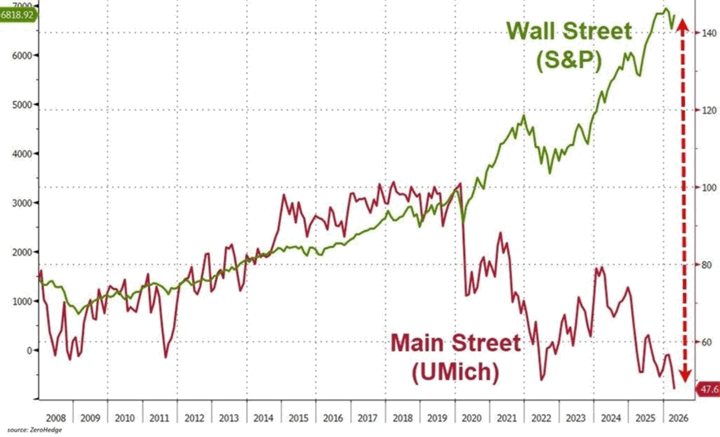
Another concerning chart. US stock performance, as measured by the S&P 500 index, continues to be at or near all-time highs. Consumer sentiment meanwhile, as measured by the University of Michigan’s Consumer Sentiment Index, is at all-time lows. The chart below calls it “Wall Street vs. Main Street” via Kobeissi Letter.

The gap between Wall Street and Main Street has never been bigger:

US consumer sentiment is down to 47.6 points, the lowest level in history.
At the same time, the S&P 500 is trading just 3% from its all-time high.
Since the 2020 pandemic, consumer sentiment has fallen -50%.
During the same period, the S&P 500 has rallied +205%.
This comes as inflation, rising housing costs, and a weakening job market are increasingly squeezing the average American household.
Meanwhile, 87% of all equities are held by the wealthiest 10% of households.
Asset owners are the biggest winners in this economy.

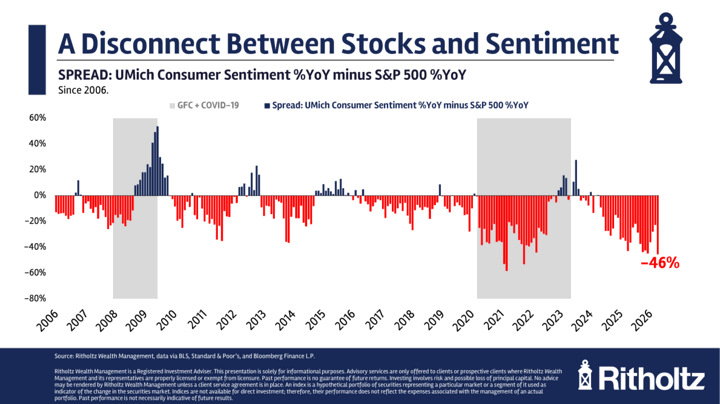
More commentary from Barry Ritholtz:

Investing in US Stocks Has Been Quite Rewarding

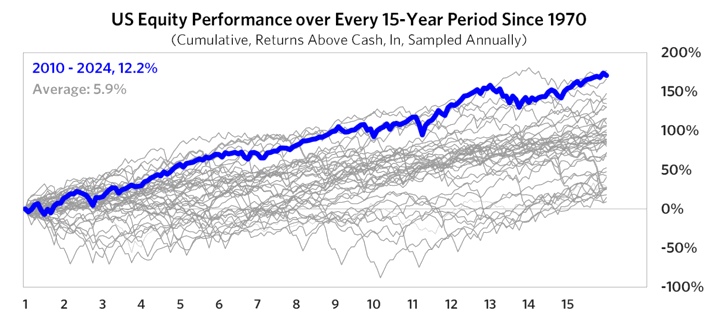
What’s on my mind these days? Here’s one thing. Based on this Bridgewater article, out of any 15-year period to be invested in US stocks dating back to 1970, the one we’ve just lived through was the best (2010 through end of 2024).

I was a bit surprised to see this. I’m disappointed that the same chart for growth in average inflation-adjusted worker income does not look the same at all. What does it mean for the future? I have no idea. Maybe our economic system is just tilted towards rewarding businesses instead of the average worker now, and high performance will be the norm. Maybe the next 15 years will have horrible performance, but the average worker will earn a much better relative income. Will AI simply reward the huge corporations even more, or will we find a way to distribute the benefits?

Vanguard: Recommended Strategies for Maximizing Retirement Income

Vanguard Research recently released a whitepaper titled Vanguard’s Principles for Retirement Income (direct PDF link) and I was surprised to find it rather substantial – almost a short book on retirement income planning that provides valuable insight into their (growing!) financial advisory services. The focus is clearly about creating a sustainable income from your portfolio, not the usual stuff about growing your portfolio.

Focusing on income rather than account balances can lead to clearer decision-making in retirement.

Without a defined income plan, investors may spend too cautiously or risk drawing down their assets too quickly. With an income-focused framework, you can better understand how to turn your savings into spending by having a clearer view of:

– How much you can withdraw over time.
– How long your assets may need to last.
– How different risks can affect outcomes.

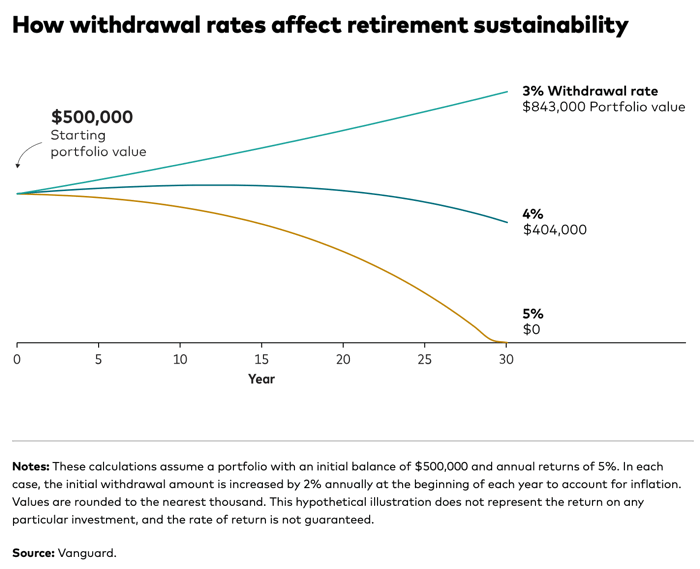
As a start, you have your sources of guaranteed income (pensions, annuities, Social Security) and roughly 3.5% to 4% of your portfolio, based on historical numbers:

Here are some of the recommended strategies to help stretch things further to create enough income for the rest of your lifetime. Some are more for those that really need to make some big, hard decisions in order to not run out of money, while others are more about marginal improvements.

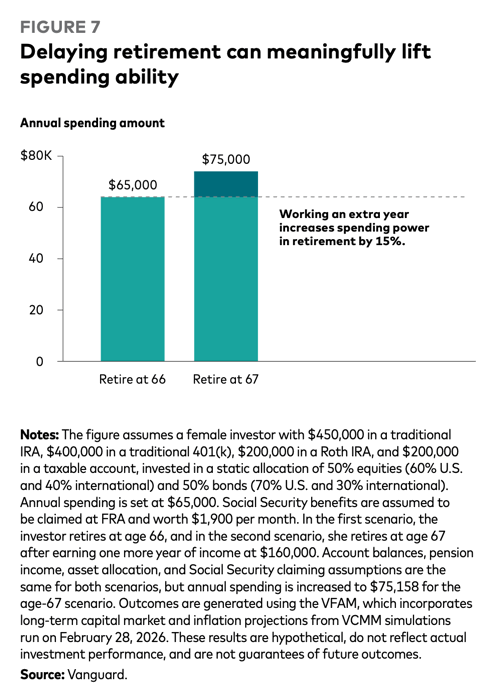
  • Work longer. Not ideal, but powerful. You earn more, you also delay the start of Social Security claiming, and you have a shorter retirement period to cover.
  • Dynamic spending. Rather than a fixed percentage withdrawal rate, dynamic spending extends the life of the portfolio by reducing withdrawals if there are poor market returns. There are many ways to implement this.
  • Convert some assets to SPIA (single-premium income annuity). If you need to support a hard floor in your income to support essentials, an SPIA can help provide the reliable income needed.
  • Tapping home equity. Something to consider if necessary to provide for essentials, especially later in retirement.
  • Roth conversions. Converting tax-deferred investments to Roth when your marginal tax brackets are lower (like right after you stop working) can reduce your overall tax paid.
  • Tax-efficient withdrawal strategy. In general, you should withdraw from taxable accounts
    first, then tax-deferred, then save Roth for last.

If anything, this paper provides some good places to dig deeper when the time comes.

Plynk Brokerage App: Dividend Match (25% Bonus up to $250 per Year)

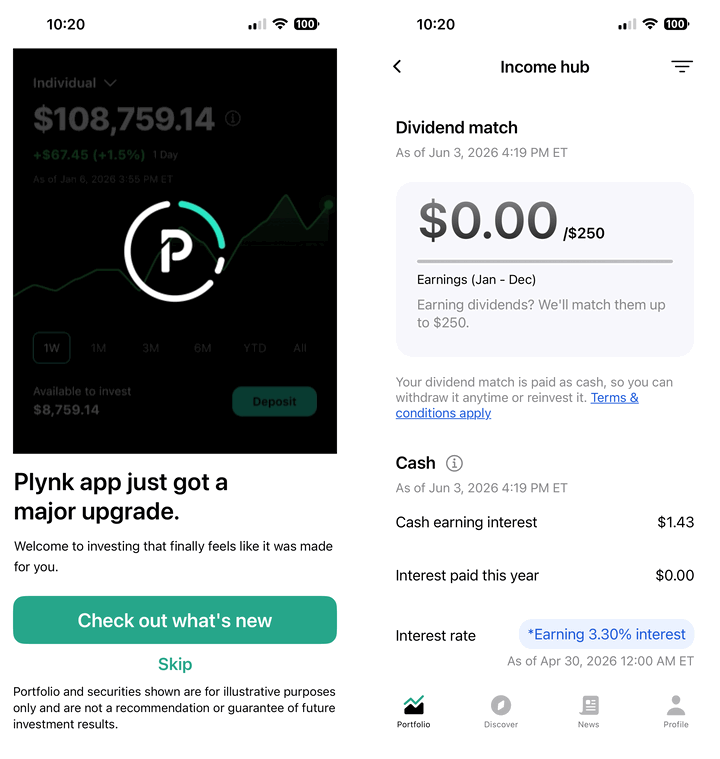
Plynk is a standalone brokerage app that is quietly a subsidiary of a subsidiary of Fidelity Investments. It seems to be a place where they can experiment with a younger target audience with tools like automatic recurring investments, simulated trading, educational tools, etc. They’ve also offered a few worthwhile bonuses in the app. Plynk just underwent another design reboot, and – surprise! – the interface now looks a lot more like Robinhood.

Plynk also just added a new promotion called Dividend Match (hat tip DoC), which pays you a bonus of 25% of the dividends your taxable brokerage account holdings earn each calendar month, up to $250 max per year. Important highlights:

  • Dividend match is available to both existing and new customers. No opt-in required.
  • Eligible shares. For common stock and non-daily accrual mutual funds and ETFs, you must hold for at least 30 calendar days prior to the ex-dividend date to receive the Bonus. For mutual funds and ETFs that accrue daily interest and generally pay a dividend at the end of each month, there is no required holding period.
  • Formula: Eligible_Shares × Dividend_Per_Share × 25% subject to the $250 annual cap on Bonus amount.
  • The annual cap resets on January 1 of each year.

An interesting bonus that would seem to incentivize customers to maintain their (dividend-paying) holdings at Plynk. The S&P 500 dividend yield is only around 1% now, but if you moved over around $100,000 and normally would get $1,000 in annual dividends, now you could get an extra $250 in dividends.

iShares 0-3 Month Treasury Bond ETF (SGOV) is a daily accrual ETF that holds short-term Treasury bills and can be a useful approximation of cash. Right now, SGOV has a 30-day SEC yield of 3.54%. If you got a 25% bonus on that yield, you would be getting 4.43%.

You could also do this with Vanguard 0-3 Month Treasury Bill ETF (VBIL) which has a slightly lower expense ratio and thus slightly higher SEC yields, but a tiny bit higher bid/ask spread at times (although it is pretty much one cent like SGOV).

You’d have to hold a little over $28,000 in SGOV/VBIL in order to reach the $1,000 in annual dividends to max out this promo.

I’m guessing the money would be reported as 1099-MISC, so the tax rate would also be higher than normal interest.

This would be nice if it was a permanent or guaranteed feature. I’m considering it especially as I already have an open account, but I’m afraid Plynk will end the promo quickly even though it is meant as an ongoing offer with no set expiration date.

Still Buying the Haystack and Sleeping Well Because I’ll Own The Needles (Winners)

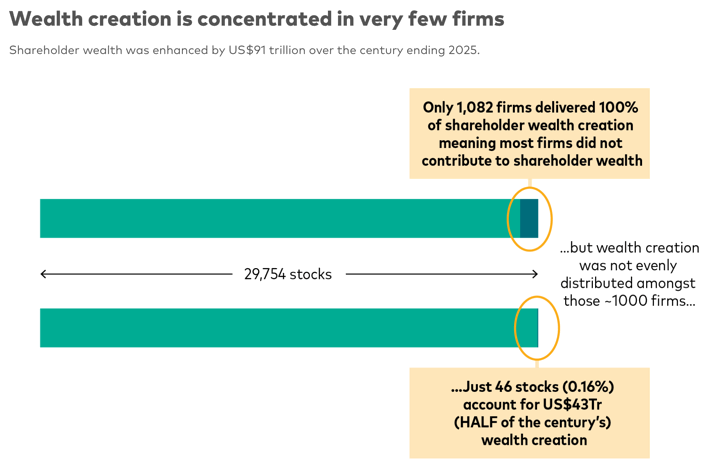
In 2019, I wrote the post Buying The Haystack: Sleeping Well Because I’ll Own The Winners (Needles). Recently, Hendrik Bessembinder updated his previous research with the paper One Hundred Years in the U.S. Stock Markets (SSRN/PDF), which tracked the “investment outcomes for 29,754 common stocks listed on the public U.S. stock markets over the 100-year period from 1926 to 2025”. Some highlights:

  • Total Net Wealth created over that period: ~$91 Trillion.
  • The 0.2% Needles: Just 46 stocks (roughly 0.2% of the ~30,000 total stocks) were responsible for generating 50% of that $91 trillion.
  • The 4% Needles: Only 4% of all stocks accounted for 100% of the net value creation. The other 96% collectively just matched risk-free US Treasury bills – many were complete or nearly complete losses, the rest had smaller gains that only just offset those losses. This means that the top 4% created all of the net wealth creation.

Here is a chart that summarizes this info from a Vanguard Australia article Equity market skewness: The few mega-winners and the case for diversification:

I will simply quote Bogle and myself now, because I am lazy and honestly that’s how investment writing works. You just end up repeating and/or repackaging the same 10-25 rules over and over again.

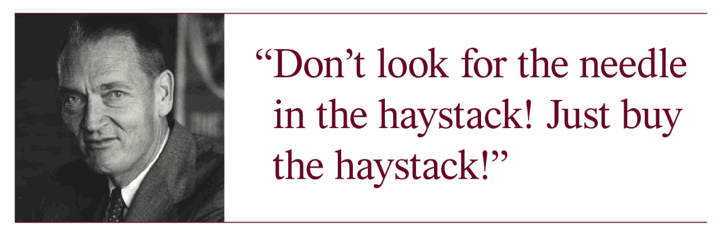
As the late Jack Bogle told us: “Don’t look for the needle in the haystack. Just buy the haystack.”

I don’t know which will be the most successful US companies in the future, but I know that I will own them via the total US index fund in my portfolio. I will own the next Amazon, Google, Facebook, Apple, or Visa. I’ll also own whoever disrupts them after that. Since I own a big chunk of global stocks inside the Vanguard Total International Stock Index fund, I’ll be covered if they come from the other side of the world.

In 2026, this means I own NVIDIA/Alphabet/Google/Microsoft, but in 10 years, I know that the picture will be at least somewhat different.

Advantages of Owning Vanguard Total US and Total International Stocks ETFs Separately

One of the most popular ways to build out the stock portion of a simple index fund portfolio is to own the following two Vanguard ETFs:

  • Vanguard Total US Stock Market ETF (VTI), which tracks the CRSP US Total Market Index representing ~100% of the investable U.S. stock market and includes large-, mid-, small-, and micro-cap stocks.
  • Vanguard Total International Stock ETF (VXUS), which tracks the FTSE Global All Cap ex US Index representing equity market performance in developed and emerging markets, including 48 countries and excluding the United States.

However, a lesser-known option is to own a single Vanguard ETFs that attempts to track all the investable stocks in the entire world:

  • Vanguard Total World Stock ETF (VT), which tracks the FTSE Global All Cap Index, a free-float-adjusted, market-capitalization-weighted index designed to measure the market performance of large-, mid-, and small-capitalization stocks of companies located around the world.

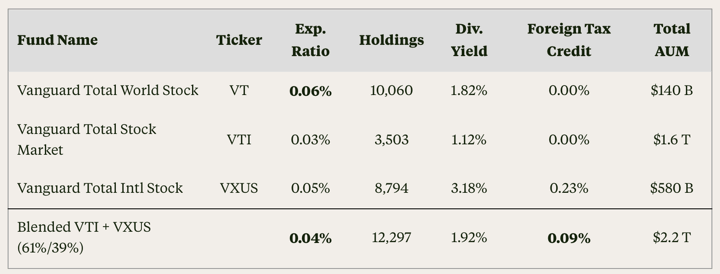
You may already have noticed that VTI/VXUS together have a lower blended expense ratio than VT, at least partially due to how big they are and their economies of scale. This Elm Wealth article goes into detail about one of the major benefits of owning them separately in a taxable brokerage account: the ability to obtain the Foreign Tax Credit. VT is ~60% US stocks and thus does not qualify for the Foreign Tax Credit.

The net result of this is that VXUS effectively earns you an extra 0.23%, which when added to the expense ratio difference in a blended 60% VTI/40% VXUS portfolio ends up being worth 0.13% annually. The effect of an extra ~0.13% in essentially guaranteed extra performance every year (in a taxable account) is pretty significant and can really compound over time. I’m happy to see a number placed on this benefit.

The article includes other good points, with the overall takeaway being that owning both VTI and VXUS has a lot of notable advantages and only minor disadvantages. VTI and VXUS are my largest holdings by far, and I agree that it’s hardly any extra work to add the tiny bit of complexity of owning two ETFs (that mostly already rebalance automatically with price changes).

Best Interest Rates on “Cash”: Bank Accounts, Treasury Bills, Money Markets, ETFs – May 2026

Here’s my monthly survey of the best interest rates on cash as of May 2026, roughly sorted from shortest to longest maturities. Banks and brokerages love taking advantage of idle cash, and you can often earn more interest while keeping the same level of safety by moving to another FDIC-insured bank or NCUA-insured credit union. Check out my Ultimate Rate-Chaser Calculator to see how much extra interest you could earn from switching. Rates listed are available to everyone nationwide. Rates checked as of 5/14/26.

TL;DR: Savings account interest rates dropped slightly overall. You can get 4.4% APY if you accept certain hoops/restrictions, but most are under 4% now. Short-term T-Bill rates ~3.7%. Top 5-year CD rates are ~4.1% APY, while the 5-year Treasury rate is also ~4.1%.

High-yield savings accounts*
Since the huge megabanks still pay essentially zero interest, everyone should at least have a separate, no-fee online savings account to piggy-back onto your existing checking account. The interest rates on savings accounts can drop at any time, so I list the top rates as well as competitive rates from banks with a history of competitive rates and solid user experience. Some banks will bait you with a temporary top rate and then lower the rates in the hopes that you are too lazy to leave.

  • The top saving rate at the moment: Pibank at 4.40% APY (no min), but they have some weird restrictions; you can only use wire/Plaid to deposit and wire transfers to withdraw funds?! CineFi (no min) is at 4.34% APY, a division of Southern Bancorp Bank. OnPath FCU held at 4.25% APY with $25,000 minimum balance.
  • SoFi Bank is at 3.30% APY (new customers can get up to 4.00% APY for 6 months + increased $425 bonus with qualifying direct deposit. You must maintain a direct deposit of any amount (even $1) each month for the higher ongoing APY. SoFi has historically competitive rates and full banking features.
  • Here is a limited survey of high-yield savings accounts. They aren’t the top rates, but a group that have historically kept it relatively competitive such that I like to track their history. This month they start at 3.10% APY on up.

Short-term guaranteed rates (1 year and under)
A common question is what to do with a big pile of cash that you’re waiting to deploy shortly (plan to buy a house soon, just sold your house, just sold your business, legal settlement, inheritance). My usual advice is to keep things simple and take your time. If not a savings account, then put it in a flexible short-term CD under the FDIC limits until you have a plan.

  • No Penalty CDs offer a fixed interest rate that can never go down, but you can still take out your money (once) without any fees if you want to use it elsewhere. Marcus has a 13-month No Penalty CD at 3.80% APY ($500 minimum deposit). Farmer’s Insurance FCU has a 9-month No Penalty CD at 4.00% APY ($1,000 minimum deposit). USALLIANCE Financial CU has a 11-month No Penalty CD at 3.90% APY ($500 minimum deposit).
  • E-Trade Bank has a 12-month CD at 4.10% APY (no minimum deposit). Early withdrawal penalty is 90 days of interest.
  • Farmer’s Insurance FCU has a 12-month CD at 4.00% APY with new money required. $1,000 minimum to open. Early withdrawal penalty is 90 days of interest.

Money market mutual funds
Many brokerage firms that pay out very little interest on their default cash sweep funds (and keep the difference for themselves). Note: Money market mutual funds are highly-regulated, but ultimately not FDIC-insured, so I would still stick with highly reputable firms.

  • Vanguard Federal Money Market Fund (VMFXX) is the default sweep option for Vanguard brokerage accounts, which has a 7-day SEC yield of 3.55% (changes daily, but also works out to a compound yield of 3.61%, which is better for comparing against APY). Odds are this is much higher than your own broker’s default cash sweep interest rate.
  • Vanguard Treasury Money Market Fund (VUSXX) is an alternative money market fund which you must manually purchase, but the interest will be mostly (100% for 2025 tax year) exempt from state and local income taxes because it comes from qualifying US government obligations. Current 7-day SEC yield of 3.61% (compound yield of 3.67%).

Treasury Bills and Ultra-short Treasury ETFs
Another option is to buy individual Treasury bills which come in a variety of maturities from 4-weeks to 52-weeks and are fully backed by the US government. You can also invest in ETFs that hold a rotating basket of short-term Treasury Bills for you, while charging a small management fee for doing so. T-bill interest is exempt from state and local income taxes, which can make a significant difference in your effective yield.

  • You can build your own T-Bill ladder at TreasuryDirect.gov or via a brokerage account with a bond desk like Vanguard and Fidelity. Here are the current Treasury Bill rates. As of 5/13/26, a new 4-week T-Bill had the equivalent of 3.66% annualized interest and a 52-week T-Bill had the equivalent of 3.80% annualized interest.
  • The iShares 0-3 Month Treasury Bond ETF (SGOV) has a 3.55% 30-day SEC yield (0.09% expense ratio) and effective duration of 0.10 years. The Vanguard 0-3 Month Treasury Bill ETF (VBIL) has a 3.59% 30-day SEC yield (0.06% expense ratio) and effective duration of 0.10 years.

US Savings Bonds
Series I Savings Bonds offer rates that are linked to inflation and backed by the US government. You must hold them for at least a year. If you redeem them within 5 years there is a penalty of the last 3 months of interest. The annual purchase limit for electronic I bonds is $10,000 per Social Security Number, available online at TreasuryDirect.gov.

  • “I Bonds” bought between May 2026 and October 2026 will earn a 4.26% rate for the first six months. The rate of the subsequent 6-month period will be based on inflation again. More on Savings Bonds here.
  • In mid-October 2026, the CPI will be announced and you will have a short period where you will have a very close estimate of the rate for the next 12 months. I will post another update at that time.

Rewards checking accounts
These unique checking accounts pay above-average interest rates, but with unique risks. You have to jump through certain hoops which usually involve 10+ debit card purchases each cycle, a certain number of ACH/direct deposits, and/or a certain number of logins per month. If you make a mistake (or they judge that you did) you risk earning zero interest for that month. Some folks don’t mind the extra work and attention required, while others would rather not bother. Rates can also drop suddenly, leaving a “bait-and-switch” feeling.

  • La Capitol Federal Credit Union pays 6.50% APY on up to $10,000 if you make 15 debit card purchases of at least $5 each per statement cycle. Anyone can join this credit union via partner organization, Louisiana Association for Personal Financial Achievement ($20).
  • OnPath Federal Credit Union (my review) pays 6.00% APY on up to $10,000 if you make 15 debit card purchases, opt into online statements, and login to online or mobile banking once per statement cycle. Anyone can join this credit union via $5 membership fee to join partner organization. You can also get a $150 Visa Reward card when you open a new account and make qualifying transactions.
  • Genisys Credit Union pays 6.75% APY on up to $7,500 if you make 10 debit card purchases of $5+ each per statement cycle, and opt into online statements. Anyone can join this credit union via $5 membership fee to join partner organization.
  • Oklahoma Central Credit Union pays 6.00% APY on up to $10,000 if you make 15 debit card purchases (non-ATM) per statement cycle. Anyone can join this credit union if they are “affiliated with another credit union”.
  • First Southern Bank pays 5.50% APY on up to $25,000 if you make at least 15 debit card purchases, 1 ACH credit or payment transaction, and enroll in online statements.
  • Credit Union of New Jersey pays 6.00% APY on up to $25,000 if you make 12 debit card purchases, opt into online statements, and make at least 1 direct deposit, online bill payment, or automatic payment (ACH) per statement cycle. Anyone can join this credit union via $5 membership fee to join partner organization.
  • Andrews Federal Credit Union pays 5.25% APY (decreased) on up to $25,000 if you make 15 debit card purchases, opt into online statements, and make at least 1 direct deposit or ACH transaction per statement cycle. Anyone can join this credit union via partner organization.
  • Capitol Credit Union pays 6.00% APY on up to $15,000 if you make 12 debit card purchases, opt into online statements, and make at least 1 direct deposit or ACH transaction per statement cycle. Anyone can join this credit union via partner organization ($5 to Wild Basin Wilderness).
  • Find a locally-restricted rewards checking account at DepositAccounts.

Certificates of deposit (greater than 1 year)
CDs offer higher rates, but come with an early withdrawal penalty. By finding a bank CD with a reasonable early withdrawal penalty, you can enjoy higher rates but maintain access in a true emergency. Alternatively, consider building a CD ladder of different maturity lengths (ex. 1/2/3/4/5-years) such that you have access to part of the ladder each year, but your blended interest rate is higher than a savings account. When one CD matures, use that money to buy another 5-year CD to keep the ladder going. Some CDs also offer “add-ons” where you can deposit more funds if rates drop.

  • NASA Federal Credit Union has a 5-year certificate at 4.18% APY ($1,000 minimum), 4-year at 4.10% APY, 3-year at 4.05% APY, 2-year at 4.00% APY, and 1-year at 3.95% APY. Early withdrawal penalty for the 5-year is 365 days of interest. Anyone nationwide can join via a complimentary membership to the National Space Society (NSS).
  • Advancial Federal Credit Union has has a 5-year certificates at 4.14%/4.24%/4.34% APY APY based on either a $1,000/$25,000/$50,000 opening balance. Early withdrawal penalty for the 5-year is 365 days of interest. Anyone nationwide should be able to join via membership with partner organization US Dog Agility Association, but I would call to verify first.
  • Mountain America Credit Union (MACU) has a 5-year certificate at 4.05% APY ($500 minimum), 4-year at 4.00% APY, 3-year at 4.00% APY, 2-year at 4.20% APY, and 1-year at 3.90% APY. Early withdrawal penalty for the 4-year and 5-year is 365 days of interest. Anyone can join this credit union via partner organization American Consumer Council (use promo code “consumer” when joining).
  • You can buy certificates of deposit via the bond desks of Vanguard and Fidelity. You may need an account to see the rates. These “brokered CDs” offer FDIC insurance and easy laddering, but they don’t come with predictable early withdrawal penalties. Right now, I see a 5-year non-callable brokered CD at 4.10% APY (callable: no, call protection: yes). Be warned that both Vanguard and Fidelity will list higher rates from callable CDs, which importantly means they can (and will!) call back your CD if rates drop significantly later.

Longer-term Instruments
I’d use these with caution due to increased interest rate risk (tbh, I don’t use them at all), but I still track them to see the rest of the current yield curve.

  • Willing to lock up your money for 10 years? You can buy long-term certificates of deposit via the bond desks of Vanguard and Fidelity. These “brokered CDs” offer FDIC insurance, but they don’t come with predictable early withdrawal penalties. You might find something that pays more than your other brokerage cash and Treasury options. Right now, I see a 10-year CDs at [n/a] APY (non-callable) vs. 4.44% for a 10-year Treasury. Watch out for higher rates from callable CDs where they can call your CD back if interest rates drop.

All rates were checked as of 5/14/26.

* I no longer recommend fintech companies due to the possibility of significant loss due to poor recordkeeping and the lack of government protection in such scenarios. The point of cash is absolute safety of principal.

Photo by Giorgio Trovato on Unsplash

SoFi Promos: New $300 Crypto Transfer Bonus, 1% ACAT Transfer Bonus, $425 New Checking Bonus, $300-$1000 Loan Bonuses

(Updated: SoFi has a new $300 transfer bonus on the crypto account. Per the terms, you should be able to get the $50 new account bonus and then the $300 deposit bonus. I have updated the other offers as well.)

SoFi (“Social Finance”) is an all-in-one finance app that expanded from students loans into banking, stocks, crypto, credit cards, and more. They often run a bunch of different promotional offers; New users can receive a separate opening bonus for each separate part of SoFi (Money, Invest, Loans, etc).

  • SoFi $300 Transfer Bonus (New & Existing customers): $300 SOFID bonus. Transfer $1,000 or more in eligible crypto to SoFi Crypto by 10/14/26 and earn a $300 bonus in SOFID.* SOFID is their new stablecoin. Transferred crypto assets must be held on platform through 10/14/27 (one year). If you’ve done any other crypto bonus previously, like with Kraken, you can use that to buy $1,000 of USDC stablecoin, which qualifies for the bonus. $300 bonus on $1,000 is a 30% return in one year, not bad at all.
  • SoFi Checking Referral Offer: Up to $425 new account bonus. Open a new SoFi Checking account and add at least $50 to your account within 21 days, and get $25. Then get up to $400 additional bonus with qualifying direct deposit.
  • SoFi Credit Score Monitoring Offer: $10 bonus. Earn $10 in rewards points when you activate free credit score monitoring.
  • SoFi Invest Referral Offer: $25 new account bonus. Taxable brokerage account. Open an Active Investing account with $25 or more, and you’ll get $25 in stock.
  • SoFi Crypto Referral Offer: $25 new account bonus. Open a new SoFi Crypto account, buy $25 of crypto within 30 days, and get a $25 bonus in SOFID stablecoin.
  • SoFi ACAT Transfer Offer: 1% Match Bonus. Get a 1% match on ACAT transfers to IRA or taxable brokerage accounts (max $100,000 on $5,000,000 transferred). Minimum hold period for five (5) years from the settlement date.
  • SoFi 401(k) Rollover Offer: 1% Match Bonus. Get a 1% match when you roll over your 401(k) into a SoFi IRA. Minimum hold period for five (5) years from the settlement date.
  • SoFi Student Loan Refi: $300 bonus. Warning: Do your research before refinancing your Federal student loans to a private lender. You may lose some consumer protections.
  • SoFi Doctors and Dentists Student Loan Refi: $1,000 bonus. Special low rates just for doctors and dentists.
  • SoFi Private Student Loan: $300 bonus. For those looking for a new student loan (not a refinance).
  • SoFi Personal Loans Referral Offer: Fixed $300 bonus. Fixed $300 bonus, 90 days after successful funding. The loan has no fees and you can pay it back in full after 90 days (you can pay it down to $50 before then to accrue minimal interest, thus making it an opportunity to make a net profit on this offer).

Vanguard To Add Morningstar Branding to Several Index Funds

Last month, I mentioned that Morningstar had bought the Center for Research in Security Prices (CRSP) from the University of Chicago. CRSP started out as a non-profit, but was later converted to an LLC and sold for $375 million. Vanguard used these low-cost indexes to keep their expense ratios extremely low, and I expressed concern over this as Morningstar is a for-profit, publicly-traded corporation. This contrasts with Vanguard’s famous “at-cost” structure.

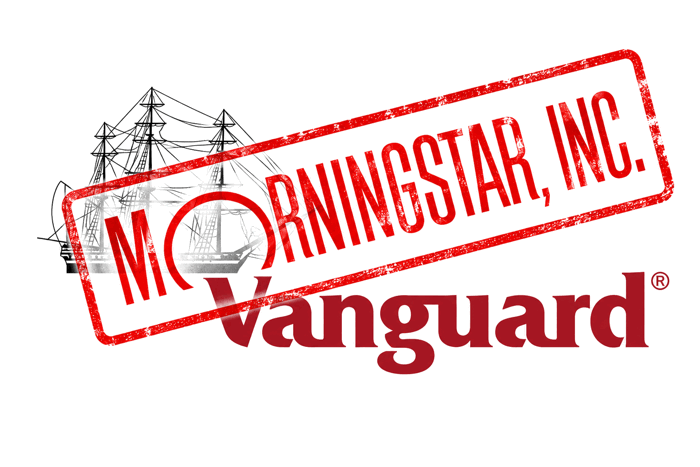
Vanguard just announced that starting in July 2026, Vanguard will add the “Morningstar” brand to 13 different US stock index funds (across 51 different share classes). Just a few examples:

  • Vanguard Morningstar Total Stock Market ETF (VTI)
  • Vanguard Morningstar Large-Cap ETF (VV)
  • Vanguard Morningstar Value ETF (VTV)
  • Vanguard Morningstar Small-Cap Value ETF (VBR)

Was this a strategic blunder on Vanguard’s part? CRSP basically only had one client: Vanguard. According to RIABiz, “Vanguard funds accounted for 97% of all assets tracking CRSP indices” at the time of sale.

Vanguard should have either bought CRSP themselves or switched to in-house indexes. In-house indexes are exactly how Fidelity offers their ZERO fund line with 0.00% expense ratio. The Four Fidelity ZERO Funds:

  • Fidelity ZERO Total Market Index Fund (FZROX) tracks the Fidelity U.S. Total Investable Market Index.
  • Fidelity ZERO Large Cap Index Fund (FNILX) tracks the Fidelity U.S. Large Cap Index.
  • Fidelity ZERO Extended Market Index Fund (FZIPX) tracks the Fidelity U.S. Extended Market Index.
  • Fidelity ZERO International Index Fund (FZILX) tracks the Fidelity Global ex U.S. Index.

I don’t think poorly of Morningstar, but at the same time they did not create these indexes out of some exceptional skill or store of knowledge. Morningstar does make other (not so popular) indices, but they just bought these from a university that needed money.

I can only speculate that Morningstar went to Vanguard and said something like “We own these indexes now. We’ll keep the price the same so your expense ratios don’t blow up… IF you add our name to every fund that uses them.” They get name recognition in lieu of bigger cash payments. Here’s what RIABiz says:

A Vanguard spokesman confirms better economics in the form of “cost certainty,” is part of the “agreement,” following the rebrand. “Consistent with our longstanding commitment to low-cost investing, our agreement includes long term cost certainty for Vanguard,” he says, in an email.

“Cost certainty” may prove a polite way to say that Morningstar can’t use its monopsonistic market power to ask for a bigger cut of revenues over time.

Overall, seems like a clever move my Morningstar, not so much from Vanguard. Vanguard does use other index providers like Russell and FTSE, but historically do not use their name on their flagship low-cost index funds.

2026 Berkshire Hathaway Annual Shareholder Meeting Video, Transcript, and Notes

The 2026 Berkshire Hathaway Annual Shareholder Meeting occurred on May 2nd, 2026. Here is the full 5-hour meeting (pseudo-transcript) and a 7-minute highlight reel from CNBC from Omaha. This is the first one where Warren Buffett was not on stage answering questions as the CEO, but it still felt very similar to past meetings. I think they are lucky that both Buffett and Abel don’t have enormous egos and are allowing for a gradual transition. In addition to the main meeting, there was also a ~25 minute CNBC interview with Warren Buffett (transcript). Did you also know that Bill Murray was also interviewed as a shareholder since the 1970s and regular meeting attendee?

In a way, this meeting was a throwback in the way that focus was more the details of BRK as a company instead of Buffett and Munger talking about worldly wisdom. I still enjoyed watching and listening to the entire Q&A session with new CEO Greg Abel, Vice Chairman Ajit Jain, BNSF Railway CEO Katie Farmer, and NetJets CEO Adam Johnson. Of course, Charlie Munger’s unfiltered honesty was still sorely missed. It does get a bit sleepy when everyone is so polite.

Here are a few personal takeaways and notes.

Transition is going well, still lots of cash because they see prices as too high, and are still holding cash for the next inevitable crisis. From the Buffett interview, I thought this was a nice summary of the current situation.

Well, I think it’s all working. It’s all working. It isn’t our ideal surrounding area or environment, I should say, in terms of deploying cash for Berkshire, but in terms of how we got the right management, we got the right arrangement, and you know, we can pick our spots, and nobody can tell us what to do exactly. And so sometimes we’re doing nothing, but other times we get quite active.

Gambling is everywhere. I’m seriously disturbed by the amount of people who think that zero-day options are their path to financial freedom. More truth from Buffett:

Well, it feels like, you know, I’ve compared the markets to a church with a casino attached. And people can move between the church and casino. And I would say there are more people in the church and more people in the casino, but the casino has gotten very attractive to people. If you’re buying one day options, or selling them, I mean that is – that’s not investing, it’s not speculating, it’s gambling.

Investing and insurance both involve saying “no” a lot. From Ajit Jain:

You know, insurance, like investing, is a game of patience. It’s extremely difficult to get people to sit idle and do nothing. When I recruit people, my usual approach is to tell them upfront. I say, your job is to say ‘no.’ You will be bombarded day after day with various deals, but your fundamental responsibility is to say ‘no.’ I tell them, occasionally you’ll come across a deal that hits you like a plank, shouting ‘money here,’ and that’s when you come to me, and then we’ll decide together whether to proceed.

You know, joking aside, when everyone else is being hustled by brokers and taken to London, it’s really hard to just sit there and do nothing. I believe that in the insurance industry, and certainly in the investment field, the true test of success lies in the ability to say ‘no.’

This feels similar to what individuals face these days. There are so many things that will gladly take your money. Crypto memecoins, sports betting, prediction markets, risky options, Buy Now Pay Later debt, margin leverage.

As a shareholder, I feel that we’ll have to be patient as well to see what happens as Abel takes a more active role in improving the internal operations.

Past BRK meetings: