Best Interest Rates on Cash: Bank Accounts, Treasury Bills, Money Markets, ETFs – September 2026

Here’s my monthly survey of the best interest rates on cash as of September 2026, roughly sorted from shortest to longest maturities. Banks and brokerages love taking advantage of idle cash, and you can often earn more interest while keeping the same level of safety by moving to another FDIC-insured bank or NCUA-insured credit union. Check out my Ultimate Rate-Chaser Calculator to see how much extra interest you could earn from switching. Rates listed are available to everyone nationwide. Rates checked as of 9/14/26.

TL;DR: Savings account interest rates are mostly stable, while rates on some longer-term CDs have risen significantly. You can get 4.34% APY on savings if you accept certain hoops/restrictions, but most are under 4% now. Short-term T-Bill rates ~3.8%. Top 5-year CD rates are now ~4.8% APY (brokered), while the 5-year Treasury rate is also ~4.8%.

High-yield savings accounts*
Since the huge megabanks still pay essentially zero interest, everyone should at least have a separate, no-fee online savings account to piggy-back onto your existing checking account. The interest rates on savings accounts can drop at any time, so I list the top rates as well as competitive rates from banks with a history of competitive rates and solid user experience. Some banks will bait you with a temporary top rate and then lower the rates in the hopes that you are too lazy to leave.

  • The top saving rate at the moment: Elevault (no min) is at 4.34% APY, a division of Southern Bancorp Bank.
  • SoFi Bank is at 3.10% APY (new customers can get up to $475 in bonuses with qualifying direct deposit. You must maintain a direct deposit of any amount (even $1) each month for the higher ongoing APY. SoFi has historically competitive rates and full banking features.
  • Here is a limited survey of high-yield savings accounts. They aren’t the top rates, but a group that have historically kept it relatively competitive such that I like to track their history. This month they start at 3.00% APY on up.

Short-term guaranteed rates (1 year and under)
A common question is what to do with a big pile of cash that you’re waiting to deploy shortly (plan to buy a house soon, just sold your house, just sold your business, legal settlement, inheritance). My usual advice is to keep things simple and take your time. If not a savings account, then put it in a flexible short-term CD under the FDIC limits until you have a plan.

  • No Penalty CDs offer a fixed interest rate that can never go down, but you can still take out your money (once) without any fees if you want to use it elsewhere. Marcus has a 11-month No Penalty CD at 4.00% APY ($500 minimum deposit). Farmer’s Insurance FCU has a 9-month No Penalty CD at 4.00% APY ($1,000 minimum deposit). USALLIANCE Financial CU has a 11-month No Penalty CD at 4.00% APY ($500 minimum deposit).
  • Eagle Bank has a 12-month CD at 4.45% APY ($1,000 minimum deposit). Early withdrawal penalty is not clearly disclosed, but is 90 days of interest according to 3rd-party sources.

Money market mutual funds
Many brokerage firms that pay out very little interest on their default cash sweep funds (and keep the difference for themselves). Note: Money market mutual funds are highly-regulated, but ultimately not FDIC-insured, so I would still stick with highly reputable firms.

  • Vanguard Federal Money Market Fund (VMFXX) is the default sweep option for Vanguard brokerage accounts, which has a 7-day SEC yield of 3.63% (changes daily, but also works out to a compound yield of 3.69%, which is better for comparing against APY). Odds are this is much higher than your own broker’s default cash sweep interest rate.
  • Vanguard Treasury Money Market Fund (VUSXX) is an alternative money market fund which you must manually purchase, but the interest will be mostly (100% for 2025 tax year) exempt from state and local income taxes because it comes from qualifying US government obligations. Current 7-day SEC yield of 3.71% (compound yield of 3.77%).

Treasury Bills and Ultra-short Treasury ETFs
Another option is to buy individual Treasury bills which come in a variety of maturities from 4-weeks to 52-weeks and are fully backed by the US government. You can also invest in ETFs that hold a rotating basket of short-term Treasury Bills for you, while charging a small management fee for doing so. T-bill interest is exempt from state and local income taxes, which can make a significant difference in your effective yield.

  • You can build your own T-Bill ladder at TreasuryDirect.gov or via a brokerage account with a bond desk like Vanguard and Fidelity. Here are the current Treasury Bill rates. As of 9/11/26, a new 4-week T-Bill had the equivalent of 3.85% annualized interest and a 52-week T-Bill had the equivalent of 4.34% annualized interest.
  • The iShares 0-3 Month Treasury Bond ETF (SGOV) has a 3.63% 30-day SEC yield (0.09% expense ratio) and effective duration of 0.10 years. The Vanguard 0-3 Month Treasury Bill ETF (VBIL) has a 3.63% 30-day SEC yield (0.06% expense ratio) and effective duration of 0.10 years.

US Savings Bonds
Series I Savings Bonds offer rates that are linked to inflation and backed by the US government. You must hold them for at least a year. If you redeem them within 5 years there is a penalty of the last 3 months of interest. The annual purchase limit for electronic I bonds is $10,000 per Social Security Number, available online at TreasuryDirect.gov.

  • “I Bonds” bought between May 2026 and October 2026 will earn a 4.26% rate for the first six months. The rate of the subsequent 6-month period will be based on inflation again. More on Savings Bonds here.
  • In mid-October 2026, the CPI will be announced and you will have a short period where you will have a very close estimate of the rate for the next 12 months. I will post another update at that time.

Rewards checking accounts
These unique checking accounts pay above-average interest rates, but with unique risks. You have to jump through certain hoops which usually involve 10+ debit card purchases each cycle, a certain number of ACH/direct deposits, and/or a certain number of logins per month. If you make a mistake (or they judge that you did) you risk earning zero interest for that month. Some folks don’t mind the extra work and attention required, while others would rather not bother. Rates can also drop suddenly, leaving a “bait-and-switch” feeling.

  • La Capitol Federal Credit Union pays 6.50% APY on up to $10,000 if you make 15 debit card purchases of at least $5 each per statement cycle. Anyone can join this credit union via partner organization, Louisiana Association for Personal Financial Achievement ($20).
  • OnPath Federal Credit Union (my review) pays 6.00% APY on up to $10,000 if you make 15 debit card purchases, opt into online statements, and login to online or mobile banking once per statement cycle. Anyone can join this credit union via $5 membership fee to join partner organization. You can also get a $150 Visa Reward card when you open a new account and make qualifying transactions.
  • Genisys Credit Union pays 6.75% APY on up to $7,500 if you make 10 debit card purchases of $5+ each per statement cycle, and opt into online statements. Anyone can join this credit union via $5 membership fee to join partner organization.
  • Oklahoma Central Credit Union pays 6.00% APY on up to $10,000 if you make 15 debit card purchases (non-ATM) per statement cycle. Anyone can join this credit union if they are “affiliated with another credit union”.
  • First Southern Bank pays 5.50% APY on up to $25,000 if you make at least 15 debit card purchases, 1 ACH credit or payment transaction, and enroll in online statements.
  • Credit Union of New Jersey pays 5.50% APY on up to $25,000 if you make 12 debit card purchases, opt into online statements, and make at least 1 direct deposit, online bill payment, or automatic payment (ACH) per statement cycle. Anyone can join this credit union via $5 membership fee to join partner organization.
  • Andrews Federal Credit Union pays 5.25% APY on up to $25,000 if you make 15 debit card purchases, opt into online statements, and make at least 1 direct deposit or ACH transaction per statement cycle. Anyone can join this credit union via partner organization.
  • Capitol Credit Union pays 6.00% APY on up to $15,000 if you make 12 debit card purchases, opt into online statements, and make at least 1 direct deposit or ACH transaction per statement cycle. Anyone can join this credit union via partner organization ($5 to Wild Basin Wilderness).
  • Find a locally-restricted rewards checking account at DepositAccounts.

Certificates of deposit (greater than 1 year)
CDs offer higher rates, but come with an early withdrawal penalty. By finding a bank CD with a reasonable early withdrawal penalty, you can enjoy higher rates but maintain access in a true emergency. Alternatively, consider building a CD ladder of different maturity lengths (ex. 1/2/3/4/5-years) such that you have access to part of the ladder each year, but your blended interest rate is higher than a savings account. When one CD matures, use that money to buy another 5-year CD to keep the ladder going. Some CDs also offer “add-ons” where you can deposit more funds if rates drop.

  • NASA Federal Credit Union has a 5-year certificate at 4.28% APY ($1,000 minimum), 4-year at 4.20% APY, 3-year at 4.15% APY, 2-year at 4.10% APY, and 1-year at 4.05% APY. Early withdrawal penalty for the 5-year is 365 days of interest. Anyone nationwide can join via a complimentary membership to the National Space Society (NSS).
  • Advancial Federal Credit Union has has a 5-year certificates at 4.28%/4.39%/4.49% APY based on either a $1,000/$25,000/$50,000 opening balance. Early withdrawal penalty for the 5-year is 365 days of interest. Anyone nationwide should be able to join via membership with partner organization US Dog Agility Association, but I would call to verify first.
  • Popular Direct has a 5-year certificate at 4.50% APY ($10,000 minimum) but with a huge early withdrawal penalty of 730 days of interest.
  • Sallie Mae Bank has a 5-year certificate at 4.40% APY ($2,500 minimum) but with a more reasonable early withdrawal penalty of 180 days of interest.
  • You can buy certificates of deposit via the bond desks of Vanguard and Fidelity. You may need an account to see the rates. These “brokered CDs” offer FDIC insurance and easy laddering, but they don’t come with predictable early withdrawal penalties. Right now, I see a 5-year non-callable brokered CD at 4.80% APY (callable: no, call protection: yes). Be warned that both Vanguard and Fidelity will list higher rates from callable CDs, which importantly means they can (and will!) call back your CD if rates drop significantly later.

Longer-term Instruments
I’d use these with caution due to increased interest rate risk (tbh, I don’t use them at all), but I still track them to see the rest of the current yield curve.

  • Willing to lock up your money for 10 years? You can buy long-term certificates of deposit via the bond desks of Vanguard and Fidelity. These “brokered CDs” offer FDIC insurance, but they don’t come with predictable early withdrawal penalties. You might find something that pays more than your other brokerage cash and Treasury options. Right now, I see a 10-year CDs at 4.85% APY (non-callable) vs. 4.97% for a 10-year Treasury. Watch out for higher rates from callable CDs where they can call your CD back if interest rates drop.

All rates were checked as of 9/14/26.

* I no longer recommend fintech companies for cash savings due to the possibility of significant loss due to poor record-keeping and the lack of government protection in such scenarios. The point of cash is absolute safety of principal.

Photo by Giorgio Trovato on Unsplash
Live Oak Bank: $300 Bonus on $20,000 Deposit (New and Existing Customers)

(Update: Offer is back, this time for $300 for $20k with a 90 day hold. Again available to both new and existing customers depositing new funds. For existing customers, the deposits must be in addition to your balance as of September 7th, 2026. To be clear, you need to open up a *new* personal savings account through the specific link below. You can have more than one savings account. You can’t just transfer in more money as an existing customer to your existing account and expect the bonus. Thanks to reader Andrea for the tip.)

Live Oak Bank is an FDIC-insured internet bank that is focused on lending to small businesses. Their personal savings account has a limited-time offer of a $300 bonus if you deposit $20,000+ in new funds into a new online savings account by 5:00 p.m. ET on October 16th, 2026 per this special offer page and keep it there for 90 days. The current interest rate is 4.00% APY. Direct deposit is not required. Valid for both new and existing customers, as long as you are adding new money (lookback date is 9/7/26).

To be clear, you need to open up a *new* personal savings account through the specific link above. You can have more than one savings account. You can’t just transfer in more money as an existing customer to your existing account and expect the bonus.

Unlike some other deposit bonuses, the 90-day window starts when the new money hits:

Beginning on the date in September or October 2026 when the new account attains a balance of at least $20,000, if the balance remains equal to or exceeding $20,000 for 90 consecutive days, then the account will be eligible for the bonus if all other conditions are met. If all eligibility criteria are met, the $300 cash bonus will be deposited to your open, eligible account within 45 days following the expiration of the 90-day period.

Bonus math. This is a 1.5% bonus on $20,000 if you keep it there for 90 days, which makes it the equivalent of 6% APY annualized. Bonus will be paid around Day 135 (45 days afterward) and the account must be open at that time, but you only need to maintain full balance through Day 90. The bonus is on top of the standard interest rate, currently a competitive 4.00% APY as of 9/8/26.

This equivalent of roughly 10% total APY over 90 days makes it a solid offer for those with compatible balances looking for short-term place to hold their cash for a few months. Live Oak Bank seems to come and go with the competitiveness of their rates, but they’ve been strong recently and it’s nice that this is available to existing customers.

CIT Bank Platinum Savings APY Boost Promo: 6-Months at 4.25% APY (New and Existing Customers)

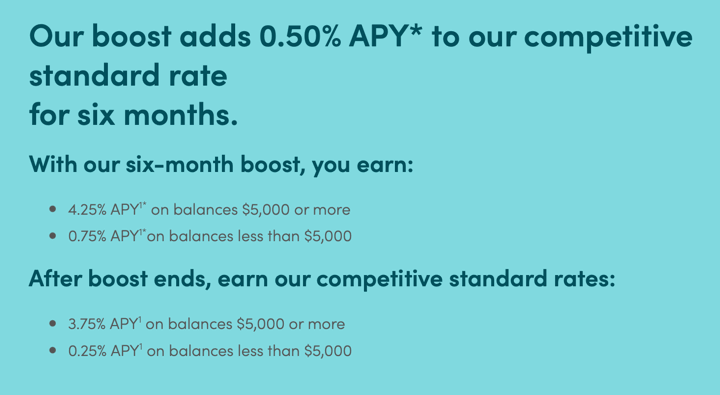
CIT Bank has a limited-time Platinum Savings APY Boost Promotion, offering a boosted interest rate of 4.25% APY for 6 months on their Platinum Saving account that is 0.50% APY above the standard APY (currently 3.75% APY) for balances of $5,000 and above. Thankfully, this offer is available to both new and selected existing customers that activate the promotion.

New customers will need to sign up for a new CIT Bank Platinum Savings account using the promo code BOOST50 to qualify. There is a $100 minimum balance required to open, and you will need a $5,000 minimum balance to get the higher interest rate on this tiered account. There are no monthly service fees.

Existing customers with a Platinum Savings account opened prior to the promotion must enroll via the enrollment web page using promo code CITBoost. You will not get the 6-month boost automatically. From the fine print:

CIT Bank Customers with an account prior to the promotion: This Platinum Savings APY Boost promotion is valid for a Primary account owner with an existing account with a CIT Bank User ID before the start of the promotion, provided that the following requirements are met:

– Customers without a Platinum Savings account open prior to the Promotion must open a new Platinum Savings account via the enrollment web page using Promo Code BOOST50.
– Customers with a Platinum Savings account opened prior to the promotion may enroll their current Platinum Savings account into the Platinum Savings Boost promotion via the enrollment web page using Promo Code BOOST50.
– Customers who are not the Primary account owner on a Platinum Savings account may open a new Platinum Savings account as the primary account owner via the enrollment web page using Promo Code BOOST50.
– Accounts opened or enrolled during the program period without the Promo Code are ineligible to receive the APY boost.

Note that the terms also add the following:

Customers are ineligible to participate in the Platinum Savings APY Boost promotion if:

They are earning an APY over the standard rate.
They participated in a previous APY Boost promotion.
They participated in a cash bonus promotion in the past 6 months.

Still, I am appreciative that some existing customers are again eligible for this promotion, as most other banks will only allow new customers to participate.

Note that if the base rate on the Platinum Savings account changes, during the promo you will maintain a 0.50% APY interest rate boost above the standard interest rate.

1APY disclosure for Platinum Savings:

Platinum Savings is a tiered interest rate account. Interest is paid on the entire account balance based on the interest rate and APY in effect that day for the balance tier associated with the end-of-day account balance. APYs — Annual Percentage Yields are accurate as of July 1, 2026: 0.25% APY on balances of $0.01 to $4,999.99; 3.75% APY on balances of $5,000.00 or more. Interest Rates for the Platinum Savings account are variable and may change at any time without notice. The minimum to open a Platinum Savings account is $100.

2 Discloser on multipliers:

Based on comparison to the national average Annual Percentage Yield (APY) on savings accounts as published in the FDIC National Rates and Rate Caps, accurate as of September 21, 2026.

* Platinum Savings APY Boost Promotion Terms and Conditions

This is a limited time offer available to New and Existing customers who meet the Platinum Savings APY Boost promotion criteria.

Accounts enrolled in the Platinum Savings Annual Percentage Yield (APY) Boost promotion will receive a 0.50% APY boost on the Platinum Savings current standard APY tiers for 6 months following the opening of a new account or when an existing Platinum Savings account is enrolled in the promotion. The Platinum Savings APY boost will be applied on account balances up to $9,999,999.00. Account balances above $9,999,999.00 will earn the standard APY. If the standard-published APY should change during the promotion period, the APY boost will move with it, offering an account APY above the standard rate.

The Promotion begins on September 29, 2026, and ends December 15, 2026. Customers enrolled in the promotion prior to the end date will receive the APY boost for the 6-month period outlined in the terms and conditions.

The promotion can end at any time without notice.

For complete list of account details and fees, see the CIT Bank Personal Account disclosures.

GalaxyOne App: $1,000 Bonus on $10,000 Deposit

GalaxyOne is a fintech super-app that combines a checking account, stock trading, and crypto. Checking account is through Cross River Bank, FDIC. Brokerage is through FIN2, a FINRA/SIPC member firm. Digital assets are held in custodial wallets with Paxos Trust Company, a New York State-chartered trust company. Previously known as Fierce App.

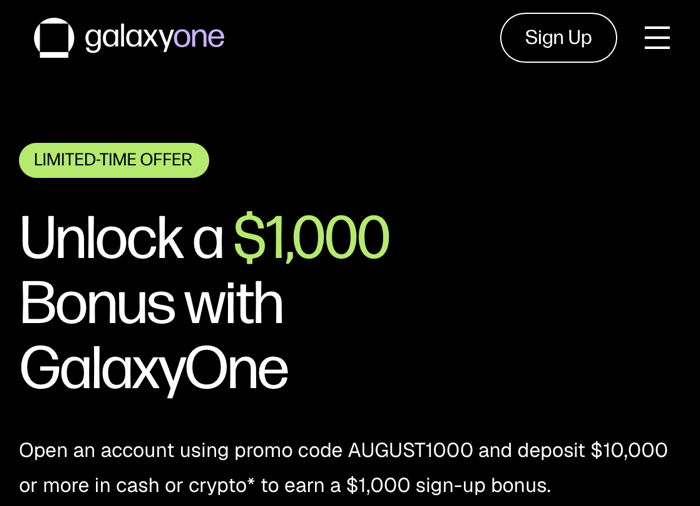
Right now they are offering a $1,000 new customer bonus. Hat tip to DoC. You must open a new account using promo code AUGUST1000 and deposit $10,000 or more in cash or crypto within 30 days, and hold it for 120 days to earn the $1,000 sign-up bonus. Must open by August 31, 2026, and then you have 30 days to make the deposit. You get the bonus 30 days after meeting these terms.

The fact that this is a fintech makes it a little concerning, and I don’t keep my money long-term in fintechs, but might be okay with the short-term since the bonus is effectively 30% annualized. You can hold your deposit at Cross River Bank and earn an additional 3.50% APY (would be my choice), or go nuts and hold it in crypto earning 8% yield (backed by Galaxy Digital).

Best Interest Rates on Cash: Bank Accounts, Treasury Bills, Money Markets, ETFs – August 2026

Here’s my monthly survey of the best interest rates on cash as of August 2026, roughly sorted from shortest to longest maturities. Banks and brokerages love taking advantage of idle cash, and you can often earn more interest while keeping the same level of safety by moving to another FDIC-insured bank or NCUA-insured credit union. Check out my Ultimate Rate-Chaser Calculator to see how much extra interest you could earn from switching. Rates listed are available to everyone nationwide. Rates checked as of 8/16/26.

TL;DR: Savings account interest rates dropped slightly overall, while rates on longer-term CD rose slightly. You can get 4.34% APY if you accept certain hoops/restrictions, but most are under 4% now. Short-term T-Bill rates ~3.7%. Top 5-year CD rates are ~4.5% APY, while the 5-year Treasury rate is ~4.4%.

High-yield savings accounts*
Since the huge megabanks still pay essentially zero interest, everyone should at least have a separate, no-fee online savings account to piggy-back onto your existing checking account. The interest rates on savings accounts can drop at any time, so I list the top rates as well as competitive rates from banks with a history of competitive rates and solid user experience. Some banks will bait you with a temporary top rate and then lower the rates in the hopes that you are too lazy to leave.

  • The top saving rate at the moment: Elevault (no min) is at 4.34% APY, a division of Southern Bancorp Bank.
  • SoFi Bank is at 3.10% APY (new customers can get up to $475 in bonuses with qualifying direct deposit. You must maintain a direct deposit of any amount (even $1) each month for the higher ongoing APY. SoFi has historically competitive rates and full banking features.
  • Here is a limited survey of high-yield savings accounts. They aren’t the top rates, but a group that have historically kept it relatively competitive such that I like to track their history. This month they start at 3.00% APY on up.

Short-term guaranteed rates (1 year and under)
A common question is what to do with a big pile of cash that you’re waiting to deploy shortly (plan to buy a house soon, just sold your house, just sold your business, legal settlement, inheritance). My usual advice is to keep things simple and take your time. If not a savings account, then put it in a flexible short-term CD under the FDIC limits until you have a plan.

  • No Penalty CDs offer a fixed interest rate that can never go down, but you can still take out your money (once) without any fees if you want to use it elsewhere. Marcus has a 11-month No Penalty CD at 4.00% APY ($500 minimum deposit). Farmer’s Insurance FCU has a 9-month No Penalty CD at 4.00% APY ($1,000 minimum deposit). USALLIANCE Financial CU has a 11-month No Penalty CD at 4.00% APY ($500 minimum deposit).
  • CFG Bank has a 12-month CD at 4.30% APY (no minimum deposit). Early withdrawal penalty is not clearly disclosed, I would assume at least 180 days of interest.

Money market mutual funds
Many brokerage firms that pay out very little interest on their default cash sweep funds (and keep the difference for themselves). Note: Money market mutual funds are highly-regulated, but ultimately not FDIC-insured, so I would still stick with highly reputable firms.

  • Vanguard Federal Money Market Fund (VMFXX) is the default sweep option for Vanguard brokerage accounts, which has a 7-day SEC yield of 3.61% (changes daily, but also works out to a compound yield of 3.67%, which is better for comparing against APY). Odds are this is much higher than your own broker’s default cash sweep interest rate.
  • Vanguard Treasury Money Market Fund (VUSXX) is an alternative money market fund which you must manually purchase, but the interest will be mostly (100% for 2025 tax year) exempt from state and local income taxes because it comes from qualifying US government obligations. Current 7-day SEC yield of 3.68% (compound yield of 3.74%).

Treasury Bills and Ultra-short Treasury ETFs
Another option is to buy individual Treasury bills which come in a variety of maturities from 4-weeks to 52-weeks and are fully backed by the US government. You can also invest in ETFs that hold a rotating basket of short-term Treasury Bills for you, while charging a small management fee for doing so. T-bill interest is exempt from state and local income taxes, which can make a significant difference in your effective yield.

  • You can build your own T-Bill ladder at TreasuryDirect.gov or via a brokerage account with a bond desk like Vanguard and Fidelity. Here are the current Treasury Bill rates. As of 8/14/26, a new 4-week T-Bill had the equivalent of 3.70% annualized interest and a 52-week T-Bill had the equivalent of 3.97% annualized interest.
  • The iShares 0-3 Month Treasury Bond ETF (SGOV) has a 3.60% 30-day SEC yield (0.09% expense ratio) and effective duration of 0.10 years. The Vanguard 0-3 Month Treasury Bill ETF (VBIL) has a 3.62% 30-day SEC yield (0.06% expense ratio) and effective duration of 0.10 years.

US Savings Bonds
Series I Savings Bonds offer rates that are linked to inflation and backed by the US government. You must hold them for at least a year. If you redeem them within 5 years there is a penalty of the last 3 months of interest. The annual purchase limit for electronic I bonds is $10,000 per Social Security Number, available online at TreasuryDirect.gov.

  • “I Bonds” bought between May 2026 and October 2026 will earn a 4.26% rate for the first six months. The rate of the subsequent 6-month period will be based on inflation again. More on Savings Bonds here.
  • In mid-October 2026, the CPI will be announced and you will have a short period where you will have a very close estimate of the rate for the next 12 months. I will post another update at that time.

Rewards checking accounts
These unique checking accounts pay above-average interest rates, but with unique risks. You have to jump through certain hoops which usually involve 10+ debit card purchases each cycle, a certain number of ACH/direct deposits, and/or a certain number of logins per month. If you make a mistake (or they judge that you did) you risk earning zero interest for that month. Some folks don’t mind the extra work and attention required, while others would rather not bother. Rates can also drop suddenly, leaving a “bait-and-switch” feeling.

  • La Capitol Federal Credit Union pays 6.50% APY on up to $10,000 if you make 15 debit card purchases of at least $5 each per statement cycle. Anyone can join this credit union via partner organization, Louisiana Association for Personal Financial Achievement ($20).
  • OnPath Federal Credit Union (my review) pays 6.00% APY on up to $10,000 if you make 15 debit card purchases, opt into online statements, and login to online or mobile banking once per statement cycle. Anyone can join this credit union via $5 membership fee to join partner organization. You can also get a $150 Visa Reward card when you open a new account and make qualifying transactions.
  • Genisys Credit Union pays 6.75% APY on up to $7,500 if you make 10 debit card purchases of $5+ each per statement cycle, and opt into online statements. Anyone can join this credit union via $5 membership fee to join partner organization.
  • Oklahoma Central Credit Union pays 6.00% APY on up to $10,000 if you make 15 debit card purchases (non-ATM) per statement cycle. Anyone can join this credit union if they are “affiliated with another credit union”.
  • First Southern Bank pays 5.50% APY on up to $25,000 if you make at least 15 debit card purchases, 1 ACH credit or payment transaction, and enroll in online statements.
  • Credit Union of New Jersey pays 6.00% APY on up to $25,000 if you make 12 debit card purchases, opt into online statements, and make at least 1 direct deposit, online bill payment, or automatic payment (ACH) per statement cycle. Anyone can join this credit union via $5 membership fee to join partner organization.
  • Andrews Federal Credit Union pays 5.25% APY on up to $25,000 if you make 15 debit card purchases, opt into online statements, and make at least 1 direct deposit or ACH transaction per statement cycle. Anyone can join this credit union via partner organization.
  • Capitol Credit Union pays 6.00% APY on up to $15,000 if you make 12 debit card purchases, opt into online statements, and make at least 1 direct deposit or ACH transaction per statement cycle. Anyone can join this credit union via partner organization ($5 to Wild Basin Wilderness).
  • Find a locally-restricted rewards checking account at DepositAccounts.

Certificates of deposit (greater than 1 year)
CDs offer higher rates, but come with an early withdrawal penalty. By finding a bank CD with a reasonable early withdrawal penalty, you can enjoy higher rates but maintain access in a true emergency. Alternatively, consider building a CD ladder of different maturity lengths (ex. 1/2/3/4/5-years) such that you have access to part of the ladder each year, but your blended interest rate is higher than a savings account. When one CD matures, use that money to buy another 5-year CD to keep the ladder going. Some CDs also offer “add-ons” where you can deposit more funds if rates drop.

  • NASA Federal Credit Union has a 5-year certificate at 4.38% APY ($1,000 minimum), 4-year at 4.30% APY, 3-year at 4.25% APY, 2-year at 4.20% APY, and 1-year at 4.15% APY. Early withdrawal penalty for the 5-year is 365 days of interest. Anyone nationwide can join via a complimentary membership to the National Space Society (NSS).
  • Advancial Federal Credit Union has has a 5-year certificates at 4.28%/4.39%/4.49% APY APY based on either a $1,000/$25,000/$50,000 opening balance. Early withdrawal penalty for the 5-year is 365 days of interest. Anyone nationwide should be able to join via membership with partner organization US Dog Agility Association, but I would call to verify first.
  • Popular Direct has a 5-year certificate at 4.50% APY ($10,000 minimum) but with a huge early withdrawal penalty of 730 days of interest.
  • You can buy certificates of deposit via the bond desks of Vanguard and Fidelity. You may need an account to see the rates. These “brokered CDs” offer FDIC insurance and easy laddering, but they don’t come with predictable early withdrawal penalties. Right now, I see a 5-year non-callable brokered CD at 4.50% APY (callable: no, call protection: yes). Be warned that both Vanguard and Fidelity will list higher rates from callable CDs, which importantly means they can (and will!) call back your CD if rates drop significantly later.

Longer-term Instruments
I’d use these with caution due to increased interest rate risk (tbh, I don’t use them at all), but I still track them to see the rest of the current yield curve.

  • Willing to lock up your money for 10 years? You can buy long-term certificates of deposit via the bond desks of Vanguard and Fidelity. These “brokered CDs” offer FDIC insurance, but they don’t come with predictable early withdrawal penalties. You might find something that pays more than your other brokerage cash and Treasury options. Right now, I see a 10-year CDs at 4.65% APY (non-callable) vs. 4.67% for a 10-year Treasury. Watch out for higher rates from callable CDs where they can call your CD back if interest rates drop.

All rates were checked as of 8/16/26.

* I no longer recommend fintech companies due to the possibility of significant loss due to poor recordkeeping and the lack of government protection in such scenarios. The point of cash is absolute safety of principal.

Photo by Giorgio Trovato on Unsplash
Turn off Trusted Device 2FA/MFA Bypass, Always Log Out After Using Bank/Brokerage Accounts

I came across this r/FidelityInvestment Reddit post today about how a Fidelity user had their account compromised (and also eventually restored). In the discussion about how the hackers might have gained access to the account, I learned about some new dangers. I’m not a security expert, but this is my understanding after reading about “pass the cookie” or “cookie hijacking” attacks. The FBI also put out this alert Cybercriminals Are Stealing Cookies to Bypass Multifactor Authentication.

First, obviously phishing is a very common attack nowadays, and for example, if you enter your Fidelity password on a website that looks like the Fidelity login page, then they have your password. But if you have 2FA, you are still protected, right?

A different danger is that malware or a malicious website may use “cookie hijacking” to steal the cookies in your browser that make it appear that you have logged in before. If you use the “trusted device” feature where they bypass the 2FA/MFA (2-Factor Authentication/Multi-Factor Authentication) requirements since you are logging in from a supposedly “trusted device”, then they can now access your account without needing that text message or Authenticator code.

In some cases, if you are actively logged into your account already, malware or a malicious website can even steal your “active session” cookie that makes it appear that you’ve already logged in and passed the authentication checks. Because the website thinks you’ve already logged in, they don’t ask for anything at all.

Here are some actionable steps to maintain the highest security:

  1. Only log into sensitive financial accounts using devices where you know the operating system and web browser are secure and updated.
  2. Don’t log in from public WiFi, even with https://. If you do, at least use a VPN.
  3. Turn off the “trusted device” feature that removes 2FA or MFA if you are logging in from a “trusted device” with the proper browser cookie. This is more hassle, but basically you always want to require more than one factor.
  4. Don’t check the “Remember me” box when you log in on a sensitive site.
  5. Log in to do your financial business, and then immediately manually click “log out” to delete that active session cookie on both your browser and the external server. Do not stay logged in while you visit other websites, or wait for the system to automatically log you out after 15 minutes or so.

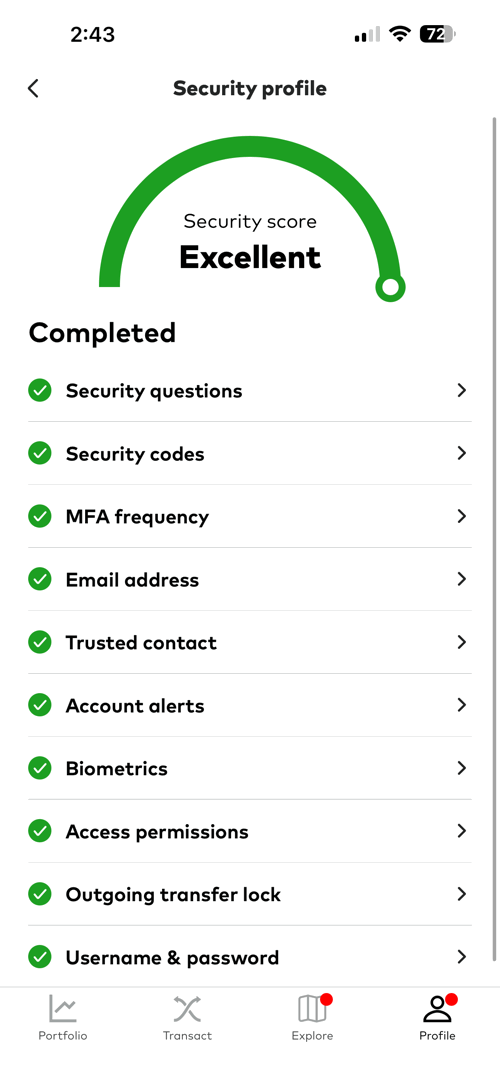
Turning off the “trusted device” feature was the last thing I needed to do in order to score an “Excellent” score on my Vanguard security profile as well. 😎

Best Interest Rates on Cash: Bank Accounts, Treasury Bills, Money Markets, ETFs – July 2026

Here’s my monthly survey of the best interest rates on cash as of July 2026, roughly sorted from shortest to longest maturities. Banks and brokerages love taking advantage of idle cash, and you can often earn more interest while keeping the same level of safety by moving to another FDIC-insured bank or NCUA-insured credit union. Check out my Ultimate Rate-Chaser Calculator to see how much extra interest you could earn from switching. Rates listed are available to everyone nationwide. Rates checked as of 7/1/26.

TL;DR: Savings account interest rates dropped slightly overall. You can get 4.4% APY if you accept certain hoops/restrictions, but most are under 4% now. Short-term T-Bill rates ~3.7%. Top 5-year CD rates are ~4.1% APY, while the 5-year Treasury rate is also ~4.1%.

High-yield savings accounts*
Since the huge megabanks still pay essentially zero interest, everyone should at least have a separate, no-fee online savings account to piggy-back onto your existing checking account. The interest rates on savings accounts can drop at any time, so I list the top rates as well as competitive rates from banks with a history of competitive rates and solid user experience. Some banks will bait you with a temporary top rate and then lower the rates in the hopes that you are too lazy to leave.

  • The top saving rate at the moment: Pibank at 4.40% APY (no min), but they have some weird restrictions; you can only use wire/Plaid to deposit and wire transfers to withdraw funds?! Elevault (no min) is at 4.34% APY, a division of Southern Bancorp Bank.
  • SoFi Bank is at 3.10% APY (new customers can get up to $475 in bonuses with qualifying direct deposit. You must maintain a direct deposit of any amount (even $1) each month for the higher ongoing APY. SoFi has historically competitive rates and full banking features.
  • Here is a limited survey of high-yield savings accounts. They aren’t the top rates, but a group that have historically kept it relatively competitive such that I like to track their history. This month they start at 3.00% APY on up.

Short-term guaranteed rates (1 year and under)
A common question is what to do with a big pile of cash that you’re waiting to deploy shortly (plan to buy a house soon, just sold your house, just sold your business, legal settlement, inheritance). My usual advice is to keep things simple and take your time. If not a savings account, then put it in a flexible short-term CD under the FDIC limits until you have a plan.

  • No Penalty CDs offer a fixed interest rate that can never go down, but you can still take out your money (once) without any fees if you want to use it elsewhere. Marcus has a 13-month No Penalty CD at 3.80% APY ($500 minimum deposit). Farmer’s Insurance FCU has a 9-month No Penalty CD at 4.00% APY ($1,000 minimum deposit). USALLIANCE Financial CU has a 11-month No Penalty CD at 3.85% APY ($500 minimum deposit).
  • E-Trade Bank has a 12-month CD at 4.10% APY (no minimum deposit). Early withdrawal penalty is 90 days of interest.
  • Farmer’s Insurance FCU has a 12-month CD at 4.00% APY with new money required. $1,000 minimum to open. Early withdrawal penalty is 90 days of interest.

Money market mutual funds
Many brokerage firms that pay out very little interest on their default cash sweep funds (and keep the difference for themselves). Note: Money market mutual funds are highly-regulated, but ultimately not FDIC-insured, so I would still stick with highly reputable firms.

  • Vanguard Federal Money Market Fund (VMFXX) is the default sweep option for Vanguard brokerage accounts, which has a 7-day SEC yield of 3.58% (changes daily, but also works out to a compound yield of 3.64%, which is better for comparing against APY). Odds are this is much higher than your own broker’s default cash sweep interest rate.
  • Vanguard Treasury Money Market Fund (VUSXX) is an alternative money market fund which you must manually purchase, but the interest will be mostly (100% for 2025 tax year) exempt from state and local income taxes because it comes from qualifying US government obligations. Current 7-day SEC yield of 3.63% (compound yield of 3.69%).

Treasury Bills and Ultra-short Treasury ETFs
Another option is to buy individual Treasury bills which come in a variety of maturities from 4-weeks to 52-weeks and are fully backed by the US government. You can also invest in ETFs that hold a rotating basket of short-term Treasury Bills for you, while charging a small management fee for doing so. T-bill interest is exempt from state and local income taxes, which can make a significant difference in your effective yield.

  • You can build your own T-Bill ladder at TreasuryDirect.gov or via a brokerage account with a bond desk like Vanguard and Fidelity. Here are the current Treasury Bill rates. As of 7/1/26, a new 4-week T-Bill had the equivalent of 3.63% annualized interest and a 52-week T-Bill had the equivalent of 3.98% annualized interest.
  • The iShares 0-3 Month Treasury Bond ETF (SGOV) has a 3.54% 30-day SEC yield (0.09% expense ratio) and effective duration of 0.10 years. The Vanguard 0-3 Month Treasury Bill ETF (VBIL) has a 3.57% 30-day SEC yield (0.06% expense ratio) and effective duration of 0.10 years.

US Savings Bonds
Series I Savings Bonds offer rates that are linked to inflation and backed by the US government. You must hold them for at least a year. If you redeem them within 5 years there is a penalty of the last 3 months of interest. The annual purchase limit for electronic I bonds is $10,000 per Social Security Number, available online at TreasuryDirect.gov.

  • “I Bonds” bought between May 2026 and October 2026 will earn a 4.26% rate for the first six months. The rate of the subsequent 6-month period will be based on inflation again. More on Savings Bonds here.
  • In mid-October 2026, the CPI will be announced and you will have a short period where you will have a very close estimate of the rate for the next 12 months. I will post another update at that time.

Rewards checking accounts
These unique checking accounts pay above-average interest rates, but with unique risks. You have to jump through certain hoops which usually involve 10+ debit card purchases each cycle, a certain number of ACH/direct deposits, and/or a certain number of logins per month. If you make a mistake (or they judge that you did) you risk earning zero interest for that month. Some folks don’t mind the extra work and attention required, while others would rather not bother. Rates can also drop suddenly, leaving a “bait-and-switch” feeling.

  • La Capitol Federal Credit Union pays 6.50% APY on up to $10,000 if you make 15 debit card purchases of at least $5 each per statement cycle. Anyone can join this credit union via partner organization, Louisiana Association for Personal Financial Achievement ($20).
  • OnPath Federal Credit Union (my review) pays 6.00% APY on up to $10,000 if you make 15 debit card purchases, opt into online statements, and login to online or mobile banking once per statement cycle. Anyone can join this credit union via $5 membership fee to join partner organization. You can also get a $150 Visa Reward card when you open a new account and make qualifying transactions.
  • Genisys Credit Union pays 6.75% APY on up to $7,500 if you make 10 debit card purchases of $5+ each per statement cycle, and opt into online statements. Anyone can join this credit union via $5 membership fee to join partner organization.
  • Oklahoma Central Credit Union pays 6.00% APY on up to $10,000 if you make 15 debit card purchases (non-ATM) per statement cycle. Anyone can join this credit union if they are “affiliated with another credit union”.
  • First Southern Bank pays 5.50% APY on up to $25,000 if you make at least 15 debit card purchases, 1 ACH credit or payment transaction, and enroll in online statements.
  • Credit Union of New Jersey pays 5.50% APY on up to $20,000 if you make 12 debit card purchases, opt into online statements, and make at least 1 direct deposit, online bill payment, or automatic payment (ACH) per statement cycle. Anyone can join this credit union via $5 membership fee to join partner organization.
  • Andrews Federal Credit Union pays 5.25% APY on up to $25,000 if you make 15 debit card purchases, opt into online statements, and make at least 1 direct deposit or ACH transaction per statement cycle. Anyone can join this credit union via partner organization.
  • Capitol Credit Union pays 6.00% APY on up to $15,000 if you make 12 debit card purchases, opt into online statements, and make at least 1 direct deposit or ACH transaction per statement cycle. Anyone can join this credit union via partner organization ($5 to Wild Basin Wilderness).
  • Find a locally-restricted rewards checking account at DepositAccounts.

Certificates of deposit (greater than 1 year)
CDs offer higher rates, but come with an early withdrawal penalty. By finding a bank CD with a reasonable early withdrawal penalty, you can enjoy higher rates but maintain access in a true emergency. Alternatively, consider building a CD ladder of different maturity lengths (ex. 1/2/3/4/5-years) such that you have access to part of the ladder each year, but your blended interest rate is higher than a savings account. When one CD matures, use that money to buy another 5-year CD to keep the ladder going. Some CDs also offer “add-ons” where you can deposit more funds if rates drop.

  • NASA Federal Credit Union has a 5-year certificate at 4.28% APY ($1,000 minimum), 4-year at 4.20% APY, 3-year at 4.15% APY, 2-year at 4.10% APY, and 1-year at 4.05% APY. Early withdrawal penalty for the 5-year is 365 days of interest. Anyone nationwide can join via a complimentary membership to the National Space Society (NSS).
  • Advancial Federal Credit Union has has a 5-year certificates at 4.14%/4.24%/4.34% APY APY based on either a $1,000/$25,000/$50,000 opening balance. Early withdrawal penalty for the 5-year is 365 days of interest. Anyone nationwide should be able to join via membership with partner organization US Dog Agility Association, but I would call to verify first.
  • Mountain America Credit Union (MACU) has a 5-year certificate at 4.15% APY ($500 minimum), 4-year at 4.09% APY, 3-year at 4.09% APY, 2-year at 4.30% APY, and 1-year at 4.00% APY. Early withdrawal penalty for the 4-year and 5-year is 365 days of interest. Anyone can join this credit union via partner organization American Consumer Council (use promo code “consumer” when joining).
  • You can buy certificates of deposit via the bond desks of Vanguard and Fidelity. You may need an account to see the rates. These “brokered CDs” offer FDIC insurance and easy laddering, but they don’t come with predictable early withdrawal penalties. Right now, I see a 5-year non-callable brokered CD at 4.40% APY (callable: no, call protection: yes). Be warned that both Vanguard and Fidelity will list higher rates from callable CDs, which importantly means they can (and will!) call back your CD if rates drop significantly later.

Longer-term Instruments
I’d use these with caution due to increased interest rate risk (tbh, I don’t use them at all), but I still track them to see the rest of the current yield curve.

  • Willing to lock up your money for 10 years? You can buy long-term certificates of deposit via the bond desks of Vanguard and Fidelity. These “brokered CDs” offer FDIC insurance, but they don’t come with predictable early withdrawal penalties. You might find something that pays more than your other brokerage cash and Treasury options. Right now, I see a 10-year CDs at [none available] APY (non-callable) vs. 4.47% for a 10-year Treasury. Watch out for higher rates from callable CDs where they can call your CD back if interest rates drop.

All rates were checked as of 7/1/26.

* I no longer recommend fintech companies due to the possibility of significant loss due to poor recordkeeping and the lack of government protection in such scenarios. The point of cash is absolute safety of principal.

Photo by Giorgio Trovato on Unsplash
CIT Bank Review: 11-Month No-Penalty CD at 3.90% APY, Platinum Savings 3.75% APY

Rate hike for No-Penalty CD. CIT Bank (not to be confused with Citi Bank) is an online-only bank that has a multi-year history of competitive rates, although they do like to start up new product lines while keeping low rates on their older product lines. Here are the current noteworthy accounts:

  • 11-Month No-Penalty CD at 3.90% APY***. $1,000 minimum balance and no monthly fees.
  • Platinum Savings Account at 3.75% APY* if you maintain a $5,000 daily balance or higher. 0.25% APY if your daily balance is under $5,000. No monthly fees. If you have any other savings accounts at CIT and can meet the minimum balance, you should consider moving funds over to this account. You can also open this new account without having to open another bank or credit union account.
  • Savings Connect Account at 3.65% APY** if you open with $100. No minimum balance and no monthly fees.
  • Member FDIC.

Check out my rate chaser calculator to see if it makes sense for you to move money over.

New customer? Opening process overview. Here’s my review of the opening process if you are a new customer.

  • The application process was completely online. You provide the usual personal information.
  • You must submit to a credit check, but in my experience it was a “soft” pull which did not harm my credit. None of my various credit monitoring services showed it was a hard pull.
  • You may fund via (1) electronic ACH transfer, (2) wire transfer, (3) mobile check deposit via CIT Bank mobile app (iOS and Android), and (4) mailing in a paper check. There was no option for credit card funding. I picked online ACH funding and you need to provide routing and account numbers, followed by manual verification via micro-deposits after a day or two. There was no instant linking option via login information.

After deposit verification, then your funding will go through.

You have successfully verified your external account. Please allow up to 5 business days for your funds to appear in your CIT Bank account.
No further action is required for this account. Thank you!

Existing savings or money market customer? Check your rate. If you already have an existing High Yield Savings account, it may remain at a lower interest rate than the currently-promoted accounts. If so, take a minute and upgrade yourself to the better interest rate.

Bottom line. CIT Bank is a lean bank offering targeted products for folks looking to get higher interest rates on their cash balances. They don’t maintain physical bank branches or fancy apps. However, I have been pleasantly satisfied with their customer service on my accounts with them.

* Here are the disclosures for the Platinum Savings:

Platinum Savings is a tiered interest rate account. Interest is paid on the entire account balance based on the interest rate and APY in effect that day for the balance tier associated with the end-of-day account balance. APYs — Annual Percentage Yields are accurate as of July 1, 2026: 0.25% APY on balances of $0.01 to $4,999.99; 3.75% APY on balances of $5,000.00 or more. Interest Rates for the Platinum Savings account are variable and may change at any time without notice. The minimum to open a Platinum Savings account is $100.

** Here are the disclosures for the Savings Connect:

APY — Annual Percentage Yield is accurate as of July 1, 2026. Interest Rates for the Savings Connect Account are variable and may change at any time without notice. The minimum to open a Savings Connect account is $100. Fees could reduce earnings on the account.

For complete list of account details and fees, see the CIT Bank Personal Account disclosures.

*** Here is the fine print (disclosures) for the 11-month No-Penalty CD:

APY — Annual Percentage Yield is accurate as of July 1, 2026. $1,000
minimum to open the account.

With a No-Penalty CD, you may withdraw the total balance and interest earned, without penalty, beginning 7 days after funds have been received for your CD. No withdrawals are permitted during the first 6 days following the receipt of funds.

BofA Rewards Subscription Credits: Eligible Select Streaming and News Services (As of May 2026)

Bank of America’s “Preferred Rewards” program officially switched over to the “BofA Rewards” program as of May 27, 2026, although most existing members will be grandfathered into their current tier for up to 11 more months or so. One of the list of program changes was the promised addition of “Subscription credits – Get up to $180 annually in credits for streaming services you use most”. Here’s what the fine print said:

BofA Rewards™ Subscription Credits. In order to be eligible for the subscription credit benefit, you must:
(1) Be enrolled in the BofA Rewards program’s Preferred Honors or Premier tiers.

(2) Agree to the full terms of the subscription credit benefit from the subscription credit benefit page within BofA Rewards.

(3) Make payments directly to eligible merchants using your Bank of America debit card linked to a checking account that you designate via the subscription credit benefit page.

Preferred Honors tier members may receive statement credits up to $8 per month, and Premier tier members may receive up to $15 per month. Eligible merchants are subject to change without notice. Currently eligible merchants can be found on the subscription credit benefit page.

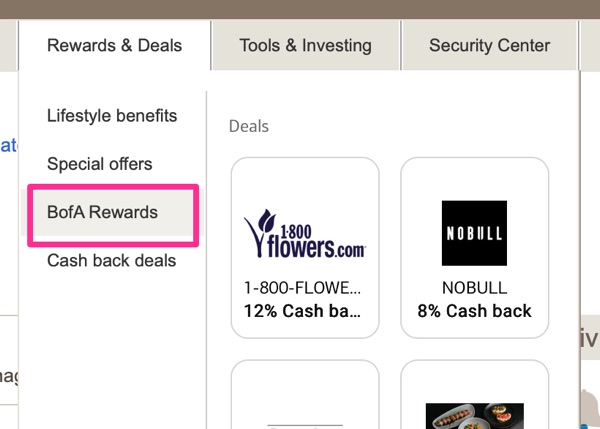
I could not find a public “subscription credit benefit page”, and it looks like it’s only visible for actual members. I am still on the new “Premier” tier, which is their highest current tier. I logged into my BofA account and navigated to the “Rewards & Deals” tab and then “BofA Rewards”.

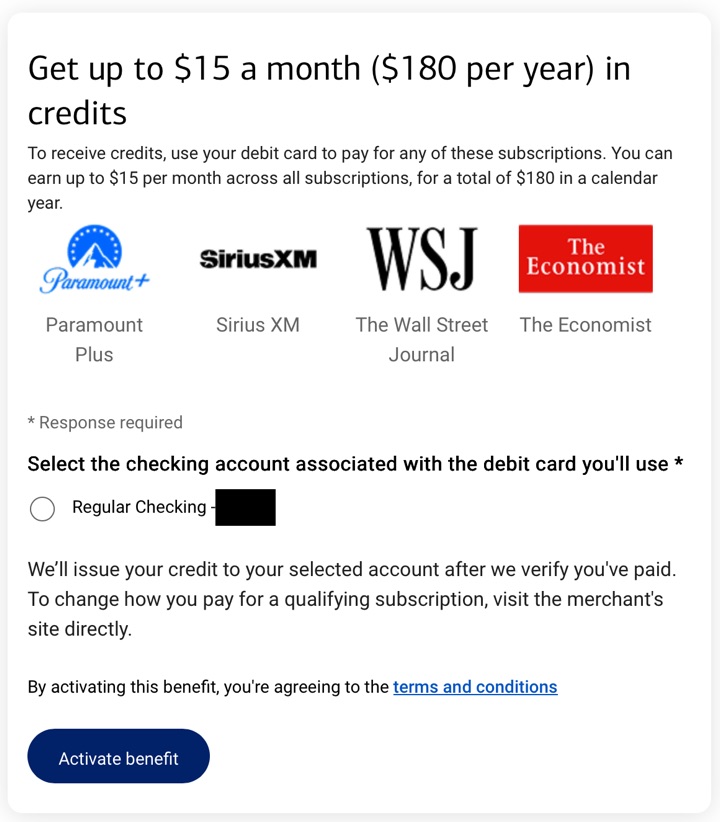
After that, I scrolled down to “Feature Benefits” to the subscription benefit details. I can only assume that they are same for everyone, but this is what I have:

Here are the current merchants along with their regular monthly prices, as the credits can only be earned in monthly increments:

  • Paramount+: $8.99/month for the ad-supported Essential tier and $13.99/month for the ad-free Premium tier (which includes Showtime).
  • SiriusXM: $11.99/month for the App-Only All Access plan, while an Car+App All Access plan normally lists for $25.99/month.
  • Wall Street Journal: Digital access is $11.25/week, but the first year is $8 every 4 weeks right now.
  • The Economist: Digital access is $29 every 4 weeks.

I’m rather disappointed with the limited selection. Personally, I don’t pay for Paramount+ right now so I might get it for “free” with this offer, but I doubt I’ll use it very much. WSJ is probably the service I use the most but I already have access via alternative means, and it doesn’t even cover the entire cost anyway. I hope BofA changes up the options regularly. Netflix would have been nice.

Best Interest Rates on “Cash”: Bank Accounts, Treasury Bills, Money Markets, ETFs – May 2026

Here’s my monthly survey of the best interest rates on cash as of May 2026, roughly sorted from shortest to longest maturities. Banks and brokerages love taking advantage of idle cash, and you can often earn more interest while keeping the same level of safety by moving to another FDIC-insured bank or NCUA-insured credit union. Check out my Ultimate Rate-Chaser Calculator to see how much extra interest you could earn from switching. Rates listed are available to everyone nationwide. Rates checked as of 5/14/26.

TL;DR: Savings account interest rates dropped slightly overall. You can get 4.4% APY if you accept certain hoops/restrictions, but most are under 4% now. Short-term T-Bill rates ~3.7%. Top 5-year CD rates are ~4.1% APY, while the 5-year Treasury rate is also ~4.1%.

High-yield savings accounts*
Since the huge megabanks still pay essentially zero interest, everyone should at least have a separate, no-fee online savings account to piggy-back onto your existing checking account. The interest rates on savings accounts can drop at any time, so I list the top rates as well as competitive rates from banks with a history of competitive rates and solid user experience. Some banks will bait you with a temporary top rate and then lower the rates in the hopes that you are too lazy to leave.

  • The top saving rate at the moment: Pibank at 4.40% APY (no min), but they have some weird restrictions; you can only use wire/Plaid to deposit and wire transfers to withdraw funds?! CineFi (no min) is at 4.34% APY, a division of Southern Bancorp Bank. OnPath FCU held at 4.25% APY with $25,000 minimum balance.
  • SoFi Bank is at 3.30% APY (new customers can get up to 4.00% APY for 6 months + increased $425 bonus with qualifying direct deposit. You must maintain a direct deposit of any amount (even $1) each month for the higher ongoing APY. SoFi has historically competitive rates and full banking features.
  • Here is a limited survey of high-yield savings accounts. They aren’t the top rates, but a group that have historically kept it relatively competitive such that I like to track their history. This month they start at 3.10% APY on up.

Short-term guaranteed rates (1 year and under)
A common question is what to do with a big pile of cash that you’re waiting to deploy shortly (plan to buy a house soon, just sold your house, just sold your business, legal settlement, inheritance). My usual advice is to keep things simple and take your time. If not a savings account, then put it in a flexible short-term CD under the FDIC limits until you have a plan.

  • No Penalty CDs offer a fixed interest rate that can never go down, but you can still take out your money (once) without any fees if you want to use it elsewhere. Marcus has a 13-month No Penalty CD at 3.80% APY ($500 minimum deposit). Farmer’s Insurance FCU has a 9-month No Penalty CD at 4.00% APY ($1,000 minimum deposit). USALLIANCE Financial CU has a 11-month No Penalty CD at 3.90% APY ($500 minimum deposit).
  • E-Trade Bank has a 12-month CD at 4.10% APY (no minimum deposit). Early withdrawal penalty is 90 days of interest.
  • Farmer’s Insurance FCU has a 12-month CD at 4.00% APY with new money required. $1,000 minimum to open. Early withdrawal penalty is 90 days of interest.

Money market mutual funds
Many brokerage firms that pay out very little interest on their default cash sweep funds (and keep the difference for themselves). Note: Money market mutual funds are highly-regulated, but ultimately not FDIC-insured, so I would still stick with highly reputable firms.

  • Vanguard Federal Money Market Fund (VMFXX) is the default sweep option for Vanguard brokerage accounts, which has a 7-day SEC yield of 3.55% (changes daily, but also works out to a compound yield of 3.61%, which is better for comparing against APY). Odds are this is much higher than your own broker’s default cash sweep interest rate.
  • Vanguard Treasury Money Market Fund (VUSXX) is an alternative money market fund which you must manually purchase, but the interest will be mostly (100% for 2025 tax year) exempt from state and local income taxes because it comes from qualifying US government obligations. Current 7-day SEC yield of 3.61% (compound yield of 3.67%).

Treasury Bills and Ultra-short Treasury ETFs
Another option is to buy individual Treasury bills which come in a variety of maturities from 4-weeks to 52-weeks and are fully backed by the US government. You can also invest in ETFs that hold a rotating basket of short-term Treasury Bills for you, while charging a small management fee for doing so. T-bill interest is exempt from state and local income taxes, which can make a significant difference in your effective yield.

  • You can build your own T-Bill ladder at TreasuryDirect.gov or via a brokerage account with a bond desk like Vanguard and Fidelity. Here are the current Treasury Bill rates. As of 5/13/26, a new 4-week T-Bill had the equivalent of 3.66% annualized interest and a 52-week T-Bill had the equivalent of 3.80% annualized interest.
  • The iShares 0-3 Month Treasury Bond ETF (SGOV) has a 3.55% 30-day SEC yield (0.09% expense ratio) and effective duration of 0.10 years. The Vanguard 0-3 Month Treasury Bill ETF (VBIL) has a 3.59% 30-day SEC yield (0.06% expense ratio) and effective duration of 0.10 years.

US Savings Bonds
Series I Savings Bonds offer rates that are linked to inflation and backed by the US government. You must hold them for at least a year. If you redeem them within 5 years there is a penalty of the last 3 months of interest. The annual purchase limit for electronic I bonds is $10,000 per Social Security Number, available online at TreasuryDirect.gov.

  • “I Bonds” bought between May 2026 and October 2026 will earn a 4.26% rate for the first six months. The rate of the subsequent 6-month period will be based on inflation again. More on Savings Bonds here.
  • In mid-October 2026, the CPI will be announced and you will have a short period where you will have a very close estimate of the rate for the next 12 months. I will post another update at that time.

Rewards checking accounts
These unique checking accounts pay above-average interest rates, but with unique risks. You have to jump through certain hoops which usually involve 10+ debit card purchases each cycle, a certain number of ACH/direct deposits, and/or a certain number of logins per month. If you make a mistake (or they judge that you did) you risk earning zero interest for that month. Some folks don’t mind the extra work and attention required, while others would rather not bother. Rates can also drop suddenly, leaving a “bait-and-switch” feeling.

  • La Capitol Federal Credit Union pays 6.50% APY on up to $10,000 if you make 15 debit card purchases of at least $5 each per statement cycle. Anyone can join this credit union via partner organization, Louisiana Association for Personal Financial Achievement ($20).
  • OnPath Federal Credit Union (my review) pays 6.00% APY on up to $10,000 if you make 15 debit card purchases, opt into online statements, and login to online or mobile banking once per statement cycle. Anyone can join this credit union via $5 membership fee to join partner organization. You can also get a $150 Visa Reward card when you open a new account and make qualifying transactions.
  • Genisys Credit Union pays 6.75% APY on up to $7,500 if you make 10 debit card purchases of $5+ each per statement cycle, and opt into online statements. Anyone can join this credit union via $5 membership fee to join partner organization.
  • Oklahoma Central Credit Union pays 6.00% APY on up to $10,000 if you make 15 debit card purchases (non-ATM) per statement cycle. Anyone can join this credit union if they are “affiliated with another credit union”.
  • First Southern Bank pays 5.50% APY on up to $25,000 if you make at least 15 debit card purchases, 1 ACH credit or payment transaction, and enroll in online statements.
  • Credit Union of New Jersey pays 6.00% APY on up to $25,000 if you make 12 debit card purchases, opt into online statements, and make at least 1 direct deposit, online bill payment, or automatic payment (ACH) per statement cycle. Anyone can join this credit union via $5 membership fee to join partner organization.
  • Andrews Federal Credit Union pays 5.25% APY (decreased) on up to $25,000 if you make 15 debit card purchases, opt into online statements, and make at least 1 direct deposit or ACH transaction per statement cycle. Anyone can join this credit union via partner organization.
  • Capitol Credit Union pays 6.00% APY on up to $15,000 if you make 12 debit card purchases, opt into online statements, and make at least 1 direct deposit or ACH transaction per statement cycle. Anyone can join this credit union via partner organization ($5 to Wild Basin Wilderness).
  • Find a locally-restricted rewards checking account at DepositAccounts.

Certificates of deposit (greater than 1 year)
CDs offer higher rates, but come with an early withdrawal penalty. By finding a bank CD with a reasonable early withdrawal penalty, you can enjoy higher rates but maintain access in a true emergency. Alternatively, consider building a CD ladder of different maturity lengths (ex. 1/2/3/4/5-years) such that you have access to part of the ladder each year, but your blended interest rate is higher than a savings account. When one CD matures, use that money to buy another 5-year CD to keep the ladder going. Some CDs also offer “add-ons” where you can deposit more funds if rates drop.

  • NASA Federal Credit Union has a 5-year certificate at 4.18% APY ($1,000 minimum), 4-year at 4.10% APY, 3-year at 4.05% APY, 2-year at 4.00% APY, and 1-year at 3.95% APY. Early withdrawal penalty for the 5-year is 365 days of interest. Anyone nationwide can join via a complimentary membership to the National Space Society (NSS).
  • Advancial Federal Credit Union has has a 5-year certificates at 4.14%/4.24%/4.34% APY APY based on either a $1,000/$25,000/$50,000 opening balance. Early withdrawal penalty for the 5-year is 365 days of interest. Anyone nationwide should be able to join via membership with partner organization US Dog Agility Association, but I would call to verify first.
  • Mountain America Credit Union (MACU) has a 5-year certificate at 4.05% APY ($500 minimum), 4-year at 4.00% APY, 3-year at 4.00% APY, 2-year at 4.20% APY, and 1-year at 3.90% APY. Early withdrawal penalty for the 4-year and 5-year is 365 days of interest. Anyone can join this credit union via partner organization American Consumer Council (use promo code “consumer” when joining).
  • You can buy certificates of deposit via the bond desks of Vanguard and Fidelity. You may need an account to see the rates. These “brokered CDs” offer FDIC insurance and easy laddering, but they don’t come with predictable early withdrawal penalties. Right now, I see a 5-year non-callable brokered CD at 4.10% APY (callable: no, call protection: yes). Be warned that both Vanguard and Fidelity will list higher rates from callable CDs, which importantly means they can (and will!) call back your CD if rates drop significantly later.

Longer-term Instruments
I’d use these with caution due to increased interest rate risk (tbh, I don’t use them at all), but I still track them to see the rest of the current yield curve.

  • Willing to lock up your money for 10 years? You can buy long-term certificates of deposit via the bond desks of Vanguard and Fidelity. These “brokered CDs” offer FDIC insurance, but they don’t come with predictable early withdrawal penalties. You might find something that pays more than your other brokerage cash and Treasury options. Right now, I see a 10-year CDs at [n/a] APY (non-callable) vs. 4.44% for a 10-year Treasury. Watch out for higher rates from callable CDs where they can call your CD back if interest rates drop.

All rates were checked as of 5/14/26.

* I no longer recommend fintech companies due to the possibility of significant loss due to poor recordkeeping and the lack of government protection in such scenarios. The point of cash is absolute safety of principal.

Photo by Giorgio Trovato on Unsplash
SoFi Promos: 2% ACAT Transfer Bonus, $425 New Checking Bonus, $300-$1000 Loan Bonuses

(Updated: 2% ACAT transfer bonus is back, valid on both IRAs and taxable brokerage accounts. For example, $2,000 on a $100,000 account value. 5-year minimum hold. Only a 1% bonus on 401k rollovers. )

SoFi (“Social Finance”) is an all-in-one finance app that expanded from students loans into banking, stocks, crypto, credit cards, and more. They often run a bunch of different promotional offers; New users can receive a separate opening bonus for each separate part of SoFi (Money, Invest, Loans, etc).

  • SoFi Checking Referral Offer: Up to $425 new account bonus. Open a new SoFi Checking account and add at least $50 to your account within 21 days, and get $25. Then get up to $400 additional bonus with qualifying direct deposit. Plus up to 4.00% APY for 6 months.
  • SoFi Credit Score Monitoring Offer: $10 bonus. Earn $10 in rewards points when you activate free credit score monitoring. Also get a few free points when your score rises.
  • SoFi Invest Referral Offer: $25 new account bonus. Taxable brokerage account. Open an Active Investing account with $25 or more, and you’ll get $25 in stock.
  • SoFi Crypto Referral Offer: $25 new account bonus. Open a new SoFi Crypto account (you’ll need a SoFi Checking and Savings account), make a single qualifying purchase of at least $50 within 30 days, and get a $25 bonus.
  • SoFi ACAT Transfer Offer: 2% Match Bonus. Get a 2% match on ACAT transfers to IRA or taxable brokerage accounts (max $100,000 on $5,000,000 transferred). Minimum hold period for five (5) years from the settlement date.
  • SoFi 401(k) Rollover Offer: 1% Match Bonus. Get a 1% match when you roll over your 401(k) into a SoFi IRA. Minimum hold period for five (5) years from the settlement date.
  • SoFi Student Loan Refi: $300 bonus. Warning: Do your research before refinancing your Federal student loans to a private lender. You may lose some protections.
  • SoFi Doctors and Dentists Student Loan Refi: $1,000 bonus. Special low rates just for doctors and dentists.
  • SoFi Private Student Loan: $300 bonus. For those looking for a new student loan (not a refinance).
  • SoFi Personal Loans Referral Offer: Fixed $300 bonus. Fixed $300 bonus, 90 days after successful funding. The loan has no fees and you can pay it back in full after 90 days (you can pay it down to $50 before then to accrue minimal interest, thus making it an opportunity to make a net profit).

Barclays Select Savings w/ AARP: $400 Bonus on $40,000 Deposit (+4% APY)

Barclays Bank Delaware has a Select Savings account (currently at 4.00% APY on all balance tiers) as part of their “AARP® Digital Banking” package which also offers Select CDS (with currently subpar rates) that is only available to AARP members with an active membership number.

(AARP membership regular price is $15 for the first year when you sign up for automatic renewal, with no age requirement. You can turn off the renewal later. Cashback portal TopCashBack is also offering $15 cash back on the first year if you sign-up and click through them.)

Right now there is a $400 bonus for new members that deposit $40,000+ in new funds. You must fund within 30 days of opening, and maintain the balance of at least $40,000 for another 120 consecutive days after funding. Bonus arrives after another 60 days. You must be a new Select Savings from Barclays customer. Note that they have other flavors of savings accounts, so be sure to apply for the right one. Direct deposit is not required. Offer expires 7/31/26. Thanks to reader Bill from Wisconsin for the tip.

Bonus math. This is a 1% bonus on $40,000 if you keep it there for 120 days, which makes it the equivalent of 3% APY annualized. Bonus will be paid around Day 180 and the account must be open at that time, but you only need to maintain full balance through Day 120 after funding. The bonus is on top of the standard interest rate, currently 4.00% APY.

The equivalent of roughly 7.00% total APY over 120 days makes it a decent offer for those with compatible balances looking for short-term place to hold their cash for a few months. Might be worth signing up for an AARP membership.