My Bond Portfolio Allocation Explained: Short-Term Treasury ETF

Most people worry about stock drama, but every so often, there is also bond drama. Bonds are debt, which means people worry when there’s an increased chance you won’t get paid back. However, the goal of my bond holdings is to have at least 5 years of expenses safely set aside so that I can comfortably ignore both stock market drama and bond market drama. If you assume a simple 4% withdrawal rate, that means roughly 20% of my portfolio should be in very safe bonds.

“Safe” means that my bonds should have both minimal default risk and interest rate risk. Minimal default risk means ideally either FDIC/NCUA-insured cash or certificates, or US Treasury bonds. Minimal interest rate risk means a relatively short duration.

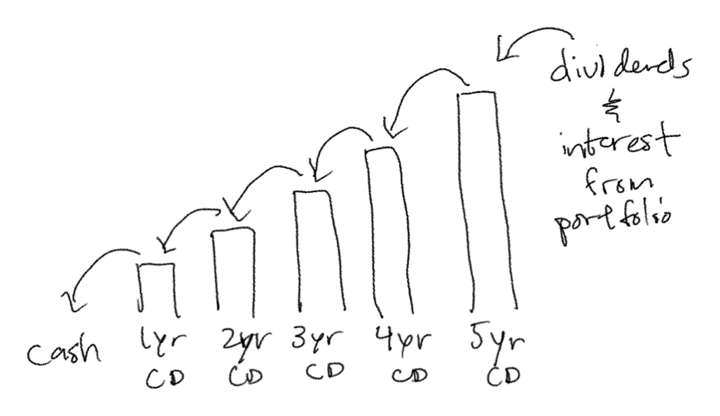
In the idealized “mental model” of my bond portfolio, this is a ladder of 1-year, 2-year, 3-year, 4-year, and 5-year certificates of deposit. Each rung of the ladder is a year of expenses. As each year passes, the 5-year CD will now have 4 years left to mature, the 4-year CD will have 3 years left, and so on, with the 1-year maturing into a liquid savings account. Then, I will take money from my portfolio (mostly dividends and interest) and buy a new 5-year CD. Usually the yield curve is such that a 5-year CD will pay more interest than the savings account, so this ladder earns more interest overall than just keeping it all in the savings account.

In reality, right now US Treasury bonds with their state income tax exemption pay more interest (in my state situation) than other safe options. For example, right now, a 5-year Treasury bond pays ~4.8% interest, but that’s effectively ~5.3% with the state income tax exemption (assuming a 10% state tax rate). There are no 5-year bank CDs that pay ~5.3% a year, even if I went through the hassle of rate-chasing across different credit unions and banks around the nation.

I could build a manual ladder of Treasury bonds, but even better (lazier) is simply buying the Vanguard Short-Term Treasury ETF (VGSH), which maintains a basket of 100% Treasury bonds with an average maturity of 2 years and a low expense ratio of 0.03%. Not exactly the same, but a short-term Treasury ETF is practically very similar to a repeating ladder of US Treasuries of 1 to 5 years. 100% of the interest is considered US government obligations, and so I retain the full state income tax deduction.

For comparison, the 30-day SEC yield today on VGSH is ~4.4%, and with the state income tax exemption that’s an effective ~4.8% for me. Meanwhile, the popular Vanguard Total Bond Market ETF (BND) has a 4.8% 30-day SEC yield but also has higher default risk (holds corporate bonds) and higher interest rate risk (longer duration). BND is fine, but this is why I prefer VGSH. I’m getting the same after-tax return as BND with lower risk. VGIT (intermediate-term Treasury ETF) has a significantly higher average maturity of about ~6 years year, longer than I need and doesn’t pay much higher interest in return.

That’s my long-winded explanation of why ~20% of my portfolio is held in Vanguard Short-Term Treasury ETF (VGSH). The rest of my bond allocation is in TIPS because they guarantee a long-term real return and thus address another risk (inflation risk) directly, but that’s a different topic.

Best Interest Rates on Cash: Bank Accounts, Treasury Bills, Money Markets, ETFs – September 2026

Here’s my monthly survey of the best interest rates on cash as of September 2026, roughly sorted from shortest to longest maturities. Banks and brokerages love taking advantage of idle cash, and you can often earn more interest while keeping the same level of safety by moving to another FDIC-insured bank or NCUA-insured credit union. Check out my Ultimate Rate-Chaser Calculator to see how much extra interest you could earn from switching. Rates listed are available to everyone nationwide. Rates checked as of 9/14/26.

TL;DR: Savings account interest rates are mostly stable, while rates on some longer-term CDs have risen significantly. You can get 4.34% APY on savings if you accept certain hoops/restrictions, but most are under 4% now. Short-term T-Bill rates ~3.8%. Top 5-year CD rates are now ~4.8% APY (brokered), while the 5-year Treasury rate is also ~4.8%.

High-yield savings accounts*
Since the huge megabanks still pay essentially zero interest, everyone should at least have a separate, no-fee online savings account to piggy-back onto your existing checking account. The interest rates on savings accounts can drop at any time, so I list the top rates as well as competitive rates from banks with a history of competitive rates and solid user experience. Some banks will bait you with a temporary top rate and then lower the rates in the hopes that you are too lazy to leave.

  • The top saving rate at the moment: Elevault (no min) is at 4.34% APY, a division of Southern Bancorp Bank.
  • SoFi Bank is at 3.10% APY (new customers can get up to $475 in bonuses with qualifying direct deposit. You must maintain a direct deposit of any amount (even $1) each month for the higher ongoing APY. SoFi has historically competitive rates and full banking features.
  • Here is a limited survey of high-yield savings accounts. They aren’t the top rates, but a group that have historically kept it relatively competitive such that I like to track their history. This month they start at 3.00% APY on up.

Short-term guaranteed rates (1 year and under)
A common question is what to do with a big pile of cash that you’re waiting to deploy shortly (plan to buy a house soon, just sold your house, just sold your business, legal settlement, inheritance). My usual advice is to keep things simple and take your time. If not a savings account, then put it in a flexible short-term CD under the FDIC limits until you have a plan.

  • No Penalty CDs offer a fixed interest rate that can never go down, but you can still take out your money (once) without any fees if you want to use it elsewhere. Marcus has a 11-month No Penalty CD at 4.00% APY ($500 minimum deposit). Farmer’s Insurance FCU has a 9-month No Penalty CD at 4.00% APY ($1,000 minimum deposit). USALLIANCE Financial CU has a 11-month No Penalty CD at 4.00% APY ($500 minimum deposit).
  • Eagle Bank has a 12-month CD at 4.45% APY ($1,000 minimum deposit). Early withdrawal penalty is not clearly disclosed, but is 90 days of interest according to 3rd-party sources.

Money market mutual funds
Many brokerage firms that pay out very little interest on their default cash sweep funds (and keep the difference for themselves). Note: Money market mutual funds are highly-regulated, but ultimately not FDIC-insured, so I would still stick with highly reputable firms.

  • Vanguard Federal Money Market Fund (VMFXX) is the default sweep option for Vanguard brokerage accounts, which has a 7-day SEC yield of 3.63% (changes daily, but also works out to a compound yield of 3.69%, which is better for comparing against APY). Odds are this is much higher than your own broker’s default cash sweep interest rate.
  • Vanguard Treasury Money Market Fund (VUSXX) is an alternative money market fund which you must manually purchase, but the interest will be mostly (100% for 2025 tax year) exempt from state and local income taxes because it comes from qualifying US government obligations. Current 7-day SEC yield of 3.71% (compound yield of 3.77%).

Treasury Bills and Ultra-short Treasury ETFs
Another option is to buy individual Treasury bills which come in a variety of maturities from 4-weeks to 52-weeks and are fully backed by the US government. You can also invest in ETFs that hold a rotating basket of short-term Treasury Bills for you, while charging a small management fee for doing so. T-bill interest is exempt from state and local income taxes, which can make a significant difference in your effective yield.

  • You can build your own T-Bill ladder at TreasuryDirect.gov or via a brokerage account with a bond desk like Vanguard and Fidelity. Here are the current Treasury Bill rates. As of 9/11/26, a new 4-week T-Bill had the equivalent of 3.85% annualized interest and a 52-week T-Bill had the equivalent of 4.34% annualized interest.
  • The iShares 0-3 Month Treasury Bond ETF (SGOV) has a 3.63% 30-day SEC yield (0.09% expense ratio) and effective duration of 0.10 years. The Vanguard 0-3 Month Treasury Bill ETF (VBIL) has a 3.63% 30-day SEC yield (0.06% expense ratio) and effective duration of 0.10 years.

US Savings Bonds
Series I Savings Bonds offer rates that are linked to inflation and backed by the US government. You must hold them for at least a year. If you redeem them within 5 years there is a penalty of the last 3 months of interest. The annual purchase limit for electronic I bonds is $10,000 per Social Security Number, available online at TreasuryDirect.gov.

  • “I Bonds” bought between May 2026 and October 2026 will earn a 4.26% rate for the first six months. The rate of the subsequent 6-month period will be based on inflation again. More on Savings Bonds here.
  • In mid-October 2026, the CPI will be announced and you will have a short period where you will have a very close estimate of the rate for the next 12 months. I will post another update at that time.

Rewards checking accounts
These unique checking accounts pay above-average interest rates, but with unique risks. You have to jump through certain hoops which usually involve 10+ debit card purchases each cycle, a certain number of ACH/direct deposits, and/or a certain number of logins per month. If you make a mistake (or they judge that you did) you risk earning zero interest for that month. Some folks don’t mind the extra work and attention required, while others would rather not bother. Rates can also drop suddenly, leaving a “bait-and-switch” feeling.

  • La Capitol Federal Credit Union pays 6.50% APY on up to $10,000 if you make 15 debit card purchases of at least $5 each per statement cycle. Anyone can join this credit union via partner organization, Louisiana Association for Personal Financial Achievement ($20).
  • OnPath Federal Credit Union (my review) pays 6.00% APY on up to $10,000 if you make 15 debit card purchases, opt into online statements, and login to online or mobile banking once per statement cycle. Anyone can join this credit union via $5 membership fee to join partner organization. You can also get a $150 Visa Reward card when you open a new account and make qualifying transactions.
  • Genisys Credit Union pays 6.75% APY on up to $7,500 if you make 10 debit card purchases of $5+ each per statement cycle, and opt into online statements. Anyone can join this credit union via $5 membership fee to join partner organization.
  • Oklahoma Central Credit Union pays 6.00% APY on up to $10,000 if you make 15 debit card purchases (non-ATM) per statement cycle. Anyone can join this credit union if they are “affiliated with another credit union”.
  • First Southern Bank pays 5.50% APY on up to $25,000 if you make at least 15 debit card purchases, 1 ACH credit or payment transaction, and enroll in online statements.
  • Credit Union of New Jersey pays 5.50% APY on up to $25,000 if you make 12 debit card purchases, opt into online statements, and make at least 1 direct deposit, online bill payment, or automatic payment (ACH) per statement cycle. Anyone can join this credit union via $5 membership fee to join partner organization.
  • Andrews Federal Credit Union pays 5.25% APY on up to $25,000 if you make 15 debit card purchases, opt into online statements, and make at least 1 direct deposit or ACH transaction per statement cycle. Anyone can join this credit union via partner organization.
  • Capitol Credit Union pays 6.00% APY on up to $15,000 if you make 12 debit card purchases, opt into online statements, and make at least 1 direct deposit or ACH transaction per statement cycle. Anyone can join this credit union via partner organization ($5 to Wild Basin Wilderness).
  • Find a locally-restricted rewards checking account at DepositAccounts.

Certificates of deposit (greater than 1 year)
CDs offer higher rates, but come with an early withdrawal penalty. By finding a bank CD with a reasonable early withdrawal penalty, you can enjoy higher rates but maintain access in a true emergency. Alternatively, consider building a CD ladder of different maturity lengths (ex. 1/2/3/4/5-years) such that you have access to part of the ladder each year, but your blended interest rate is higher than a savings account. When one CD matures, use that money to buy another 5-year CD to keep the ladder going. Some CDs also offer “add-ons” where you can deposit more funds if rates drop.

  • NASA Federal Credit Union has a 5-year certificate at 4.28% APY ($1,000 minimum), 4-year at 4.20% APY, 3-year at 4.15% APY, 2-year at 4.10% APY, and 1-year at 4.05% APY. Early withdrawal penalty for the 5-year is 365 days of interest. Anyone nationwide can join via a complimentary membership to the National Space Society (NSS).
  • Advancial Federal Credit Union has has a 5-year certificates at 4.28%/4.39%/4.49% APY based on either a $1,000/$25,000/$50,000 opening balance. Early withdrawal penalty for the 5-year is 365 days of interest. Anyone nationwide should be able to join via membership with partner organization US Dog Agility Association, but I would call to verify first.
  • Popular Direct has a 5-year certificate at 4.50% APY ($10,000 minimum) but with a huge early withdrawal penalty of 730 days of interest.
  • Sallie Mae Bank has a 5-year certificate at 4.40% APY ($2,500 minimum) but with a more reasonable early withdrawal penalty of 180 days of interest.
  • You can buy certificates of deposit via the bond desks of Vanguard and Fidelity. You may need an account to see the rates. These “brokered CDs” offer FDIC insurance and easy laddering, but they don’t come with predictable early withdrawal penalties. Right now, I see a 5-year non-callable brokered CD at 4.80% APY (callable: no, call protection: yes). Be warned that both Vanguard and Fidelity will list higher rates from callable CDs, which importantly means they can (and will!) call back your CD if rates drop significantly later.

Longer-term Instruments
I’d use these with caution due to increased interest rate risk (tbh, I don’t use them at all), but I still track them to see the rest of the current yield curve.

  • Willing to lock up your money for 10 years? You can buy long-term certificates of deposit via the bond desks of Vanguard and Fidelity. These “brokered CDs” offer FDIC insurance, but they don’t come with predictable early withdrawal penalties. You might find something that pays more than your other brokerage cash and Treasury options. Right now, I see a 10-year CDs at 4.85% APY (non-callable) vs. 4.97% for a 10-year Treasury. Watch out for higher rates from callable CDs where they can call your CD back if interest rates drop.

All rates were checked as of 9/14/26.

* I no longer recommend fintech companies for cash savings due to the possibility of significant loss due to poor record-keeping and the lack of government protection in such scenarios. The point of cash is absolute safety of principal.

Photo by Giorgio Trovato on Unsplash

Trump 530A Accounts: Non-Deductible IRA for Kids (Check if you have kids under age 10)

A Trump Account (aka 530A Account, or 530 IRA) is a new type of retirement investment account for children. They offer tax-deferred growth, but you don’t get a tax break upon contribution. Funds generally cannot be withdrawn until the child reaches age 18, whereupon it converts into a traditional IRA with penalties on most withdrawals until age 59.5. Unlike other IRAs, no earned income is required. Beyond parental contributions, there are various ways to receive contributions from the government and outside donors (including employers and nonprofits). The combined annual contribution limit for individuals and employers is $5,000 per child in 2026 (government and outside donors don’t count towards the limit).

Sources for this post are here, here, here, here, and here. My personal takeaway is that they are two main scenarios where you should open an account.

Scenario #1: If you are eligible for free money, you should take action and open an account.

  • Enrollment is not automatic. However, once you open an account, even with $0, outside contributions can arrive directly into your account. There are no annual account fees, so I see no reason not to take the money and let it grow over time until it becomes part of your child’s IRA balance. Your money will be invested in an S&P 500 index ETF (ticker SPYM) and you will need to use an app with BNY and Robinhood software handling the backend.
  • Download the official app. You need to file IRA Form 4547. Practically, you can do everything on the app found at the official site TrumpAccounts.gov. You could also wait until when you file your taxes or through the IRS website.
  • $1,000 Federal-level contribution for young kids and newborns. U.S. citizens born between January 1, 2025, and December 31, 2028, qualify for a one-time federal contribution of $1,000. The money arrives automatically after you open an account.
  • $250 Dell Foundation contribution (~75% of rest of kids under age 10). U.S. citizens born between 2016 and 2024 who live in ZIP codes where the median income is $150,000 or less qualify for $250 from the Dell Foundation. This ends up including ~75% of all kids in that age range. Limited to the first 25 million kids who open an account. Here is an eligibility tool. The money arrives automatically after you open an account.
  • Employer Contributions and/or Matching (Up to $2,500/year). Check with your employer, and look out for new commitments, especially if its a big corporation.
  • State-level Contributions. This list is also growing.
  • Things appear to be changing constantly, including Visa stating they want to enable the ability to redirect your credit card rewards to Trump Accounts.

Scenario #2: If you are already financially set for your own retirement and your children’s educational goals.

  • In general, I take the philosophy that you should worry about your own retirement needs first. If you aren’t very confident you can fund your own retirement, why are you worrying about your kids? This by itself removes the majority of US families.
  • After that, 529 accounts are most likely a better way to save money towards your child’s education. There are tax breaks on contributions in many states, there are more investment options, and the money can be withdrawn tax-free for eligible educational expenses. Even if you over-contribute, you can also now convert up to $35,000 in excess to Roth IRAs.
  • For those financially set enough that they still want to help fund their kids’ retirement beyond that, then this works like a non-deductible IRA contribution to your kids’ retirement. You have to put in after-tax money, it grows tax-deferred, but when it turns into a Traditional IRA at age 18, your kids will owe tax on all capital gains upon withdrawal (taxed as ordinary income).
  • Given that your kids will probably be an a relatively low tax bracket at age 18, this may be a good time to convert from Traditional IRA to a Roth IRA, assuming that is still allowed in the future. Boom, your kid could turn 21 with a six-figure Roth IRA.
  • I figure the folks that are rich enough for this will often be the same folks that were previously funding their kids’ Roth IRA by trying to count their chores or other household tasks as “earning income”. This account isn’t as good as a Roth IRA, but it’s a lot easier to fund.

I was surprised to find out that roughly 75% of children aged 10 and under qualify for the “low-income restricted” Dell $250 contribution, and indeed my zip code was eligible and the $250 has already arrived in my child’s account.

Certified Financial Planner (CFP) Designation is Not a Very High Bar

Last year, I took an official Certified Financial Planner (CFP) course, which satisfies the “Education” requirement of becoming an official Certified Financial Planner (CFP). Mine was online and self-paced at the University of Georgia with a net cost of around $3,000. I did not take the official CFP Exam ($925), nor did I satisfy the “Experience” requirement of 6,000 hours of “professional experience related to the financial planning process”. I don’t want the actual certification ($925 exam + $250 to apply + $575 every year + continuing education costs) – this is just an example of the strange things you can do with “financial independence”. 😜

In the end, I did learn more about several financial topics outside my personal bubble like using a financial calculator, handling estate issues for small business clients, and specific insurance topics. I would be glad that a prospective financial advisor at least had this basic core level of financial knowledge, but a lot of it was “studying for the test” and memorizing specific formulas and facts. It’s basically the equivalent of passing a semester or two of a single college class. I bought the physical textbooks, but passed the tests without opening them at all (just used the class slides). I’m still glad I tried it, otherwise I would still be curious.

The final requirement of a CFP is “Ethics”, which means passing their Candidate Fitness and Standards Background Check. Allan Roth is an experienced fee-only financial advisor whose opinion I respect, and he recently wrote a detailed article about How the CFP Board Sold Out the Public & the Profession. It’s certainly a disappointing read. Basically, the article outlines how the CFP Board is failing in its promise to only certify ethical financial planners. Many CFP holders with regulatory issues get to keep their CFP as long as they keeping paying the dues. “Nearly 1,000 CFPs have some form of criminal disclosure.”

Overall, my impression is that the CFP Board now mainly serves as a business selling the CFP designation to whoever is willing to pay the annual fees and continuing education fees as a signifier to the average person that they are a “educated and vetted financial planner”. They make millions on annual dues, exam prep classes, and continuing eduction tuition. The CFP took advantage of a vacuum, and unfortunately there really isn’t anything better. This means that all financial planners (good or bad) feel pressured to keep their CFP designation, even if they know it doesn’t mean much.

The takeaway is that a CFP designation is a bar, but not a very high bar. Yes, they took some coursework and passed a knowledge exam, although that exam is not nearly as hard as other financial tests like the CFA or CPA exams. Unfortunately, the CFP does not appear to aggressively weed out unethical advisors. The best advisors in the world still probably have a CFP, but many sketchy advisors with past complaints are also flashing their CFP. Be careful out there. If you’re looking for a planner, looking beyond the CFP badge and use BrokerCheck at a minimum, even if the CFP Board doesn’t.

Vanguard Outlook 2026: Financial Advice (Altruist Acquisition), High-Yield Cash, Better Bond Options

Vanguard has been a big part of building my net worth, and I’m always watching to see if they are keeping the culture. Barron’s last week ran the article Vanguard Conquered the ETF World. Where It’s Aiming Next, but it’s probably behind a paywall. Well, the three main areas are high-yield cash savings accounts, financial advice, and fixed-income investing. Let’s explore them all a bit.

Financial advice. I find this the most interesting area of change. Can Vanguard find a way to provide high-quality advice to the masses at a low cost? They have gathered a lot of assets into what they have built already, even though I don’t see it as a high-quality tool yet. Too rigid, and too pricey for what you get.

Vanguard just announced that they are acquiring Altruist, a start-up firm supporting independent financial advisors, for over $4 billion (WSJ gift article, official Vanguard press release). A big move by new CEO Ramji.

“Altruist’s mission to make financial advice more accessible, more affordable, and help advisers scale their practices, that very much rhymes with what we’re trying to do here at Vanguard,” Ramji said. “That’s really how this acquisition was born.”

Will Vanguard work more directly with independent advisors now? Will they successfully incorporate all this new technology and AI stuff into their in-house advice platform? Will it be a shocking amount cheaper than the competition, spreading the “Vanguard Effect” to portfolio management?

High-yield cash savings. I opened a Vanguard Cash Plus Account a while back, but so far it’s been sitting empty. The current yield is 3.35% APY as of 8/24/26, which is okay in the world of online savings accounts but not special. I know it’s FDIC-insured, but personally I feel equally as safe with a Vanguard money market fund, especially those that are 99%+ made of US Treasuries. The Barron’s article suggests that the main purpose for Cash Plus seems to be to draw in new customers that don’t already have a Vanguard brokerage account.

The current 7-day SEC yield (as of 8/24/26) on the default brokerage sweep is Vanguard Federal Money Market Fund (VMFXX) is 3.62% with a compound yield of 3.68% (best comparison to APY). I can do even better with Vanguard Treasury Money Market Fund (VUSXX), which is exempt from state income taxes. There’s also now Vanguard 0-3 Month Treasury Bill ETF (VBIL, see below). All of these options are better than Cash Plus.

Will Vanguard expand back into cash management and checking again? Maybe it’s best they don’t.

Fixed-income investing. This also makes sense, especially with a higher yield environment making people branch out to various bond segments, as with fixed income the easiest way to get a higher return without taking on more risk is to simply lower the expense ratio. The math just maths, for both cash and bonds.

Vanguard’s active bond funds charge an average annual fee of 0.10%, compared with an industry average of 0.45% (excluding Vanguard funds), according to data from Morningstar. And 83% of Vanguard active bond funds beat peer 10-year average returns, according to Morningstar.

VBIL has closed its bid/ask spread gap with SGOV and is now also at 0.01%. So you can trade it easily with minimal loss whenever you want a cash sweep option in any brokerage. On top of that, VBIL expense ratio was lowered 0.06%, while SGOV is still at 0.09%. VBIL is the new SGOV replacement in all my various brokerage spaces.

One of the company’s biggest fund launch success stories is the Vanguard 0-3 Month Treasury Bill ETF (ticker: VBIL), which reached $5 billion in assets less than a year after debuting in February 2025. That makes it the fastest-growing Vanguard ETF—fixed income or equity. Devereux notes that as VBIL grew, the company took a page from its traditional playbook and cut the expense ratio from 0.07% to 0.06%. It’s an example, she says, of how, while a lot is changing at Vanguard, “our core mission and focus on clients aren’t.”

Self-Directed Investors Hold a Lot of Cash. Maybe That’s Perfectly Rational

In this Morningstar market brief, it is revealed that the average self-directed Vanguard investor (7 million accounts!) held an asset allocation of 65% stocks, 24% cash, and 10% bonds. That’s a lot more cash than I expected as well.

Then this WSJ article comes up, Wealth Management Has a $3 Trillion Problem: Investors Are Keeping Too Much Cash (gift article). A self-directed investor and former pilot is profiled that keeps 85% in stocks and 15% in a “a money-market fund yielding 3.62%”, which suggests a Vanguard money market fund or another very-low cost money market.

He is keeping 85% of his portfolio in stocks and the rest in a money-market fund yielding 3.62%. Ross looked at historical bear markets and determined they typically don’t last longer than three years. He keeps enough of his portfolio in cash to comfortably get himself through that period, and he sells stocks when he needs to replenish his cash pile.

The rest of the article is about financial advisors thinking this is wrong and suggesting all sorts of alternatives, from muni bonds to private credit to buffer ETFs.

Now wealth and asset managers, eager to prove their worth and in many cases earn more fees, are trying to persuade investors to put it to work. Search for the phrase “too much cash” and you will find numerous articles penned by the likes of JPMorgan Chase and Charles Schwab, warning about the risk of being underinvested.

I found myself siding with the pilot. Maybe an alternative bond fund would give you a slightly higher yield, but the yield curve right now is still not very steep. As long as you are smart with your cash holdings (“cash sort”) and avoid crappy default sweep options with low yield from brokerages (like *cough*, JPMorgan Chase at 0.01% and Charles Schwab at 0.01%!) and instead buying SGOV, VBIL, or a Vanguard money market fund, you won’t be losing that much to a riskier bond alternative. Perhaps that is also partially why the cash allocation of Vanguard investors is so high. Their money market funds are quite good.

Switching to other bonds types can be fine, but be aware of the additional risk you are accepting for that higher yield. You may be taking on principal risk (buffer ETFs can lose money), duration risk (longer-term bonds can lose money), credit risk, or liquidity risk (private credit may limit withdrawals).

Finally, cash is simply a very safe, very short-term bond. Bonds are broken down by maturity, and Treasury bills with under 30 days of maturity are considered cash (“cash equivalents”). I see nothing wrong with taking your risk with stocks and keeping your “bonds” the safest flavor of bonds possible.

Long-term TIPS Yield now 3%; 4.9% Guaranteed 30-Year Withdrawal Rate

Keeping track of TIPS yields is useful because it provides a baseline of the return you can get by taking minimal risk. Beyond just the reliability of US Treasury bonds paying out their interest and return of principal at maturity, TIPS are US government-backed bonds that also address the risk of unexpectedly high inflation.

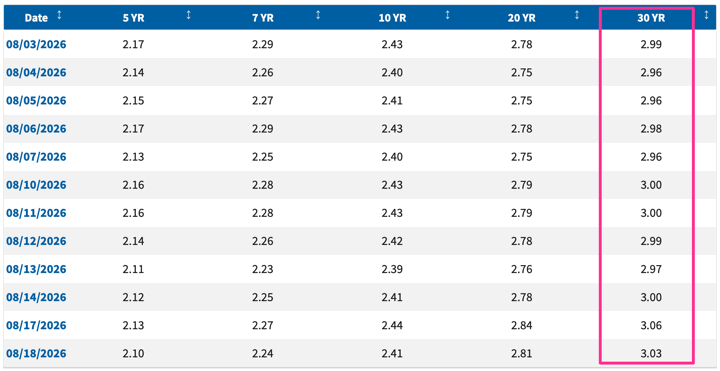
The real yield on 30-year TIPS has been at ~3% for weeks now as of August 2026, which is the first time since 2008, nearly 20 years ago. At the same time, the 30-year regular Treasury is at 5.3%, making the break-even annual inflation rate roughly 2.3%. This situation has motivated a new article by Edward F. McQuarrie and William J. Bernstein, Long TIPS Yield 3%. Time to Buy?. Only 2.3% inflation for the next 30 years? As the authors state, “Good luck with that.”

I would recommend reading it in full for their blunt and snarky writing style, but here are my major takeaways:

  • Long-term TIPS real yields at 3% or above are not common, and they usually don’t last long when they do show up.
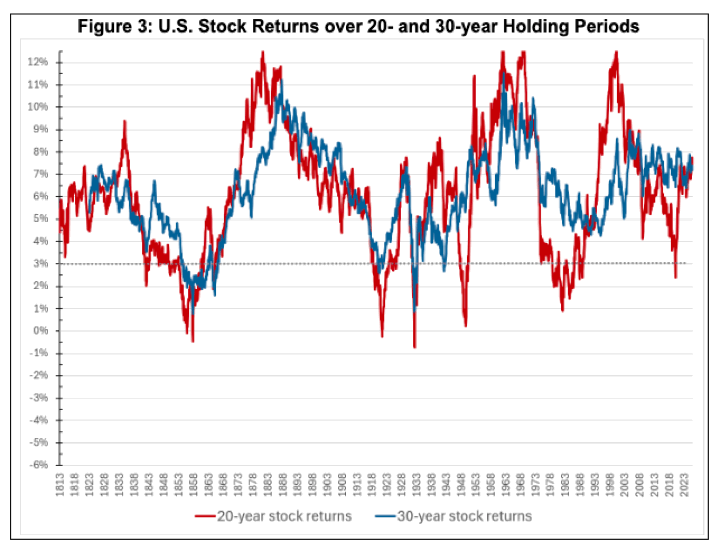
  • “Regular” nominal bonds are more likely than not to have a 30-year rolling average real return below 3%. One long-term average provided is only 1.5% real (above inflation). They do sometimes, but it’s not guaranteed and it can be a lot lower than 3%.
  • Stocks historically do provide 30-year rolling average real returns above 3% (see chart below). But your time horizon must be that long, as the short-term returns can be very different.
  • As a result, this may be a good opportunity for a near-retiree or retiree to lock in some guaranteed, inflation-protected income via a ladder of individual, long-term TIPS. Near-retirees might sell other bonds and buy TIPS. Younger folks should still own mostly stocks.
  • Per TIPSLadder.com, you can currently get a 4.9% real withdrawal rate by building such a ladder. That means with $1,000,000 invested, you can get $49,000 every year in today’s dollars every year for the next 30 years, adjusted upwards each year exactly to match CPI inflation.

What if you live past 30 more years? Remember, you don’t need to put every penny you have into a TIPS ladder. For example, if you carve out just 10% and put it into stocks instead, after 30 years those stocks will have grown quite a lot, most likely enough to fund another 7-10 years of annual income. Or you could split your portfolio up between stocks and TIPS however you like, knowing that the TIPS will provide a stable sleeve of income.

Best Interest Rates on Cash: Bank Accounts, Treasury Bills, Money Markets, ETFs – August 2026

Here’s my monthly survey of the best interest rates on cash as of August 2026, roughly sorted from shortest to longest maturities. Banks and brokerages love taking advantage of idle cash, and you can often earn more interest while keeping the same level of safety by moving to another FDIC-insured bank or NCUA-insured credit union. Check out my Ultimate Rate-Chaser Calculator to see how much extra interest you could earn from switching. Rates listed are available to everyone nationwide. Rates checked as of 8/16/26.

TL;DR: Savings account interest rates dropped slightly overall, while rates on longer-term CD rose slightly. You can get 4.34% APY if you accept certain hoops/restrictions, but most are under 4% now. Short-term T-Bill rates ~3.7%. Top 5-year CD rates are ~4.5% APY, while the 5-year Treasury rate is ~4.4%.

High-yield savings accounts*
Since the huge megabanks still pay essentially zero interest, everyone should at least have a separate, no-fee online savings account to piggy-back onto your existing checking account. The interest rates on savings accounts can drop at any time, so I list the top rates as well as competitive rates from banks with a history of competitive rates and solid user experience. Some banks will bait you with a temporary top rate and then lower the rates in the hopes that you are too lazy to leave.

  • The top saving rate at the moment: Elevault (no min) is at 4.34% APY, a division of Southern Bancorp Bank.
  • SoFi Bank is at 3.10% APY (new customers can get up to $475 in bonuses with qualifying direct deposit. You must maintain a direct deposit of any amount (even $1) each month for the higher ongoing APY. SoFi has historically competitive rates and full banking features.
  • Here is a limited survey of high-yield savings accounts. They aren’t the top rates, but a group that have historically kept it relatively competitive such that I like to track their history. This month they start at 3.00% APY on up.

Short-term guaranteed rates (1 year and under)
A common question is what to do with a big pile of cash that you’re waiting to deploy shortly (plan to buy a house soon, just sold your house, just sold your business, legal settlement, inheritance). My usual advice is to keep things simple and take your time. If not a savings account, then put it in a flexible short-term CD under the FDIC limits until you have a plan.

  • No Penalty CDs offer a fixed interest rate that can never go down, but you can still take out your money (once) without any fees if you want to use it elsewhere. Marcus has a 11-month No Penalty CD at 4.00% APY ($500 minimum deposit). Farmer’s Insurance FCU has a 9-month No Penalty CD at 4.00% APY ($1,000 minimum deposit). USALLIANCE Financial CU has a 11-month No Penalty CD at 4.00% APY ($500 minimum deposit).
  • CFG Bank has a 12-month CD at 4.30% APY (no minimum deposit). Early withdrawal penalty is not clearly disclosed, I would assume at least 180 days of interest.

Money market mutual funds
Many brokerage firms that pay out very little interest on their default cash sweep funds (and keep the difference for themselves). Note: Money market mutual funds are highly-regulated, but ultimately not FDIC-insured, so I would still stick with highly reputable firms.

  • Vanguard Federal Money Market Fund (VMFXX) is the default sweep option for Vanguard brokerage accounts, which has a 7-day SEC yield of 3.61% (changes daily, but also works out to a compound yield of 3.67%, which is better for comparing against APY). Odds are this is much higher than your own broker’s default cash sweep interest rate.
  • Vanguard Treasury Money Market Fund (VUSXX) is an alternative money market fund which you must manually purchase, but the interest will be mostly (100% for 2025 tax year) exempt from state and local income taxes because it comes from qualifying US government obligations. Current 7-day SEC yield of 3.68% (compound yield of 3.74%).

Treasury Bills and Ultra-short Treasury ETFs
Another option is to buy individual Treasury bills which come in a variety of maturities from 4-weeks to 52-weeks and are fully backed by the US government. You can also invest in ETFs that hold a rotating basket of short-term Treasury Bills for you, while charging a small management fee for doing so. T-bill interest is exempt from state and local income taxes, which can make a significant difference in your effective yield.

  • You can build your own T-Bill ladder at TreasuryDirect.gov or via a brokerage account with a bond desk like Vanguard and Fidelity. Here are the current Treasury Bill rates. As of 8/14/26, a new 4-week T-Bill had the equivalent of 3.70% annualized interest and a 52-week T-Bill had the equivalent of 3.97% annualized interest.
  • The iShares 0-3 Month Treasury Bond ETF (SGOV) has a 3.60% 30-day SEC yield (0.09% expense ratio) and effective duration of 0.10 years. The Vanguard 0-3 Month Treasury Bill ETF (VBIL) has a 3.62% 30-day SEC yield (0.06% expense ratio) and effective duration of 0.10 years.

US Savings Bonds
Series I Savings Bonds offer rates that are linked to inflation and backed by the US government. You must hold them for at least a year. If you redeem them within 5 years there is a penalty of the last 3 months of interest. The annual purchase limit for electronic I bonds is $10,000 per Social Security Number, available online at TreasuryDirect.gov.

  • “I Bonds” bought between May 2026 and October 2026 will earn a 4.26% rate for the first six months. The rate of the subsequent 6-month period will be based on inflation again. More on Savings Bonds here.
  • In mid-October 2026, the CPI will be announced and you will have a short period where you will have a very close estimate of the rate for the next 12 months. I will post another update at that time.

Rewards checking accounts
These unique checking accounts pay above-average interest rates, but with unique risks. You have to jump through certain hoops which usually involve 10+ debit card purchases each cycle, a certain number of ACH/direct deposits, and/or a certain number of logins per month. If you make a mistake (or they judge that you did) you risk earning zero interest for that month. Some folks don’t mind the extra work and attention required, while others would rather not bother. Rates can also drop suddenly, leaving a “bait-and-switch” feeling.

  • La Capitol Federal Credit Union pays 6.50% APY on up to $10,000 if you make 15 debit card purchases of at least $5 each per statement cycle. Anyone can join this credit union via partner organization, Louisiana Association for Personal Financial Achievement ($20).
  • OnPath Federal Credit Union (my review) pays 6.00% APY on up to $10,000 if you make 15 debit card purchases, opt into online statements, and login to online or mobile banking once per statement cycle. Anyone can join this credit union via $5 membership fee to join partner organization. You can also get a $150 Visa Reward card when you open a new account and make qualifying transactions.
  • Genisys Credit Union pays 6.75% APY on up to $7,500 if you make 10 debit card purchases of $5+ each per statement cycle, and opt into online statements. Anyone can join this credit union via $5 membership fee to join partner organization.
  • Oklahoma Central Credit Union pays 6.00% APY on up to $10,000 if you make 15 debit card purchases (non-ATM) per statement cycle. Anyone can join this credit union if they are “affiliated with another credit union”.
  • First Southern Bank pays 5.50% APY on up to $25,000 if you make at least 15 debit card purchases, 1 ACH credit or payment transaction, and enroll in online statements.
  • Credit Union of New Jersey pays 6.00% APY on up to $25,000 if you make 12 debit card purchases, opt into online statements, and make at least 1 direct deposit, online bill payment, or automatic payment (ACH) per statement cycle. Anyone can join this credit union via $5 membership fee to join partner organization.
  • Andrews Federal Credit Union pays 5.25% APY on up to $25,000 if you make 15 debit card purchases, opt into online statements, and make at least 1 direct deposit or ACH transaction per statement cycle. Anyone can join this credit union via partner organization.
  • Capitol Credit Union pays 6.00% APY on up to $15,000 if you make 12 debit card purchases, opt into online statements, and make at least 1 direct deposit or ACH transaction per statement cycle. Anyone can join this credit union via partner organization ($5 to Wild Basin Wilderness).
  • Find a locally-restricted rewards checking account at DepositAccounts.

Certificates of deposit (greater than 1 year)
CDs offer higher rates, but come with an early withdrawal penalty. By finding a bank CD with a reasonable early withdrawal penalty, you can enjoy higher rates but maintain access in a true emergency. Alternatively, consider building a CD ladder of different maturity lengths (ex. 1/2/3/4/5-years) such that you have access to part of the ladder each year, but your blended interest rate is higher than a savings account. When one CD matures, use that money to buy another 5-year CD to keep the ladder going. Some CDs also offer “add-ons” where you can deposit more funds if rates drop.

  • NASA Federal Credit Union has a 5-year certificate at 4.38% APY ($1,000 minimum), 4-year at 4.30% APY, 3-year at 4.25% APY, 2-year at 4.20% APY, and 1-year at 4.15% APY. Early withdrawal penalty for the 5-year is 365 days of interest. Anyone nationwide can join via a complimentary membership to the National Space Society (NSS).
  • Advancial Federal Credit Union has has a 5-year certificates at 4.28%/4.39%/4.49% APY APY based on either a $1,000/$25,000/$50,000 opening balance. Early withdrawal penalty for the 5-year is 365 days of interest. Anyone nationwide should be able to join via membership with partner organization US Dog Agility Association, but I would call to verify first.
  • Popular Direct has a 5-year certificate at 4.50% APY ($10,000 minimum) but with a huge early withdrawal penalty of 730 days of interest.
  • You can buy certificates of deposit via the bond desks of Vanguard and Fidelity. You may need an account to see the rates. These “brokered CDs” offer FDIC insurance and easy laddering, but they don’t come with predictable early withdrawal penalties. Right now, I see a 5-year non-callable brokered CD at 4.50% APY (callable: no, call protection: yes). Be warned that both Vanguard and Fidelity will list higher rates from callable CDs, which importantly means they can (and will!) call back your CD if rates drop significantly later.

Longer-term Instruments
I’d use these with caution due to increased interest rate risk (tbh, I don’t use them at all), but I still track them to see the rest of the current yield curve.

  • Willing to lock up your money for 10 years? You can buy long-term certificates of deposit via the bond desks of Vanguard and Fidelity. These “brokered CDs” offer FDIC insurance, but they don’t come with predictable early withdrawal penalties. You might find something that pays more than your other brokerage cash and Treasury options. Right now, I see a 10-year CDs at 4.65% APY (non-callable) vs. 4.67% for a 10-year Treasury. Watch out for higher rates from callable CDs where they can call your CD back if interest rates drop.

All rates were checked as of 8/16/26.

* I no longer recommend fintech companies due to the possibility of significant loss due to poor recordkeeping and the lack of government protection in such scenarios. The point of cash is absolute safety of principal.

Photo by Giorgio Trovato on Unsplash

Is Claiming Social Security Early at 62 Actually the Right Move?

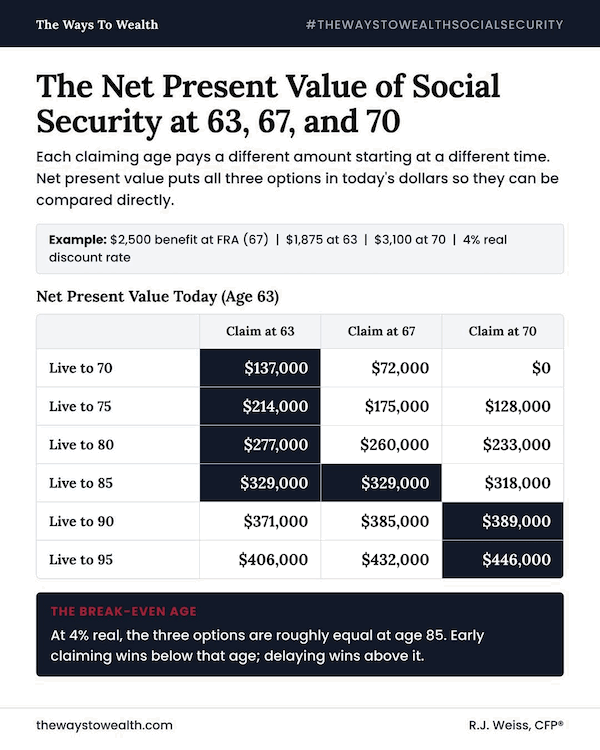
A major retirement decision is when to start claiming Social Security benefits. There are many ways to visualize the decision process, and here is another interesting one based on taking the “Net Present Value”. Essentially, you are taking into account the time value of money to aide your comparison, here assuming a 4% real return (which is both rather optimistic and yet somehow less than what people have received over the last ~10 years).

Source: Ways to Wealth via Early Retirement forum.

If you just go off this chart, you might get a different takeaway than if you used the default answer on free sites like Social Security Optimizer by T. Rowe Price or Open Social Security. Note that the default discount rate for real return is currently 2.7% for Open Social Security; changing this number may alter your results.

People are usually quite willing to accept a discount if they get the money now, and in this case the discount doesn’t even seem that high at less than 10% (again, using the assumptions provided). If you don’t live to 85, claiming at 62 actually puts you ahead.

There are many other factors to consider, like your other income which can increase the tax rates on Social Security income, Roth conversion concerns, spousal situation, health status, and so on. Social Security is still the only way to “purchase” (by waiting to claim) additional income that is both guaranteed to increase with inflation and last for the rest of your lifetime. But if you are retired and in a cashflow crunch, waiting another 5+ years to claim may not be worth the theoretical possible extra money you might get if you live past age 80-85.

Turn off Trusted Device 2FA/MFA Bypass, Always Log Out After Using Bank/Brokerage Accounts

I came across this r/FidelityInvestment Reddit post today about how a Fidelity user had their account compromised (and also eventually restored). In the discussion about how the hackers might have gained access to the account, I learned about some new dangers. I’m not a security expert, but this is my understanding after reading about “pass the cookie” or “cookie hijacking” attacks. The FBI also put out this alert Cybercriminals Are Stealing Cookies to Bypass Multifactor Authentication.

First, obviously phishing is a very common attack nowadays, and for example, if you enter your Fidelity password on a website that looks like the Fidelity login page, then they have your password. But if you have 2FA, you are still protected, right?

A different danger is that malware or a malicious website may use “cookie hijacking” to steal the cookies in your browser that make it appear that you have logged in before. If you use the “trusted device” feature where they bypass the 2FA/MFA (2-Factor Authentication/Multi-Factor Authentication) requirements since you are logging in from a supposedly “trusted device”, then they can now access your account without needing that text message or Authenticator code.

In some cases, if you are actively logged into your account already, malware or a malicious website can even steal your “active session” cookie that makes it appear that you’ve already logged in and passed the authentication checks. Because the website thinks you’ve already logged in, they don’t ask for anything at all.

Here are some actionable steps to maintain the highest security:

  1. Only log into sensitive financial accounts using devices where you know the operating system and web browser are secure and updated.
  2. Don’t log in from public WiFi, even with https://. If you do, at least use a VPN.
  3. Turn off the “trusted device” feature that removes 2FA or MFA if you are logging in from a “trusted device” with the proper browser cookie. This is more hassle, but basically you always want to require more than one factor.
  4. Don’t check the “Remember me” box when you log in on a sensitive site.
  5. Log in to do your financial business, and then immediately manually click “log out” to delete that active session cookie on both your browser and the external server. Do not stay logged in while you visit other websites, or wait for the system to automatically log you out after 15 minutes or so.

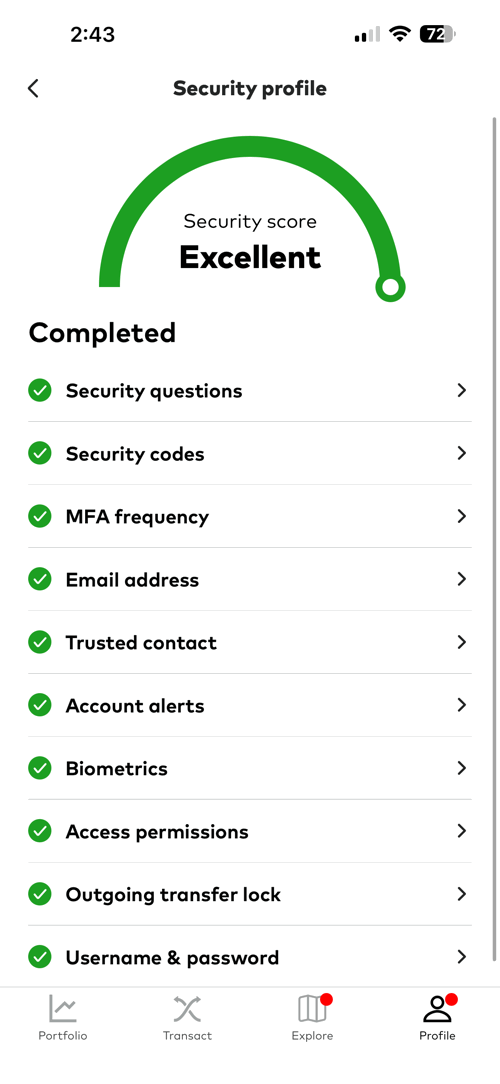
Turning off the “trusted device” feature was the last thing I needed to do in order to score an “Excellent” score on my Vanguard security profile as well. 😎

MMB Portfolio Dividend & Interest Income – 2026 2nd Quarter Update (July)

Here’s my 2026 2nd Quarter income update as a companion post to my 2026 1st Quarter asset allocation & performance update. Even though I don’t focus on high-dividend stocks or covered-call strategies, I still track the income from my portfolio as an alternative metric to price performance. The total income goes up much more gradually and consistently than the number shown on brokerage statements, which helps encourage consistent investing. Here’s a quote from Jack Bogle (source):

The true investor will do better if he forgets about the stock market and pays attention to his dividend returns and to the operating results of his companies. – Jack Bogle

Stock dividends are a portion of profits that businesses have decided to distribute directly to shareholders, as opposed to reinvesting into their business, paying back debt, or buying back shares. They have explicitly decided that they don’t need this money to improve their business, and that it would be better to distribute it to shareholders. The dividends may suffer some short-term drops, but over the long run they have grown faster than inflation.

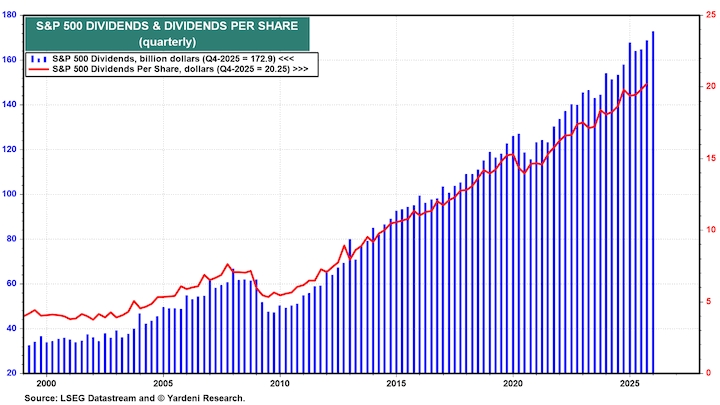
Here is the historical growth of the S&P 500 total dividend, which tracks roughly the largest 500 stocks in the US, updated as of 2026 Q1 (via Yardeni Research):

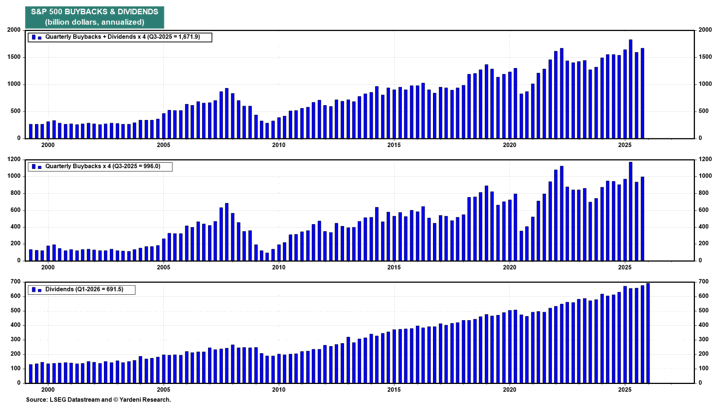
Admittedly, share buybacks have grown as a popular way to deal with extra cash, as shown in these charts (Yardeni). Many companies like that buybacks are not expected to continue forever, unlike dividends. This helps explain why the dividend yield on the S&P 500 is only around 1% now. This is why I also track the totals of both (buybacks + dividends), also shown below.

Tracking the income from my portfolio. Three of the primary “trees” that produce “fruit” in my portfolio are Vanguard Total US Stock ETF (VTI), Vanguard Total International Stock ETF (VXUS), and Vanguard Real Estate Index ETF (VNQ).

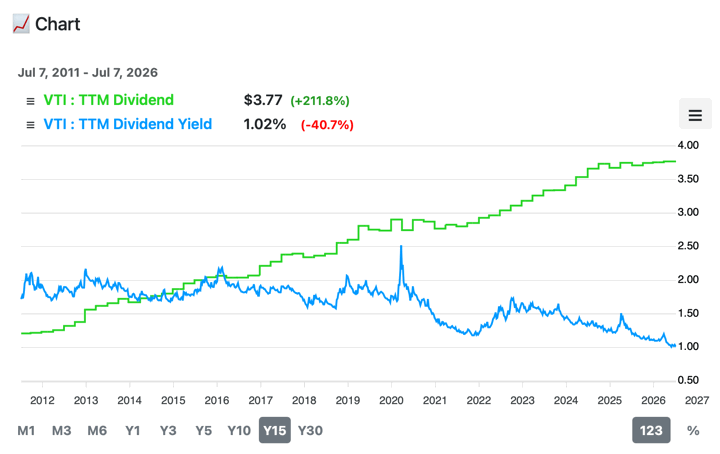
In the US, the dividend culture is somewhat conservative in that shareholders expect dividends to be stable and only go up. Thus the starting yield is lower, but grows more steadily with smaller cuts during hard times. Companies do buybacks as well, often because they are easier to discontinue. Here is an updated chart of the trailing 12-month (ttm) dividend per share over the last 15 years paid by the Vanguard Total US Stock ETF (VTI) via WallStNumbers.com.

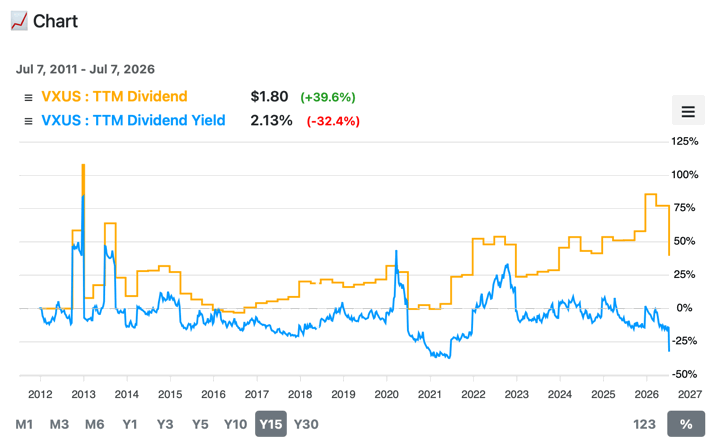
European corporate culture tends to encourage paying out a higher (sometimes even fixed) percentage of earnings as dividends, but that also means the dividends move up and down with earnings. The starting yield is currently higher but may not grow as reliably. Here is an updated chart of the trailing 12-month (ttm) dividend per share over the last 15 years paid by the Vanguard Total International Stock ETF (VXUS).

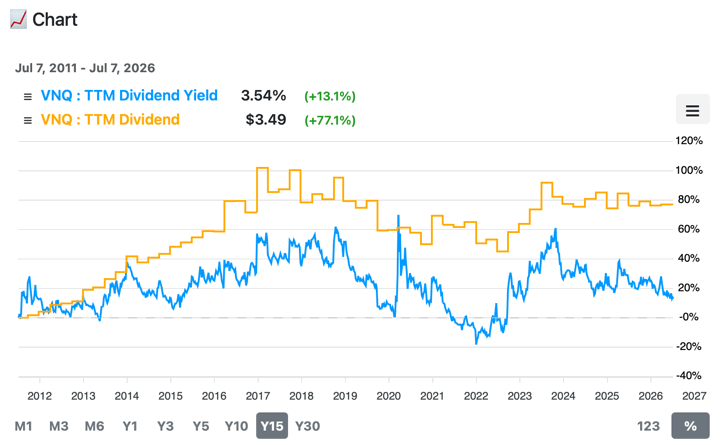
In the case of Real Estate Investment Trusts (REITs), they are legally required to distribute at least 90 percent of their taxable income to shareholders as dividends. Historically, about half of the total return from REITs is from this dividend income. Here is an updated chart of the trailing 12-month (ttm) dividend per share over the last 15 years paid by the Vanguard Real Estate Index ETF (VNQ).

The dividend yield (dividends divided by price) also serve as a rough valuation metric. When stock prices drop, this percentage metric usually goes up – which makes me feel better in a bear market. When stock prices go up, this percentage metric usually goes down, which keeps me from getting too euphoric during a bull market.

Finally, the last income component of my portfolio comes from interest from bonds and cash. Vanguard Short-Term Treasury ETF (VGSH) and Schwab US TIPS ETF (SCHP) are example holdings, with the actual amount varying with the prevailing interest rates, the real rates on TIPS, and the current rate of inflation.

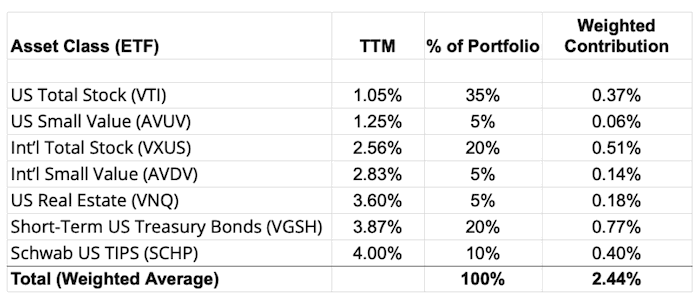
Dividend and interest income yield. To estimate the income from my portfolio, I use the weighted “TTM” or “12-Month Yield” from Morningstar (checked 7/7/26), which is the sum of the trailing 12 months of interest and dividend payments divided by the last month’s ending share price (NAV) plus any capital gains distributed (usually zero for index funds) over the same period. My TTM portfolio yield is now roughly 2.44%.

In dividend investing circles, there is a metric called yield on cost, which is calculated by dividing the current dividend by the original purchase price. In other words, while my portfolio yield today is may be lower than say a target withdrawal rate of 3%, that is because the current market price is also a lot higher. Due to increasing dividends on average over time, my yield-on-cost based on my portfolio value from 10 years ago is over 5%.

What about the 4% rule? For big-picture purposes, I support the simple 4% or 3% rule of thumb, which equates to a target of accumulating roughly 25 to 33 times your annual expenses. I would lean towards a 3% withdrawal rate if you want to retire young (closer to age 50) and a 4% withdrawal rate if retiring at a more traditional age (closer to 65). It’s just a quick and dirty target to get you started, not a number sent down from the heavens!

During the accumulation stage, your time is better spent focusing on earning potential via better career moves, improving your skillset, networking, and/or looking for asymmetrical (unlimited upside, limited downside) entrepreneurial opportunities where you have an ownership interest.

Our dividends and interest income are not automatically reinvested. They are simply another “paycheck”. As with our other variable paychecks, we can choose to either spend it or invest it again to compound things more quickly. You could use this money to cut back working hours, pursue a different career path, start a new business, take a sabbatical, perform charity or volunteer work, and so on. You don’t have to wait until you hit a magic number. Our life path has been very different because of this philosophy. FIRE is Life!

MMB Portfolio Asset Allocation & Performance – 2026 2nd Quarter Update (July)

Here is my 2026 2nd Quarter portfolio update that includes 401k/403b/IRAs and taxable brokerage accounts but excludes our house and small side portfolio of self-directed investments. Following the concept of skin in the game, the following is not a recommendation, but a sharing of our real-world, imperfect DIY portfolio.

“Never ask anyone for their opinion, forecast, or recommendation. Just ask them what they have in their portfolio.” – Nassim Taleb

How I Track My Portfolio
Here’s how I track my portfolio across multiple brokers and account types:

  • The Empower Personal Dashboard real-time portfolio tracking tools (free) automatically logs into my multiple accounts, adds up my various balances, tracks my performance, and figures out my overall asset allocation across the entire portfolio. Formerly known as Personal Capital.
  • Once a quarter, I also update my manual Google Spreadsheet (free to copy, instructions) because it helps me calculate how much I need in each asset class to rebalance back towards my target asset allocation. I also create a new sheet each quarter, so I have a personal archive of my portfolio dating back many years.

2026 2nd Quarter Asset Allocation and YTD Performance
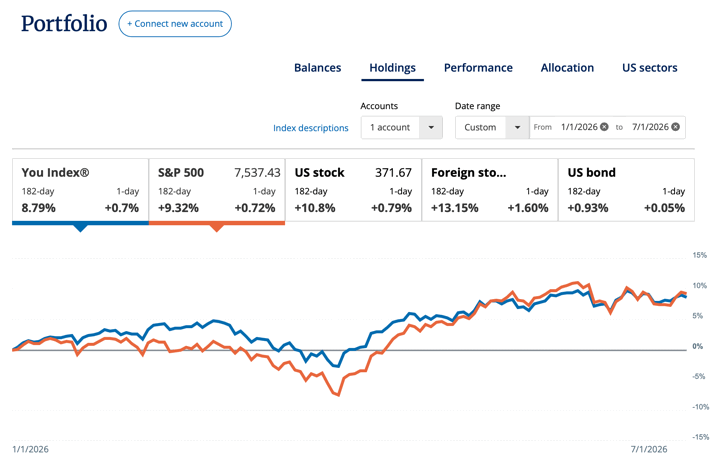
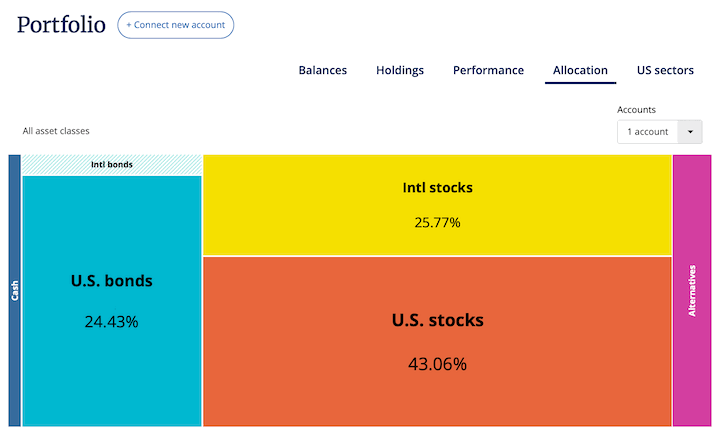
Here are updated performance and asset allocation charts, per the “Holdings” and “Allocation” tabs of my Empower Personal Dashboard.

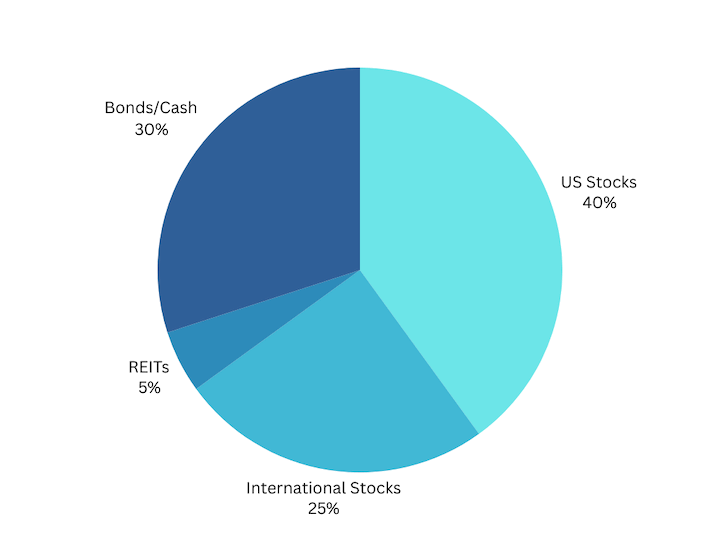
The major components of my portfolio are broad index ETFs. I do mix it up a bit around the edges, but not very much. Here is a model version of my target asset allocation with sample ETF holdings for each asset class.

  • 35% US Total Market (VTI)
  • 5% US Small-Cap Value (AVUV)
  • 20% International Total Market (VXUS)
  • 5% International Small-Cap Value (AVDV)
  • 5% US REITs (VNQ)
  • 20% US “Regular” Treasury Bonds and/or FDIC-insured deposits (VGSH)
  • 10% US Treasury Inflation-Protected Bonds (SCHP)

Big picture, the target is 70% businesses and 30% very safe short-term bonds/cash:

By paying minimal costs including management fees, transaction spreads, and tax drag, I am trying to essentially guarantee myself above-average net performance over time.

I do not spend a lot of time backtesting various model portfolios. You’ll usually find that whatever model portfolio is popular at the moment just happens to hold the asset class that has been the hottest recently.

The portfolio that you can hold onto through the tough times is the best one for you. I’ve been pretty much holding this same portfolio for 20 years. Check out these ancient posts from 2004 and 2005. Every asset class will eventually have a low period, and you must have strong faith during these periods to earn those historically high returns. You have to keep owning and buying more stocks through the stock market crashes. You have to maintain and even buy more rental properties during a housing crunch, etc. A good sign is that if prices drop, you should feel the urge to buy more of that asset instead of less. I don’t have strong faith in the long-term results of commodities, gold, or bitcoin – so I don’t own them.

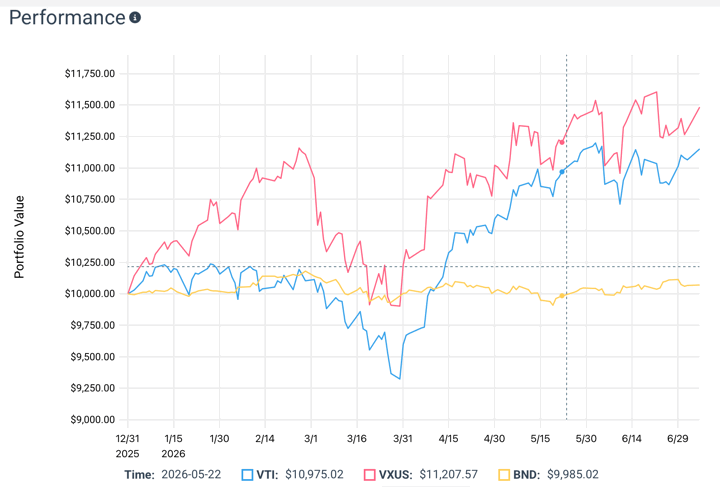
Performance details. Here’s an updated YTD Growth of $10,000 chart courtesy of Testfolio for some of the major index ETFs (total US stock, total international stock, total US bond) that shows the difference in performance in the broad indexes:

First quarter of 2026, the US broad indexes (VTI) dropped, but came back and then some in the 2nd quarter. International stocks (VXUS) are slightly ahead for the year. I’m getting a bit too stock-heavy so will be directing rebalancing funds towards bonds. I’ll share about more about the income aspect in a separate post.