A major retirement decision is when to start claiming Social Security benefits. There are many ways to visualize the decision process, and here is another interesting one based on taking the “Net Present Value”. Essentially, you are taking into account the time value of money to aide your comparison, here assuming a 4% real return (which is both rather optimistic and yet somehow less than what people have received over the last ~10 years).
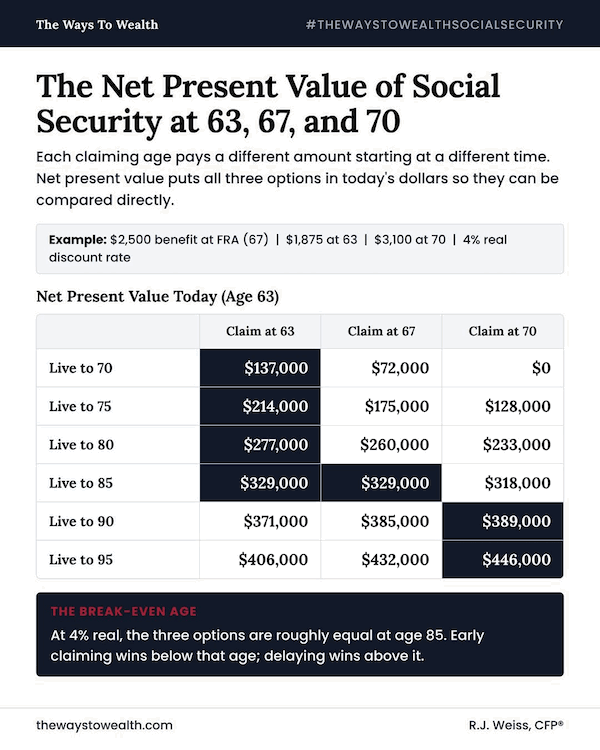
Source: Ways to Wealth via Early Retirement forum.
If you just go off this chart, you might get a different takeaway than if you used the default answer on free sites like Social Security Optimizer by T. Rowe Price or Open Social Security. Note that the default discount rate for real return is currently 2.7% for Open Social Security; changing this number may alter your results.
People are usually quite willing to accept a discount if they get the money now, and in this case the discount doesn’t even seem that high at less than 10% (again, using the assumptions provided). If you don’t live to 85, claiming at 62 actually puts you ahead.
There are many other factors to consider, like your other income which can increase the tax rates on Social Security income, Roth conversion concerns, spousal situation, health status, and so on. Social Security is still the only way to “purchase” (by waiting to claim) additional income that is both guaranteed to increase with inflation and last for the rest of your lifetime. But if you are retired and in a cashflow crunch, waiting another 5+ years to claim may not be worth the theoretical possible extra money you might get if you live past age 80-85.
 The Best Credit Card Bonus Offers – 2026
 Big List of Free Stocks from Brokerage Apps
 Best Interest Rates on Cash - 2026
 Free Credit Scores x 3 + Free Credit Monitoring
 Best No Fee 0% APR Balance Transfer Offers
 Little-Known Cellular Data Plans That Can Save Big Money
 How To Haggle Your Cable or Direct TV Bill
 Big List of Free Consumer Data Reports (Credit, Rent, Work)
Yes. Especially that it’s my money. Refuse to give them more time to take my money away from Me
If you have low/modest saving and need the money for cashflow, take it earlier. Or, work a few more years to increase your current income and future SS benefits.
If you are in poor health and don’t expect to live long, take it ASAP.
If you are married and have adequate savings to support your family until age 70, the higher earner of the couple should often wait to claim SS at 70. This is for widow/widower’s benefits (income insurance), as only the highest income continues when the partner dies. The lower earner of the couple may take SS anywhere from 62 to 70, per the needs and earned benefits of each case.
For those with large liquid retirement savings (>$1M), Social Security and Medicare involve distinct tax rules and income caps. Furthermore, large pre-tax 401k/IRA accounts become RMA “tax bombs” at 73 or 75. So, one may avoid massive tax bills by delaying Social Security, artificially keeping income in the 12% or 22% bracket, and executing Roth conversions from 65 to 75.
In sum, the simple NPV math of this post might be wrong per net worth, types of assets, the accounts where the money is held, plus all the SS, Medicare, IRMAA, and RMD tax rules.
My mom live to be 95 and my dad 88.
But as you said, life expectancy is not the only thing for us to consider.
There is the enjoyment or quality of life aspect of the money. Odds are you can enjoy life and do more things with a few more dollars in your 60’s than your 80’s,……. if you make it.
Valid points.
But my dad was happy and healthy up until literally his last breath when he had a massive heart attack and was gone instantly.
My mother was pretty good up until she had a fall and Covid the first time at 94.
Two more falls and Covid however took her out in a few months.
I do have to plan on longevity.
Does your chart take into consideration that the 8% increase between FRA and age 70 is compounded on top of inflation ? In 2027, the inflation is index is coming in much higher than anticipated?
“the 8% increase between FRA and age 70 is compounded on top of inflation”. I would suggest double checking that. I think the 8% is calculated based on the FRA amount each year, then the COLA adjustment is added. So each delayed year the benefit goes up by (8% of FRA) + Cola, not 8% of (FRA+COLA), if that makes any sense.
Thanks Paul, I stand corrected. At least, I know each year past FRA, I am receiving 8% increase plus Cola adjusted. With the added benefit of Cola adjustment each year that adds up.
We need to account for the upcoming fiscal cliff facing Social Security and Medicare. Even under the most optimistic government projections, Social Security is expected to face insolvency by 2032 (this number is decreasing all the time).
Because of this shortfall, there’s a real possibility that future retirees will receive lower benefits than currently projected. Congress will likely address this through a mix of higher payroll taxes, deficit-funded general revenue transfers, and benefit reductions—all structured to minimize political pushback from key voting blocs.
Given these potential cuts and tax hikes, claiming Social Security earlier at current reimbursement rates might actually yield a better return. Standard benefit projections may simply be overestimating what future payouts will actually look like.