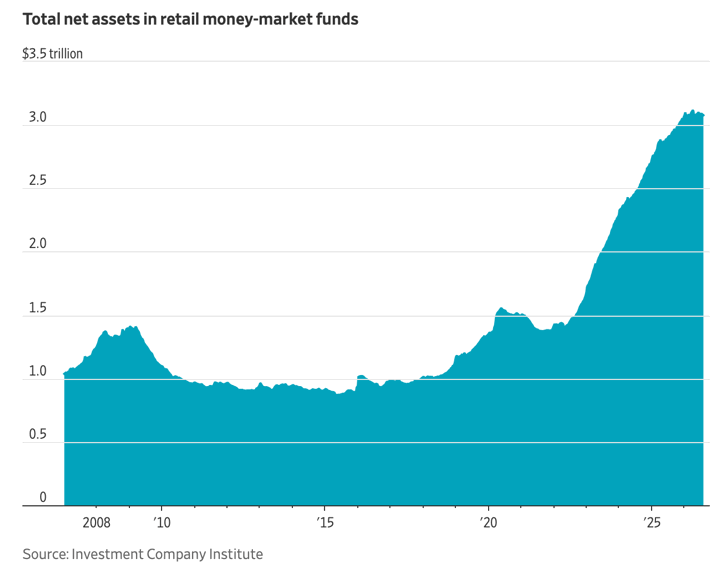
In this Morningstar market brief, it is revealed that the average self-directed Vanguard investor (7 million accounts!) held an asset allocation of 65% stocks, 24% cash, and 10% bonds. That’s a lot more cash than I expected as well.
Then this WSJ article comes up, Wealth Management Has a $3 Trillion Problem: Investors Are Keeping Too Much Cash (gift article). A self-directed investor and former pilot is profiled that keeps 85% in stocks and 15% in a “a money-market fund yielding 3.62%”, which suggests a Vanguard money market fund or another very-low cost money market.
He is keeping 85% of his portfolio in stocks and the rest in a money-market fund yielding 3.62%. Ross looked at historical bear markets and determined they typically don’t last longer than three years. He keeps enough of his portfolio in cash to comfortably get himself through that period, and he sells stocks when he needs to replenish his cash pile.
The rest of the article is about financial advisors thinking this is wrong and suggesting all sorts of alternatives, from muni bonds to private credit to buffer ETFs.
Now wealth and asset managers, eager to prove their worth and in many cases earn more fees, are trying to persuade investors to put it to work. Search for the phrase “too much cash” and you will find numerous articles penned by the likes of JPMorgan Chase and Charles Schwab, warning about the risk of being underinvested.
I found myself siding with the pilot. Maybe an alternative bond fund would give you a slightly higher yield, but the yield curve right now is still not very steep. As long as you are smart with your cash holdings (“cash sort”) and avoid crappy default sweep options with low yield from brokerages (like *cough*, JPMorgan Chase at 0.01% and Charles Schwab at 0.01%!) and instead buying SGOV, VBIL, or a Vanguard money market fund, you won’t be losing that much to a riskier bond alternative. Perhaps that is also partially why the cash allocation of Vanguard investors is so high. Their money market funds are quite good.
Switching to other bonds types can be fine, but be aware of the additional risk you are accepting for that higher yield. You may be taking on principal risk (buffer ETFs can lose money), duration risk (longer-term bonds can lose money), credit risk, or liquidity risk (private credit may limit withdrawals).
Finally, cash is simply a very safe, very short-term bond. Bonds are broken down by maturity, and Treasury bills with under 30 days of maturity are considered cash (“cash equivalents”). I see nothing wrong with taking your risk with stocks and keeping your “bonds” the safest flavor of bonds possible.
 The Best Credit Card Bonus Offers – 2026
 Big List of Free Stocks from Brokerage Apps
 Best Interest Rates on Cash - 2026
 Free Credit Scores x 3 + Free Credit Monitoring
 Best No Fee 0% APR Balance Transfer Offers
 Little-Known Cellular Data Plans That Can Save Big Money
 How To Haggle Your Cable or Direct TV Bill
 Big List of Free Consumer Data Reports (Credit, Rent, Work)
The peace of mind benefit is more important as I become older…
Time deposits a little over 4% are ok.
Several times friends have had their plans delayed or crushed due to market downturns…
An excellent article. I also suggest USFR which is a floating rate version of SGOV and VBIL, but has recently provided a slightly higher yield, And currently, short term floating rate bond funds, and AAA rated CLO funds, are higher yielding, yet very stable, cash alternatives.
Good timing on an excellent article—it highlights what feels like a very rational position right now.
I hold roughly 13% of my liquid portfolio in cash equivalents (CDs, SGOV, SPAXX, HYSA) alongside physical gold as a non-correlated hedge against bonds and equities.
Like many investors, I’m watching the U.S. navigate financial repression, where real yields (interest minus inflation and taxes) stay negative. Holding cash under these conditions means watching purchasing power erode daily, which is why I’ve audited every cash position to ensure zero capital sits idle in 0% yield accounts.
Meanwhile, long-term bonds look uninvestable due to significant downside risk as rate pressures persist globally (driven in part by Japan) and its also increasingly becoming the same trade as the market with all the AI debt issuance. On the equity side, whether AI is in a bubble or heading toward government intervention, heavy exposure carries distinct risks. Diversifying away from concentration risk while maintaining dry powder for dip-buying is essential.
In this environment, strategically holding high-yield cash equivalents isn’t passive—it’s a deliberate, logical risk-management move.
Hi, Just letting you know that the WSJ gift link goes to a different article.
Thanks, the gift link should be fixed now.
As of this past weekend (when I updated my spreadsheets) we have 15.8% in “cash” in all sorts of accounts. The range is from 0% interest at our CU checking to about 7% for the SCYB we hold, so the risk runs the gamut as well. For the CDs I try to keep the term short, no more than 12 months. I’d love to be able to ladder out some CDs for 3,4, or 5 years but the economy, the political situation and the market are all just to unstable to generate any confidence.
Keeping 2-3 years in Money Market or High Yield Savings is perfectly logical. When offset by growth/stock funds, cash forms a standard dog bone low-vs-high risk portfolio. I choose to keep some of the 3rd year buffer in SCHD — it pays 3.27% and has the potential growth upside of its dividend stock holdings.
The trouble with bonds is that governments today use them to control inflation through underpayment (rate repression). Given the ceiling on returns and Biden-era bond crash just a few years ago, there’s no reason to accept latent risk for 1-2% boost over Money Market funds. If another Volker-style interest rate boom happens, shift from MM to bonds with the trend.