The trend in many alternative asset classes is to make previously illiquid and high-value investments like art, collectibles, farmland, and music royalties more accessible to us common folk by offering fractional ownership. From the comfort of my smartphone, I can buy a $250 fractional share of a Shelby Mustang and hope to sell my equivalent of a turn signal stalk at a tidy profit in the future.
Masterworks does this for art, letting you invest as little as $500 into multi-million dollar works of art by artists like Basquiat, Picasso, and Banksy. The pitch is pretty direct:
Contemporary art has outperformed the S&P for the past 25 years, but there has been no way to invest in it. Masterworks is the first company to offer investment products within the art market.
The Masterworks website claims that the Contemporary Art asset class has returned 13.8% annualized from 1995-2021, much more than the 10.2% from the S&P 500. This data “reflects value-weighted price appreciation for all Contemporary Art (works produced after 1945) sold at least twice at public auction.”

In addition, this chart from a 2022 Citi Art Market report shows that Contemporary Art had a very low or even slightly negative historical correlation with stocks (Developed Equities, -0.04) and bonds (Investment Grade Fixed Income, 0.15).

Here’s what Citi says about future art prices:
Citi Private Bank’s proprietary strategic asset allocation methodology does not address art. We instead approach art primarily from the collector perspective of the clients whom we serve rather than strictly as an investment. In any case, art does not lend itself to an objective cash flow-based analysis as equities, fixed income, and real estate do. In this regard, it has more in common with commodities. As such, rigorous estimates of future long-term returns are not possible.
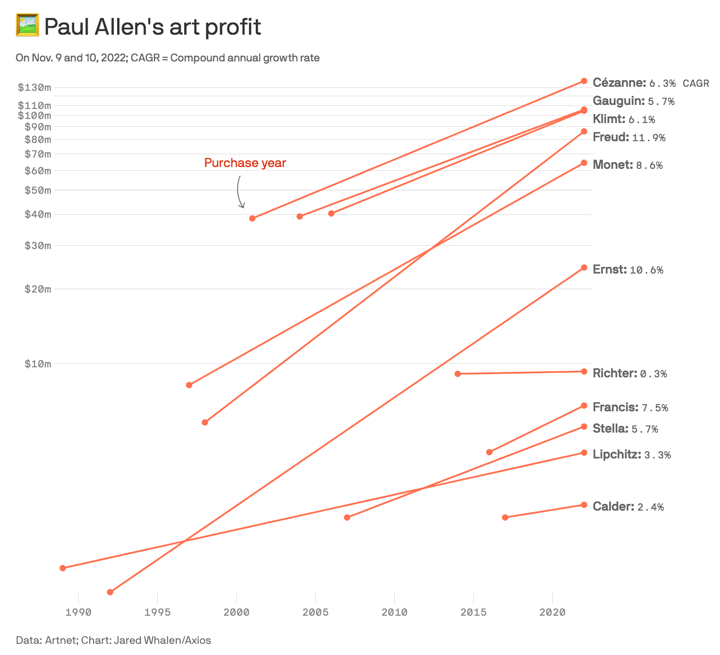
Alright, how about some more data points then? Recently, the estate of Paul Allen sold off a record-breaking $1.6 billion of art, most of which was also both bought and sold at a public auction. This gives us both the purchase and sell prices and the ability to calculate annualized return. This Axios article included an analysis and created the chart below.
Some sales are impressive, like a Cézanne that was bought for ~$38 million and sold for ~$138 million less than 20 years later. A cool $100 million profit ain’t too shabby. However, once you calculate the overall return including the holding periods, the annualized return was only 6.2% annualized over an average holding period of 18 years. Axios notes that the S&P 500 grew at 8.9% annualized over the past 18 years, which allows them to drop this zinger:
The bottom line: Allen would have made more money just buying an S&P 500 index fund.
I can see art as as an asset class having positive long-term returns in the future, and I can see it having a relatively low correlation to stocks, but I suppose that I have a hard time seeing it return something amazing and consistently better than the S&P 500. Especially for any basket of specific pieces, it may return 4% more than the S&P 500 annually, or it may return 4% less than the S&P 500 annually. This would be more of a fun, amusing thing – “I own a flower petal from that Monet!” – that might retain permanent value in the future.
(I can’t tell a Stella from a Seurat, so I have no personal investment in Masterworks.)
 Retirement income planning would be so much easier if you could buy a known amount of guaranteed lifetime income that automatically adjusted for inflation. However, the reality is that not a single insurance company in the entire world is willing to take on that long-term inflation risk. The only possibility left is to ladder inflation-linked bonds (TIPS) so that each year you would cash out some bonds and interest to create your own DIY inflation-adjusted income.
  Here’s my monthly roundup of the best interest rates on cash as of November 2022, roughly sorted from shortest to longest maturities. We all need some safe assets for cash reserves or portfolio stability, and there are often lesser-known opportunities available to individual investors. Check out my
 Inflation still 🚀 😬 Savings I Bonds are a unique, low-risk investment backed by the US Treasury that pay out a variable interest rate linked to inflation. With a holding period from 12 months to 30 years, you could own them as an alternative to bank certificates of deposit (they are liquid after 12 months) or bonds in your portfolio.






 Here’s my quarterly income update for my

 Here’s my quarterly update on my current investment holdings as of 10/4/22, including our 401k/403b/IRAs and taxable brokerage accounts but excluding real estate and side portfolio of self-directed investments. Following the concept of

 The Best Credit Card Bonus Offers – 2026
 Big List of Free Stocks from Brokerage Apps
 Best Interest Rates on Cash - 2026
 Free Credit Scores x 3 + Free Credit Monitoring
 Best No Fee 0% APR Balance Transfer Offers
 Little-Known Cellular Data Plans That Can Save Big Money
 How To Haggle Your Cable or Direct TV Bill
 Big List of Free Consumer Data Reports (Credit, Rent, Work)