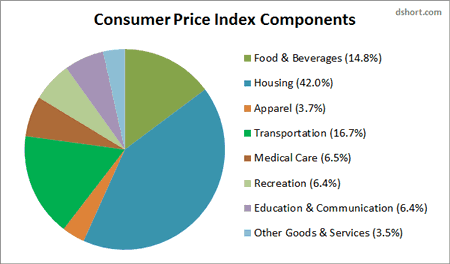
Inflation. Deflation. Hyperinflation. It’s all people seem to talk about these days. I’m always reading that you should always consider your investment returns after inflation. But what is inflation? Most of the time, they are talking about the Consumer Price Index for Urban Consumers (CPI-U) published monthly by the Bureau of Labor Statistics. This is based on the price of a theoretical basket of goods. Here are the components of the CPI, made into a nice pie chart by dshort.com from this recent BLS CPI report.
However, common sense tells us that we do not all share the same inflation rate. A long-distance trucker will be much more sensitive to the price of gas than a couple living in Manhattan. A grandmother who has owned her home since 1940 and doesn’t plan on moving doesn’t notice if rents are rising 3% or 6% a year. The CPI could have very little correlation to your personal inflation rate.
In addition, it’s possible to manage our own personal inflation rates by changing our behavior or making some upfront investments. Let’s take a look at the largest components of the CPI.
Housing (42%)
This category includes the cost of rent (or owner’s equivalent cost) as well as utilities like gas and electricity. The most obvious way to deal with inflation is to own a house, either directly or via mortgage. With a 30-year fixed mortgage, your monthly payment is going to stay the same, and your total housing payment is only going to vary a bit as your insurance and property taxes go up. My neighbor used to have a mortgage of $300 a month.
As for utilities, a solution I plan to install is solar photovoltaic (PV)panels. In most states, you can sell back the electricity you generate with solar panels throughout the day, so that it cancels out your entire electricity bill. With a large enough system, you will never have a power bill again. Here is a helpful PDF consumer’s guide on solar systems from the Department of Energy.
The large upfront cost can be defrayed with federal and state tax credits, and the panels come with (about) a 25-year warranty. Other parts, like the inverter, come with a 10-year warranty. If you have the space you could also install a windmill, or contract electricity from other sources.
If you live in an especially hot/cold climate and much of your expense is cooling/heating, a very important area is insulation.
Transportation (17%)
This category includes the cost of vehicles, public transportation, and fuel. I plan on owning all my cars for at 10 years each, so even though it will catch up to me eventually, the annualized cost should remain reasonable. Avoiding the hit of depreciation during the early years, either buy buying used or holding for a long time, is important.
As for fuel, again I plan on using my solar panels to create electricity for my plug-in electric vehicle. Range is currently an issue, but as battery technology improves, I expect that it will be feasible for most households to own at least one electric vehicle.
Food & Beverages (15%)
This category includes food at home, dining out, and also alcohol. Why not grow some of your own food? We are starting to dabble in square-foot gardening, which involves planting small, efficient gardens that use minimal water, pesticides, and labor. Dining out is one of those expenses that is almost all for pleasure and convenience, so if it becomes hurtful then we’ll cut back. I’ve already been cutting back on the alcohol for waistline reasons.
Education & Communication (6%)
I’m not sure why these two are lumped together, but I really don’t see communication costs rising very much in the future. It would appear that data transfer is only going to get faster and cheaper. On the other hand, education costs continue to skyrocket. (Okay, now I see why they are together… sneaky) Even though this is only 6% of the CPI, if you have kids then tuition prices are likely a huge concern. If you don’t have kids (and are done with school), then you don’t care at all.
There are still some limited opportunities for prepaid college tuition out there, which are worth exploring if you accept the penalties for not following their restrictions. An example is the Florida Prepaid college plan.
Any other ideas for controlling your personal inflation rate?




 The Best Credit Card Bonus Offers – 2026
 Big List of Free Stocks from Brokerage Apps
 Best Interest Rates on Cash - 2026
 Free Credit Scores x 3 + Free Credit Monitoring
 Best No Fee 0% APR Balance Transfer Offers
 Little-Known Cellular Data Plans That Can Save Big Money
 How To Haggle Your Cable or Direct TV Bill
 Big List of Free Consumer Data Reports (Credit, Rent, Work)