If you’re like me, your 401k plan comes with a little newsletter each month. A common theme in the world of personal finance advice is to nudge up your savings by one more percentage point a year.
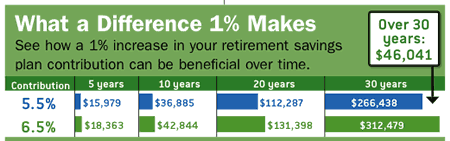
For the “average” person, this is probably not a bad idea. According to the PSCA‘s 52nd Annual Survey of Profit Sharing and 401(k) Plans, the average contribution to a retirement savings plan in 2009 was about $2,114 at a rate of only 5.5% based on a $38,428 annual salary.
Assuming yearly salary raises of 3% and a 6.3% annual rate of return, bumping up that contribution rate by just one percentage point, to 6.5%, could potentially improve savings by close to $6,000 in 10 years and more than $46,000 in 30 years. [source]
But who’s average? The NY Times brings us another pretty interactive calculator where you can input your own numbers and play around. You’ll see what would happen if you increased your savings by one percent, and also what would happen if you increased your savings by 1% every year – up to a max of putting away 16% per year.
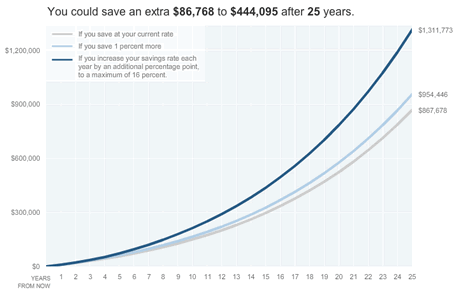
I always have to remind myself that $100,000 won’t buy nearly the same amount of stuff in 20 or 30 years. I need to check my math, but you could simply put down how much you expect your raises and investments to outpace inflation, which should provide inflation-adjusted amounts.
 The NY Times has a new series called the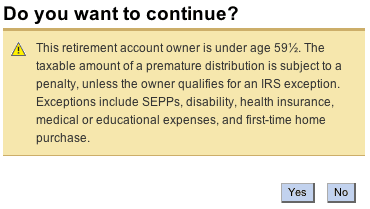
 It’s getting very close to April 15th, which in addition to tax returns is also the funding deadline for IRAs in the 2009 tax year. A reader wrote in asking whether they should dip into their savings in order to fully fund their Roth IRA contribution for the year. I would imagine this is a common scenario this time of year.
 401k company matches are great ways to boost your retirement savings, but sometimes you have to be careful in order to capture it all. My wife’s company offers a 3% match, but only up to 3% of whatever you contributed that pay period. What if you contribute less than 3% for some period, and then a much larger amount a later period, with the overall total being much more than 3%? With some plans, you are simply out of luck and have missed out on potential money. Other plans offer what is called a “catch-up” or “true-up” contribution. Do you know which one you have?
 Okay, let’s try this again. There are no longer any income phase-outs on Roth IRA conversions from Traditional IRAs. As in previous years, individuals or couples with a modified adjusted gross income (MAGI) over a certain limit are ineligible to contribute directly to a Roth IRA. In 2010, the phase-outs begin at $105,000 for single filers and $167,000 for those married filing jointly.
  Here’s the next installment of my
 The Best Credit Card Bonus Offers – 2026
 Big List of Free Stocks from Brokerage Apps
 Best Interest Rates on Cash - 2026
 Free Credit Scores x 3 + Free Credit Monitoring
 Best No Fee 0% APR Balance Transfer Offers
 Little-Known Cellular Data Plans That Can Save Big Money
 How To Haggle Your Cable or Direct TV Bill
 Big List of Free Consumer Data Reports (Credit, Rent, Work)