A Better Way To View Stock Market Risk

(alternate title: Don’t Put Your Roth IRA into CDs or Cash!)

The prospect of losing your hard-earned money is scary. You know that if you invest with $1000 in stocks, in a year you could be left with either a huge gain or a huge loss. People (including me in the past) tend to look at the stock market like a slot machine:
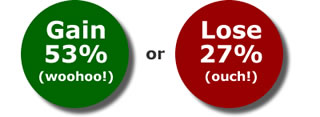
Wrong Outlook

This is good in that, yes, for the short-term the stock market is risky. Don’t put money you may need right away into stocks. However, when young people tell me that they are putting their Roth IRAs in a bank CD because they are afraid of the stock market, that is bad. Roth IRAs are long-term investments. We’re talking 30, 40, 60 years for some people! The way you should be looking at the stock market is this:
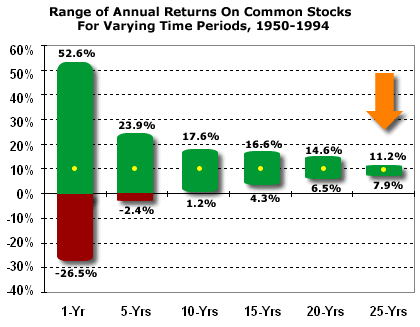

Correct Outlook

[Read more…]

Target Retirement Mutual Funds: T. Rowe Price vs. Vanguard

T. Rowe Price vs. Vanguard

Target-dated retirement mutual funds are getting more and more popular, offering instant diversification into stocks and bonds, as well as automatically shift to a more conservative blend as you near your target retirement date. An all in one fund! Whenever you see a finance article talk about the “best” of these mutual funds, invariably Vanguard and T. Rowe Price top the list. Recently, Kiplinger’s Personal Finance magazine named T. Rowe Price “the best Target fund available”. I’ve been meaning to do my own personal (and imperfect) comparison for a while now.

What makes a fund good?
First, why am I picking these two to compare? If you’ve read the books on my reading list, you’ll know that history and research has shown that the two most important factors that predict long-term performance are:

  1. Asset class – What is the fund invested in? Large-cap domestic stocks? Short-term bonds?
  2. Expense ratio – How much is the mutual fund company charging for its services?

Vanguard founder John Bogle sums it up well:
[Read more…]

Index Mutual Funds or Index ETFs: Which Is Better?

Ever since exchange-traded funds became popular, many index fund investors have taken notice. Should we try to take advantage of the often-lower expense ratios? Can we overcome the commissions from trading? For example, both of these track the S&P 500 index:

IVV – iShares ETF, expense ratio of 0.10%
VFINX – Vanguard Mutual Fund, expense ratio of 0.18%

I just ran across this article at IndexUniverse.com, which compares the performance of mutual funds vs. ETFs for various indexes.

The general conclusion was that the main ETF for an index outperforms the average mutual fund tracking the same index. However, if you choose the Vanguard fund version, you will get very similar or sometimes even better performance due to their superior index management. [Read more…]

First-Time Home buyers, IRA Withdrawals, and Penalties

The IRS allows first-time home buyers to take money out of IRAs before age 59½ without penalty. Although I don’t like the idea of taking money out of retirement accounts in order to pay for a house, I still would like to know what my options are. You know, just in case. Here’s a generalized summary of what I found.

What counts as a first-time home buyer? You may be surprised to know that it just means you haven’t owned a house in the previous two years. It has to be used to buy a person’s principal residence, but you could simply be a relative of that person and still qualify.

Traditional IRA Withdrawals
As a first-time home buyer, you can take out $10,000 from a Traditional IRA without the usual 10% early withdrawal penalty. It doesn’t matter if it is contributions or earnings. You’ll still have to pay any applicable income taxes, though.
[Read more…]

A Decade Of Net Worth History Revealed

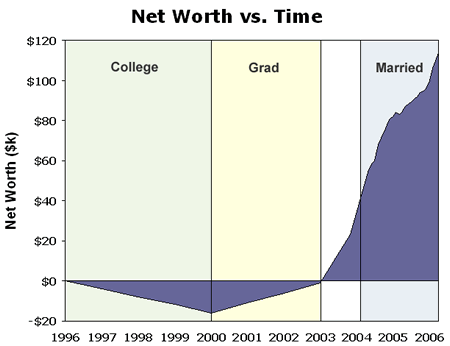
Net Worth vs. Time

A voyeuristic blow-by-blow after the jump…
[Read more…]

Roth IRAs For Everyone!

Back in May, legislation was passed that allows Traditional IRAs to be converted to Roth IRAs without any income restrictions in 2010. Previously, this conversion was only available to taxpayers with adjusted gross incomes of $100,000 or less, no matter if you’re married or single. You even get two years to pay the taxes on the conversion. One of the more detailed articles I’ve seen written about this change is this USA Today article.

Another side effect of this new law is that it opens up a gaping loophole so that allows anyone to contribute to an Roth IRA, albeit indirectly:
[Read more…]

Am I Putting Too Much Away For Retirement?

credit to ??After reading my most recent net worth update, some of you must be wondering why I’m putting so much money into retirement accounts like 401k’s and IRAs, especially given my mid-term goal of buying a house in a year or so. I mean, I can’t touch this money until I’m almost 60 without penalty, right? And we’ll need some taxable funds to draw from if we want to retire earlier than that. What’s up?

My reasoning is that I’m looking ahead to the future where both my wife and I will most likely earn six-figure incomes. Because I want to keep our lifestyle simple and reach our long-term goal of an early retirement, we’ll easily be maxing out all the tax-advantaged accounts available to us then, so I want to stick as much into these accounts as possible now.
[Read more…]

October 2006 Investment Portfolio Snapshot

Here is another snapshot of my retirement portfolio as of market close 10/7. As indicated in my previous snapshot, I simultaneously sold ~$10,000 of iShares S&P 500 Index ETF (IVV) and contributed $10,000 to my Solo 401k, which I used to buy Fidelity Total Stock Market Index Fund (FSTMX).

[Read more…]

Estimating Future Investment Returns: 30-Year Forecast

It’s very hard to estimate exactly how much we’ll have to save for retirement, as that would require knowing how much our investments will grow in the future. Even if we try to do long-term trends, this can be difficult. But Richard Ferri, author of All About Asset Allocation and founder of Portfolio Solutions, LLC has done his best by layering risk premiums to estimate market returns. You can find the article for free online – ‘Portfolio Solutions 30-year Market Forecast’. An excerpt:

At the end of each year, we analyzed several economic and market risk factors including Federal Reserve forecasts, inflation forecasts derived from inflation protected securities, and the volatility of asset classes, styles, and categories. From that data, we developed estimates for longterm future returns.

Here are some of the results:
[Read more…]

FundAdvice.com and Portfolio Tweaking

Spent some time this weekend reading many of the articles at FundAdvice.com. The website is the educational arm of Merriman Capital Management, an investment management firm that is heavily into DFA funds. They promote no-load, asset-specific, low-cost funds (which often end up as index funds), and have a lot of interesting things to say on both active and passive investing.

I naturally gravitated towards the passive investing articles, and favorite article so far is ‘The ultimate buy-and-hold strategy’, which agrees with why I want to slice-and-dice my portfolio. I was also intrigued by their ideas for investors with small portfolios. Instead of picking an all-in-one fund or a cash fund until you have enough to invest, they advise you to pick the asset class with the most potential return but highest volatility (U.S. small-cap value to begin with) and build upwards.
[Read more…]

Work For A Big Company? Read a Review of Your 401(k) Plan

Do you work for a large government entity or corporation? Are you looking for an independent review of your company’s 401k plan or maybe some investment suggestions? I just ran across 401khelp.com, which does just that for a large list of companies, including for example Bank of America, Boeing, ChevronTexaco, Cingular Wireless, Cisco Systems, Citigroup, Costco, Dow Chemical, General Motors, Hewlett Packard, Home Depot, Honeywell, IBM, Microsoft, Nike, and the U.S. Government.

I wouldn’t follow their fund suggestions blindly, but it’s something to consider. They do seem to promote low-cost index funds overall, but also like some actively managed ones as well. This is part of a larger site, FundAdvice.com, which I’m still perusing. I am intrigued by their suggested portfolios, especially their Vanguard ones since it’s close to my portfolio, but I haven’t entirely figured out their philosophy behind them yet.

Finding a Good Self-Employed Solo 401k Administrator

As I’ve mentioned in my SEP IRA versus Solo 401(k) comparison, the problem with the additional paperwork involved with a 401(k) is that you have to find an administrator that is willing to do it for you at minimal cost. Compare that with the SEP-IRA, you can usually walk up to many brokers, open up an account, and start trading anything with no annual fees and just commissions.

For example, I opened up my SEP-IRA last year with Vanguard, but I can’t open up a Self-Employed 401(k) with them directly as they won’t be my administrator. The only option I found was to go through a third-party administrator like 401kBrokers, which charges an annual maintenance fee of 0.25% of the account balance. I think the fees are pretty fair considering there is no setup fee or other annual fees, but I still don’t want to pay them if I don’t have to.
[Read more…]