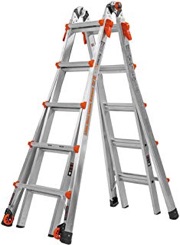
 Building a “CD ladder” means funding a combination of certificates of deposit (CDs) with different maturities so that you have always have a portion of your funds maturing soon (providing liquidity) but you also increase your interest rates (more $$$). Here are two common CD ladder types:
- 2 Year Ladder: Four maturity “rungs” – 6-month, 12-month, 18-month, and 24-month CDs
- 5 year Ladder: Five maturity “rungs” – 1, 2 ,3 ,4, and 5-year CDs
You start out by funding a CD for each rung (i.e. a $5,000, 5-year ladder would have $1,000 in each maturity). Then, after a year, you can keep the ladder going by buying another rung at the longest maturity (i.e. the 5-year ladder would buy another $1,000 5-year CD after one year has passed).
Fidelity has a CD ladder service where they will build a CD automatically for you using brokered CDs from their inventory. They will even re-invest, or “Auto Roll”, your maturing funds into a new rung if you wish. The service itself is free, but the CD rates aren’t necessarily the absolute highest available, especially when you include credit unions.

Alternatively, you could move around your own funds and build your own ladder (DIY) using certificates from various banks and credit unions. Finally, you could also buy Treasury bill and bonds of similar maturities, as they are also backed by the government so you can be confident that you’ll get your principal back.
I decided to run a quick survey today (February 13, 2019) to see what your average interest rates would be for the three different methods:
- Fidelity Auto – Fidelity will construct using the highest rates in their brokered CD inventory.
- DIY – Picking the highest rate at any FDIC or NCUA-insured institution that is open to anyone nationwide.
- Treasury – Buying individual Treasury bonds on the secondary market (bond desk, alternative rates).

(Fidelity CDs were issued by State Bank of India, Morgan Stanley, and Goldman Sachs. DIY banks used in this comparison are Ally Bank/Limelight Bank, NASA FCU, and Georgia Banking Company. Rates as of 2/13/19.)
The chart shows that currently DIY you would gain an average of 0.40% annually on your cash invested over the automatic Fidelity service. If you had a $5,000 ladder, that would be $20 in extra interest per year. If you had a $50,000 ladder, that would be $200 a year. If you had a $500,000 ladder, that would be $2,000 a year. You would have to balance the extra work of DIY with the added convenience of the Fidelity service. This number is only a snapshot and will change over time.
Right now, Treasury bonds don’t really offer much of a premium above the top DIY CD rates in this scenario. Even if you had state income tax of 10%, your effective average APY would still only be about 2.8%. That is about break-even with the Fidelity automatic service.
This is one reason why I track the top CD interest rates each month.
 I recently joined the
 Here’s my monthly roundup of the best interest rates on cash for February 2019, roughly sorted from shortest to longest maturities. Check out my
  The
The 



 The Best Credit Card Bonus Offers – 2026
 Big List of Free Stocks from Brokerage Apps
 Best Interest Rates on Cash - 2026
 Free Credit Scores x 3 + Free Credit Monitoring
 Best No Fee 0% APR Balance Transfer Offers
 Little-Known Cellular Data Plans That Can Save Big Money
 How To Haggle Your Cable or Direct TV Bill
 Big List of Free Consumer Data Reports (Credit, Rent, Work)