You’ve probably seen commercials for a service called LifeLock, which offers identity theft protection services ranging from $10 to $30 a month. After a $12 million settlement with the FTC over deceptive marketing practices, they are again in trouble with the FTC over… their deceptive marketing practices. The main problem that I have with this service is that they are charging you for things you could do yourself, and often you will have to do it yourself even if you pay them.
Here’s what they used to say:
First, we ask the credit bureaus to set fraud alerts on your behalf. Usually, this is done through our automated systems and the alerts are set within an hour. From time to time there may be a hitch and we have to do the first one manually, usually because they have a different address on file for you. If this happens, we’ll tell you right away and do what needs to be done to get the alerts set.
Since then, I believe the credit bureaus have gotten angry at Lifelock (making money off of your data is their job!) and now you have to set the credit freezes yourself.
Free – Just call the numbers below. Technically, alerting any single bureau should automatically initiate fraud alerts on all of them, but it may be more reliable to simply call each one separately.
* Equifax: 800-685-1111; Fraud Dept. 800-525-6285
* Experian: 888-397-3742 (same for Fraud Dept.)
* Trans Union: 800-916-8800; Fraud Dept. 800-680-7289
I should note that this will also hinder your ability to get quick approvals for things like auto loans or credit card applications. One good tip is to use your cell phone as the contact number so that the bureaus can quickly verify your identity when you really do want to apply for credit.
Second, unless your circumstances change and you tell us not to, every 90 days or so we ask the credit bureaus to do it again.
Free – Use Google Calendar (also free) to e-mail you a reminder to call again in 90 days. Rinse and repeat.
Third, we request that your name be removed from pre-approved credit card and junk mail lists and we keep making the requests as they expire. Statistics show that this is one of the most common ways that thieves hijack identities. Plus, all that mail is just so irritating. Many of our clients tell us that this alone is worth the price.
Free – Just go to OptOutPrescreen.com to get removed for 5 years. I’m probably in the minority here, but I kind of like getting pre-approved offers myself, it helps me track trends in interest rates, special offers, and gives me an idea of how good my credit score is.
Fourth, we order your free credit reports on your behalf from the major credit bureaus and they are sent directly to you. We do this every year.
Free – Yet another feature that is free to all by the Fair Credit Reporting Act, and can be found at AnnualCreditReport.com. In fact, here are 4 more ways to get a free credit report. One of them is simply placing a fraud alert as described about. If you keep setting one up every 90 days, you can technically get a total of 15 free reports every year (3 credit bureaus x 5 each).
Last, but certainly not least: If your Identity is stolen while you are our client, we?re going to do whatever it takes to recover your good name. If you need lawyers, we?re going to hire the best we can find. If you need investigators, accountants, case managers, whatever, they?re yours. If you lose money as a result of the theft, we?re going to give it back to you. We will do whatever it takes to help you recover your good name and we will spend up to $1,000,000 to do it.
Not free. But, you can get lower levels of identity theft protection for free at various financial institutions like your local credit union or at many major banks, just for having an account with them.
So, is the convenience of LifeLock, as well their $1 million dollar insurance policy worth $110-120 a year? My vote is no. Although I’m sure that identity theft can be very painful and costly, if you really did all the free things above your chances of being affected are very slim. The time saved is minimal and the “million dollar guarantee” seems to be overkill and more of a marketing ploy. If anything, I’d use the money to go buy a good paper shredder instead.
 I had written previously about
  MSN Money recently wrote a new article titled
  You’ve probably heard that the average American has over $8,000 of credit card debt. It’s been quoted all over the place. But does that single stat accurately explain the whole picture?
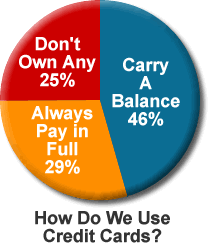 Another source of information is the Federal Reserve’s Survey of Consumer Finances (SCF). Here, the 2004 survey found that the average (mean) balance for those carrying a balance was $5,100, but the median was only $2,200. The large difference between the mean and median values indicates that the debt is not spread around equally – a small amount of borrowers have the majority of the debt. In addition, only 46% of families actually carried a balance, and 25% of families don’t even have any credit cards at all.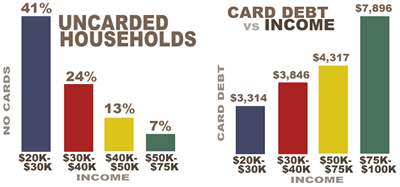
 You have bad credit. You want to buy a house. Why bother with such old-fashioned ideas like paying off debts and slowly building back your credit? You want that McMansion now! All those other sub-prime defaults are just crimping your style. Well, now you can simply buy good credit! Or more accurately, rent it.
 I just redeemed a bunch of ThankYou points and I think I got some great rewards for doing things I would have done anyways. Consider this:
 The Best Credit Card Bonus Offers – 2026
 Big List of Free Stocks from Brokerage Apps
 Best Interest Rates on Cash - 2026
 Free Credit Scores x 3 + Free Credit Monitoring
 Best No Fee 0% APR Balance Transfer Offers
 Little-Known Cellular Data Plans That Can Save Big Money
 How To Haggle Your Cable or Direct TV Bill
 Big List of Free Consumer Data Reports (Credit, Rent, Work)