 Updated May 2022. Vanguard regularly announces expense ratio cuts to their mutual funds and ETFs. This post serves to keep track of these updates, as Vanguard usually removes the press releases after a certain amount of time. Most changes will be minor, it is always good to see continuing progress.
April 29, 2022 press release. Highlights:
- Vanguard Total US Bond Market ETF (BND) lowered to 0.03%.
- Vanguard Short-Term Bond ETF (BSV) lowered to 0.04%.
- Vanguard Intermediate-Term Bond ETF (BIV) lowered to 0.04%.
- Vanguard Long-Term Bond ETF (BLV) lowered to 0.04%.
- Vanguard Total International Stock Market (VXUS) lowered to 0.07%.
- Vanguard Total World Stock ETF (VT) lowered to 0.07%.
- Vanguard FTSE Emerging Markets ETF (VWO) lowered to 0.08%.
- Vanguard Total International Bond ETF (BNDX) lowered to 0.07%.
- Vanguard FTSE All-World ex-US ETF (VEU) lowered to 0.07%.
- Vanguard FTSE All-World ex-US Small-Cap ETF (VSS) lowered to 0.07%.
Vanguard Select ETFs. These 13 Vanguard Select ETFs are what Vanguard thinks should be the building blocks of your portfolio due to their diversification, low costs, and liquidity. Here are the current expense ratios on the four broadest ones + their classic S&P 500 ETF:
- Vanguard Total US Stock Market (VTI) at 0.03%.
- Vanguard Total International Stock Market (VXUS) at 0.07%.
- Vanguard Total US Bond Market (BND) at 0.03%.
- Vanguard Total International Bond (BNDX) at 0.07%.
- Vanguard 500 Index (VOO) at 0.03%.
Background. When you invest in a mutual fund or ETF, the fund company charges you a fee called the annual net expense ratio. If you hold a steady $10,000 in a hypothetical fund with a 1% expense ratio, that would result in an annual charge of $100. These expenses are actually deducted daily in tiny increments from the funds’ net asset value (NAV), and while the numbers can seem small initially they will compound quietly and relentlessly over time. Here is an illustration from the Vanguard website comparing the Vanguard average expense ratio vs. the industry average over different time periods (source):

Vanguard has a long history of lowering their expense ratios as their assets under management grow, whereas the industry average hasn’t changed nearly as much (source).


The Vanguard Effect. In recent years as index funds have shot up in popularity, most of the major providers have introduced similar low-cost products (notably iShares, Fidelity, and Schwab). Every subsequent “price drop” is less newsworthy or impactful to my portfolio. However, I think competition is great and even Vanguard needs to be kept on its toes. I have bought ETFs from other providers when they are the best available option.
However, you can’t ignore the fact that Vanguard has been the leader in the industry. The super-low-cost ETFs only exist where Vanguard has already established itself. If Vanguard hasn’t pushed the cost down in a specific area, their competitors know that and keep the costs high. Here’s a chart showing the “Vanguard Effect“.
Due to the combination of Vanguard’s excellent ETFs and their not-as-excellent customer service recently, you may want to consider buying Vanguard ETFs for free at your preferred brokerage firm including Fidelity, Schwab, TD Ameritrade, and E-Trade.
 Inflation (and thus I Bonds) 🚀🚀🚀! Savings I Bonds are a unique, low-risk investment backed by the US Treasury that pay out a variable interest rate linked to inflation. With a holding period from 12 months to 30 years, you could own them as an alternative to bank certificates of deposit (they are liquid after 12 months) or bonds in your portfolio.
  I’m going to wait a bit on my full May interest rate update, as I expect more rate changes early this week. Even the rates quoted below may become outdated quickly, but I wanted to point out certain rates at multi-year highs and also near the psychological 3% level. Here are a few examples as of 5/1/22:
 This is a bit of an “inside baseball” topic appealing only to serious DIY investors, but I found this FT article about
  Vanguard is based right outside of Philadelphia, so the Philadelphia Inquirer often provides helpful insights on the company. Their new article
 The 2022 Berkshire Hathaway Annual Shareholder Meeting will be held

 I had to double-check the date when I received the press release for this product to make sure it wasn’t April 1st. 🤯


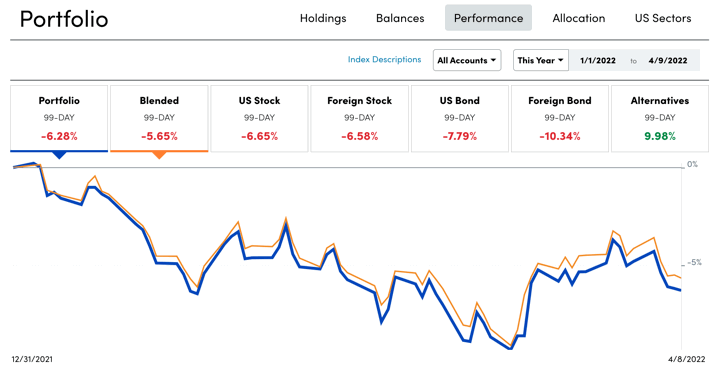
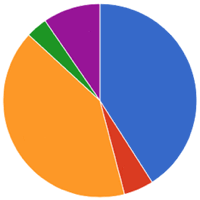 Here’s my quarterly update on my current investment holdings as of 4/8/22, including our 401k/403b/IRAs and taxable brokerage accounts but excluding a side portfolio of self-directed investments. Following the concept of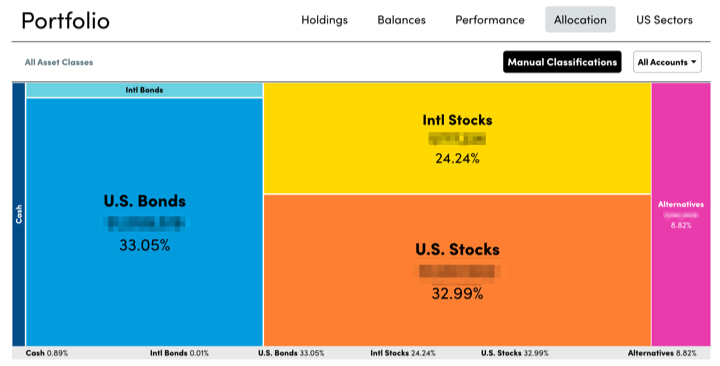
 The Best Credit Card Bonus Offers – 2026
 Big List of Free Stocks from Brokerage Apps
 Best Interest Rates on Cash - 2026
 Free Credit Scores x 3 + Free Credit Monitoring
 Best No Fee 0% APR Balance Transfer Offers
 Little-Known Cellular Data Plans That Can Save Big Money
 How To Haggle Your Cable or Direct TV Bill
 Big List of Free Consumer Data Reports (Credit, Rent, Work)