 The official IRA contribution deadline for Tax Year 2021 is April 15th, 2022. However, I choose to use April 15th as the informal deadline for my same-year IRA contributions (Tax Year 2022). By around April 1st, I have usually finished filing my income taxes and thus have handled any expected tax bills. I also have the first quarter of dividends arrive in my brokerage accounts, so I also have funds ready to re-invest. The optimal time would actually be make my contributions on January 1st, but sometimes we just have to settle for “good enough”.
If your Modified Adjusted Gross Income (MAGI) exceeds the limits for a direct Roth IRA contribution ($144,000 for singles and $214,000 for married filing joint for tax year 2022), you may still be eligible for the “Backdoor” Roth IRA. Christine Benz of Morningstar has a excellent summary of Backdoor Roth IRA concerns.
A backdoor Roth is simple enough and should be tax-free in many cases. An investor who earns too much to make a direct Roth IRA contribution simply opens a traditional nondeductible IRA–available to investors regardless of income level. Shortly thereafter–and here’s where the backdoor part comes in–he converts it to a Roth IRA, another move unrestricted by income limits. Assuming he has no other IRA assets, the only taxes due on the conversion would be any appreciation in the investments since he opened the account. That taxable amount should be limited, assuming he converts the money promptly and/or leaves the money in cash until the conversion is finalized.
Here’s my even-shorter version of the tips:
- First, check if you have other pre-tax traditional IRA assets such as a rollover IRA. Converting to a Roth IRA may subject these assets to taxes on a pro-rated basis.
- Get rid of these pre-tax IRAs, if possible, by rolling them into an employer 401(k), 403(b), or 457 plan instead. Self-employed business owners can also roll into a Solo 401k.
- Contribute and then convert to Roth quickly. Make the non-deductible Traditional IRA contribution, invest for a day or two in cash, and then quickly convert to Roth. The IRS has clarified that no waiting period is required, making it better to do it right away to avoid any tax complications.
- Repeat at the beginning of every year. Just keep doing it every year, as soon as you can, and build up that precious Roth IRA balance that can grow tax-free forever with no required minimum distributions. Ignore news about the option “maybe” going away until it actually goes away.
Here’s our simple three-day process at Vanguard.
Day one: Make non-deductible contribution to a Traditional IRA account. You could fund in various ways, I exchanged from funds within my Vanguard taxable brokerage account. Just put it in Vanguard Federal Money Market temporarily.

Day two: Go to “Balances & Holdings” page and find the “Convert to Roth IRA” link. Complete required steps.

Day three: Your traditional IRA balance is now $0. Invest the funds that are now in your Roth IRA. In this case, I would have a taxable gain of just $0.03, which simply rounds to zero.
Note: There is still some debate about how much time should pass between the non-deductible Traditional IRA contribution and the Roth conversion. Some people believe that the 2017 Tax Cuts and Jobs Act (TCJA) officially signaled acceptance of this move. Others still want you to wait either for a monthly statement or even a full year in between the steps. I’m not a tax attorney and this is not tax advice. This is just what I did and I don’t lose any sleep over it.




 Here’s my monthly roundup of the best interest rates on cash as of March 2022, roughly sorted from shortest to longest maturities. I look for lesser-known opportunities available to individuals while still keeping your principal FDIC-insured or equivalent. I use this information for both my cash reserves and as possible bond substitutes. Check out my
  WeBull 12 Free Fractional Stocks Offer
 SoFi Invest Free $25 in Stock Offer
 TradeUP Free Stocks Offer
 Public Free Stock Offer
 Robinhood Free Stock Offer
 One of the perpetual debates in retirement planning circles is withdrawal rates, AKA how much monthly income can you take from a portfolio. Once you nail down a withdrawal rate and retirement spending target, then you get Your Number – how much you need to have saved to retire (after backing out Social Security and other income streams). It’s common to start with the static 4% rule, but that rule also includes some drawbacks. An alternative is a flexible withdrawal rule that adjusts based on market returns. When your portfolio grows, you can spend a little more. If it shrinks, you cut back a little. Sounds reasonable, right?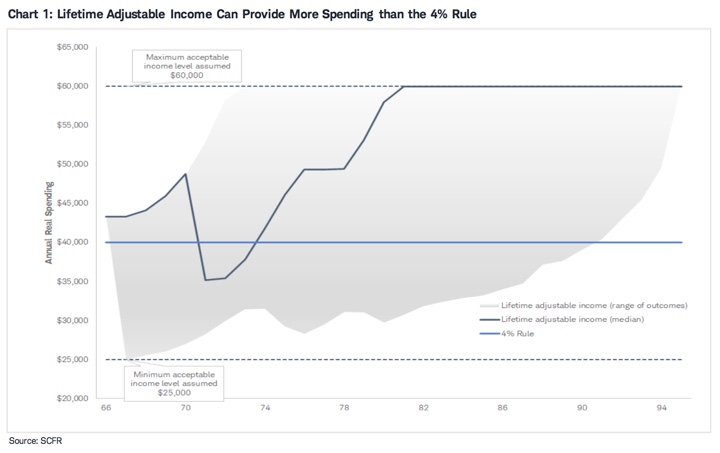



 The Best Credit Card Bonus Offers – 2026
 Big List of Free Stocks from Brokerage Apps
 Best Interest Rates on Cash - 2026
 Free Credit Scores x 3 + Free Credit Monitoring
 Best No Fee 0% APR Balance Transfer Offers
 Little-Known Cellular Data Plans That Can Save Big Money
 How To Haggle Your Cable or Direct TV Bill
 Big List of Free Consumer Data Reports (Credit, Rent, Work)