
I’ve invested over $50,000 of my “alternative” money into PeerStreet real estate notes because of the ability to diversify into 50+ different high-interest loans backed by physical real estate. Here is a case study of a commercial property loan where Peerstreet negotiated an exit when it was already very deep into the foreclosure process. You can find additional case study links and the most recent update to my overall portfolio performance in my Peerstreet review.

Initial investment details.
- Property: Commercial property in New Jersey.
- Target Net Investor Rate/Term: 9.25% APR for 17 months.
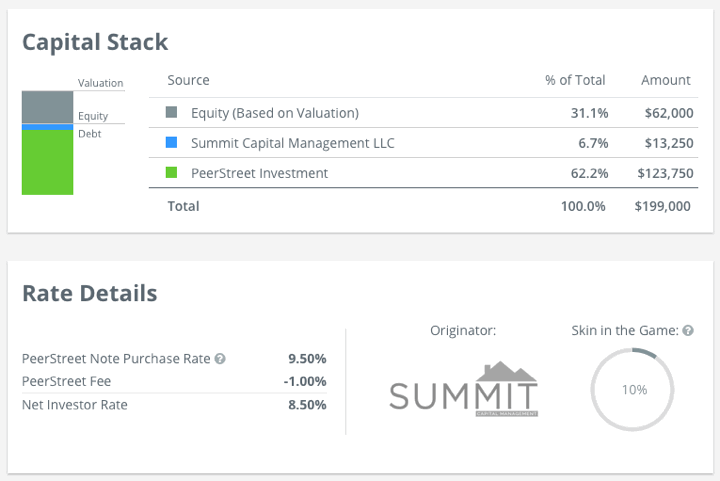
- Amount invested: $1,133 out of $1,700,000 loan.
- Appraised at $4M = 43% LTV.
- Loan secured by the property in first position.
- Bridge loan to redevelop into a 179-unit apartment building.
Timeline.
- May 2018. Loaned out $1,133, my share of $1,700,000 total.
- June 2018. One single interest payment was made.
- August 2018. No more payments.
- September 2018. Legal notices sent.
- November 2018. PeerStreet and the borrower agree to a forbearance agreement. The terms of the forbearance include, the borrower paying $8,500 and in return, PeerStreet will not file the foreclosure complaint until the end of November. The borrower states that they are in the process of refinancing the loan.
- December 2018. The forbearance agreement has expired and the borrower has not cured or paid off their loan. The loan file has been sent to a local law firm to initiate legal proceedings against the borrower. Foreclosure counsel filed the foreclosure complaint on December 13, 2018. The complaint has been sent out for service.
- February 2019. All parties have been Served. Once the time to answer expires, we will move for defaults.
- June 2019. Foreclosure counsel filed the final judgment package and are waiting on the court to enter the same. Judgment should be entered in the next 3 to 6 weeks
- July 2019. The foreclosure process continues and PeerStreet is in negotiations to sell the note back to the lender. On 7/31/2019, PeerStreet provided the originating lender with an updated payoff statement as repurchase discussions continue. PeerStreet continues to wait for the Court’s ruling on its Motion for Final Judgment in the foreclosure.
- September 2019. The Escrow Agent advised that it has received the bulk of the funds for the repurchase of the loan at $1,850,000.00.
- October 2019. PeerStreet has completed its sale of the note, and final proceeds have been distributed to investors. Proceeds from the sale were $1,815,227, net of costs and fees associated with the foreclosure. The cash-on-cash return on this investment, after taking into account interest and fees paid to investors, was positive at 107.7%.
Final numbers. I invested $1,113 in May 2018 and got paid $87.52 of interest and $1,113 of principal for a total of $1,265.27 as of October 2019. (This was an automated reinvestment which included whatever cash was in my account, thus the odd numbers.) This works out to a 7.86% total return over 17 months, which is roughly a 5.5% annualized return. My overall annualized return across my entire portfolio is 7.3%. These numbers are net of all PeerStreet fees.
My commentary. This loan is an example of Peerstreet negotiating a settlement, in this case getting my principal back and even a a small positive return. This loan was initially concerning because the lender made a single payment and then stopped. While you have collateral, if the loan goes into default, it takes a very, very long time to seize and sell that collateral. This is why you need to diversify your notes and never invest money you need anytime soon.
I can only assume that Peerstreet negotiated with the lender here because they just didn’t want it to drag out any further. They might have gotten more money if they foreclosed, but they would also have had to finish the foreclosure, prep it for sale, market it, and then wait for a sale of the property. The lender still took advantage of the situation, as they basically didn’t have to pay any interest for 17 months and then they ended up paying less interest than they initially promised. The borrower also likely had a bad mark on their credit report, which should hurt their ability to get future loans.
I’ve read many reviews of real estate crowdfunding sites done by new investors who haven’t had the chance to experience how it all works out. Some are overly positive because they haven’t had any late payments yet, while others are too negative because they have some really late loans and assume the worst. With Peerstreet, both of my loans that went “bad” took over a year to sort out, but in the end they had positive returns. Of course, that is not always the case and I have lost some principal on a single note from another now-defunct real estate site.
Bottom line. Out of the $50,000+ I’ve now invested into 51 loans at PeerStreet over 3+ years, 48 were paid back in full in a timely manner, while three have reached various stages of the foreclosure process. This is one example where we went pretty deep into the foreclosure process, but PeerStreet negotiated directly with the borrower to settle the debt and thus avoided another several months of waiting and selling the property. The annualized return for this loan was 5.5%, while my overall annualized return across my entire portfolio is 7.3%.
If you are interested, you can sign up and browse investments at PeerStreet for free before depositing any funds or making any investments. You must qualify as an accredited investor (either via income or net worth) to invest. If you already invest with them, they now sync with Mint.com.
 Home ownership continues to be a goal for many people, but downpayment requirements also keep rising with housing prices. I previously posted about
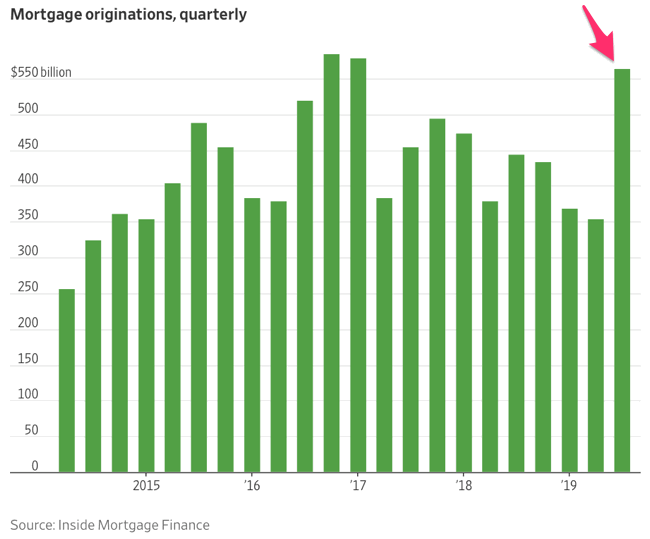
 If you have a mortgage rate above 4%, you should keep an eye on mortgage rates during August to see if there is an opportunity to refinance and save money. (Potential buyers should obviously also take notice, but they were probably paying attention already.) In November 2018, the average 30-year mortgage rate was nearly 5%. In July, the average 30-year mortgage rate was only 3.75%. There are a LOT of outstanding mortgages that become good opportunities for a refinance with even small drops from here. See this chart via











 The Best Credit Card Bonus Offers – 2026
 Big List of Free Stocks from Brokerage Apps
 Best Interest Rates on Cash - 2026
 Free Credit Scores x 3 + Free Credit Monitoring
 Best No Fee 0% APR Balance Transfer Offers
 Little-Known Cellular Data Plans That Can Save Big Money
 How To Haggle Your Cable or Direct TV Bill
 Big List of Free Consumer Data Reports (Credit, Rent, Work)