Why the interest in 401k limits? Well, we found out that my wife now gets a company match to her 403b retirement plan. Score! I then wanted to explore how to maximize both our $16,500 401k limits and the company match.
Example: Maxing Out But Missing Out Too
You make $120,000 per year and get a full 3% company match during each pay period. Let’s just say you get paid $10,000 gross monthly. However, you are a really motivated saver and can defer 20% of your income each month into the 401k.
For the first 8 months of the year, you put away $2,000 (20% of $10,000) and the company matches $300 (3% of $10,000). That’s brings you to $16,000 in salary deferrals. On the 9th month you can only contribute $500, which the company also matches $300 again. On the remaining 3 months of the year, you can’t contribute at all, so there is nothing to match! Even though you contributed significantly more than 3% of your salary, you’ll miss out on $300 x 3 = $900 of free money.
Solutions and Potential Problems
The solution is usually given to space out your salary deferrals evenly throughout the remainder of the year. For the above example, you would divide $16,500 by 12 = $1375 each month. If you can only set percentages, you’d set aside 13.75% each month ($1,375 / $10,000).
The problem with this is that for those people who earn hourly wages, overtime, or bonuses, it can be hard to synchronize. Get paid too much, and you’ll lose match again. Get paid too little, and you might max out your match, but not fully reach the $16,500 limit. Also, if you quit or are laid off before the end of the year, you might not be able to reach the limits either.
My tweaked solution. I would vary the percentage so that you always contribute at least 3% each pay period the entire year, but otherwise front-load contributions early on. Again with the example, you could set aside the $2,000 per month for 6 months, and then put in $750 per month for 6 months. Percentage-wise, this is 20% for first half the year, and then 7.5% for the last half. This way, you are balancing getting your annual limit maxed out as closely as possible, along with getting all the available match.
True-Up Contributions
But before going too far, you should ask your benefits administrator whether they offer what is called “true-up” contributions. What this does is compare your year-to-date (YTD) contributions to your YTD salary. If you contributed at least 3% of your YTD salary, but did not receive a 3% company match, then they will send in an additional contribution to “true-up” the numbers.
Some companies perform this true-up calculation after every pay period, while others wait until the end of each year. If they true-up every pay period, then it would seem to be a good idea to contribute as much as you can as early as you can – you’ll get the full year’s match early this way.
Our company does one true-up after the end of the year, and the credit doesn’t show up until March. However, I was also told that if you aren’t employed in March, you won’t get this credit. So again, the front-load with minimum method might be the best idea to get your match as it comes available.
As I write this, I realize that I really overthink some of this stuff. What can I say, I’m excited about our new match, and I just can’t help myself!
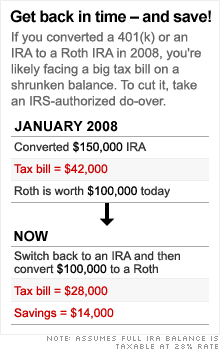
 So you listened to the financial experts and dutifully contributed $5,000 to your Roth IRA in early 2008. Unfortunately, stuff hit the fan and now you’re left with a lot less. Wouldn’t it be nice to be able to find some silver lining and shield another ~$1,000 plus earnings from taxes forever?


 The Best Credit Card Bonus Offers – 2026
 Big List of Free Stocks from Brokerage Apps
 Best Interest Rates on Cash - 2026
 Free Credit Scores x 3 + Free Credit Monitoring
 Best No Fee 0% APR Balance Transfer Offers
 Little-Known Cellular Data Plans That Can Save Big Money
 How To Haggle Your Cable or Direct TV Bill
 Big List of Free Consumer Data Reports (Credit, Rent, Work)