In a CNN Money article titled “Got enough to retire? Think again”, I actually found the opposite.
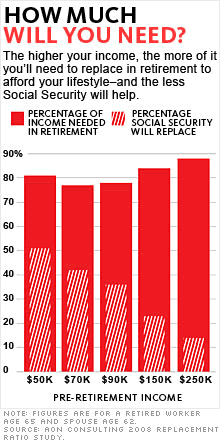
The main point of the article is that you may need to replace a lot more than just 70-80% of your pre-retirement income after you stop working.
Here’s the chart of average replacement rates from an Aon study:
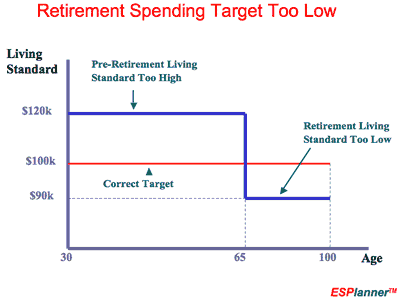
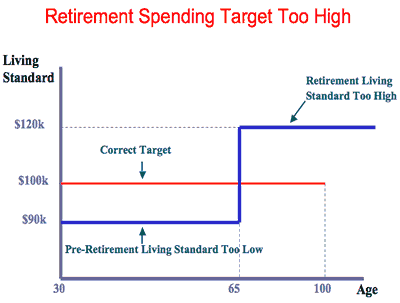
However, I am agreeing with the authors of Spend Til The End on this one – using replacement rates and averages for this sort of thing is dangerous. One should always look at their own unique situation. It’s you, isn’t it? For example, I don’t see why a household earning $100k or even $500k a year can’t get by on spending $40k per year, especially if their mortgage is paid off.
But after looking at the chart some more, something else caught my eye.
Let’s just say that your spending in retirement requires income of $40,000 per year. This is the same as assumed for a household earning $50,000 pre-retirement according to the study. Even though we earn more than that, I know that we can easily run on $40k per year outside of housing costs.
The graphic suggest that 50% of that, or $25,000 per year, will be covered by Social Security. That only leaves $15,000 per year to be covered by your pension or investment portfolio. Assuming no pension and a 4% withdrawal rate, that means you would need a nest egg of $375,000 in today’s dollars. That is much less than the multi-million dollar figures usually being thrown around.
Now, how much would you need to save to get that $375k? If you save $5,000 inflation-adjusted dollars per year, and they earn a 4% annual real (above inflation) return, every year for 35 years – you’d end up with a little over $380,000. In essence, you’d just have to max out your Roth IRA each year and call it a day. (The contribution limit is $5,000 this year, but the cap rises with inflation.)
Of course, this is all rough numbers and you’ll still have to work until the full Social Security retirement age. Most young people like myself are skeptical of Social Security, but I have come to believe that SS will be with us for a long time – it is just too critical a piece of the retirement puzzle for much of America. And hey, the solution to any underfunding – as always – is simple: tax the high-income earners more!
 I just finished reading the book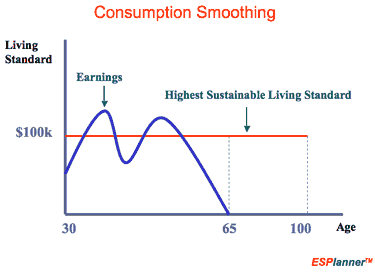

 The Best Credit Card Bonus Offers – 2026
 Big List of Free Stocks from Brokerage Apps
 Best Interest Rates on Cash - 2026
 Free Credit Scores x 3 + Free Credit Monitoring
 Best No Fee 0% APR Balance Transfer Offers
 Little-Known Cellular Data Plans That Can Save Big Money
 How To Haggle Your Cable or Direct TV Bill
 Big List of Free Consumer Data Reports (Credit, Rent, Work)