Okay, so I view my last post on 401k loans as a failure. I tried to use as little math as possible in explaining why 401k loans are not a bad idea due to the incorrect concept of “double taxation”. Instead, I probably managed to confuse many of you all further. I have tried to come up with a better example with the math thrown back in, and think I have found one. Please give me another chance! 🙂
The Method
If double-taxation really occurs in 401k loans, that would mean that taking out such a loan somehow negates the inherent tax-advantages of the 401(k) plan. Certainly, taking a loan and paying it back would be worse than just leaving the 401(k) completely alone, right? I am going to walk slowly through three scenarios that will show that this is simply not true. The three hypothetical scenarios:
- Elton contributes $10,000 to a 401(k) and does nothing. He does not take any loans of any type. He waits a year and pays for his $10,000 wedding in cash.
- Elton contributes $10,000 to a 401(k). He then takes out a 401(k) loan of $10,000 to pay for his wedding, and then repays the $10,000 a year later using after-tax money earned from his job.
- Elton contributes $10,000 to a 401(k). He then takes out a credit card loan of $10,000 to pay for his wedding, and then repays the $10,000 a year later using after-tax money earned from his job.
Very Simple Assumptions
Annual gross salary is $20,000. Income tax is 25% of gross income. There is no interest charged on any loans, as I’m just trying to isolate the issue of double-taxation. There is no growth in the funds, either. He doesn’t need to eat or sleep, so no other expenses. 😉 (And yes, 401(k) loans are usually capped at 50% of total balances.)
The Results
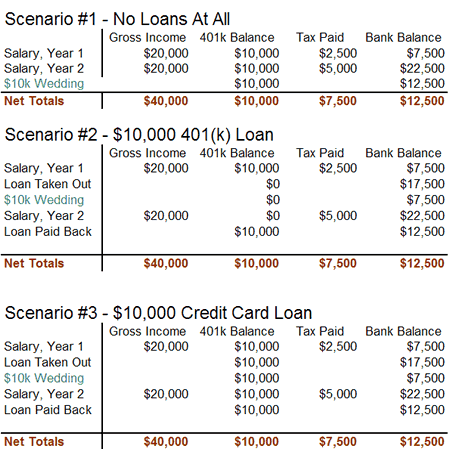
Scenario #1: No Loans
- In Year 1, Elton makes a total of $20k gross. He contributes $10k pre-tax to his 401k, and pays taxes on the remaining $10k.
- In Year 2, he again makes $20k gross and does not make any additional 401k contributions.
- He spends $10k on his wedding. The 401k stays at $10,000 the whole time.
Scenario #2: 401k Loan
- In Year 1, Elton makes a total of $20k gross. He contributes $10k pre-tax to his 401k, and pays taxes on the remaining $10k.
- He then takes a $10k 401k loan out, and puts the $10k in his bank.
- He spends $10k on his wedding, and his bank balance goes down accordingly.
- In Year 2, he again makes $20k gross and does not make any additional 401k contributions.
- Finally, he pays back the borrowed $10,000 back into his 401k using the money he earned in Year 2.
Scenario #3: Credit Card Loan
- In Year 1, Elton makes a total of $20k gross. He contributes $10k pre-tax to his 401k, and pays taxes on the remaining $10k.
- He then borrows $10k via his credit card.
- He spends $10k on his wedding.
- In Year 2, he again makes $20k gross and does not make any additional 401k contributions.
- Finally, he pays back the borrowed $10,000 back into his credit card using the money he earned in Year 2. The 401k stays at $10,000 the whole time.
Recap
In all three scenarios, the amount of taxes paid is the same, and the final result is the same. Total taxable income over two years is $30k in all 3 cases. Final taxes paid: 25% of $30k, or $7,500. You end up with a 401k with $10,000 of pre-tax money in all 3 cases. No additional taxes are paid by taking out a 401(k) loan.
It does not matter even if he spends the $10,000 borrowed and pays it back later with after-tax money! Thus, I still conclude that there is no “double-taxation” on 401k loan principal.
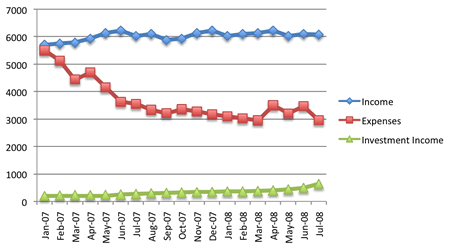
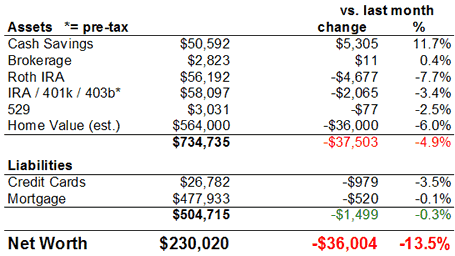
 I recently received a nice greenish pamphlet from the government, my Social Security Statement! I thought it would tell me how much to expect from them in retirement… instead it just says is that I haven’t accumulated enough work credits to get Social Security benefits. Gee, thanks… *toss*. But wait, a few recent events have shown me other ways that it can be useful.
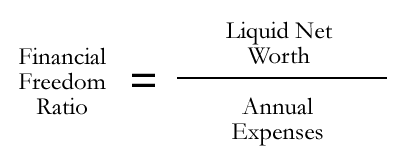
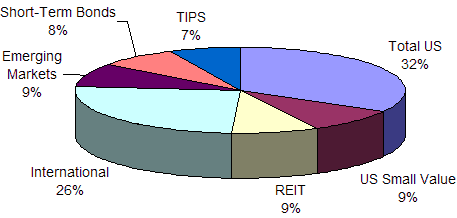
 After months of being stuck in the day-to-day issues of buying a house, moving, and work, I spent a lot of time today… daydreaming! Mainly because I am getting tired of only having 2-3 weeks of vacation per year, I went back to thinking about how early I can achieve financial freedom. Let’s say I really want to retire in 10 years by age 40. What do I need to do?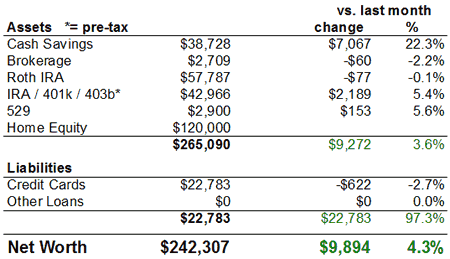
 Along with other deals that I blog about, this helps me earn
 The Best Credit Card Bonus Offers – 2026
 Big List of Free Stocks from Brokerage Apps
 Best Interest Rates on Cash - 2026
 Free Credit Scores x 3 + Free Credit Monitoring
 Best No Fee 0% APR Balance Transfer Offers
 Little-Known Cellular Data Plans That Can Save Big Money
 How To Haggle Your Cable or Direct TV Bill
 Big List of Free Consumer Data Reports (Credit, Rent, Work)