 All this talk about portfolio rebalancing is to improve your risk-adjusted return, not to maximize absolute returns. You are trying to squeeze the most return out of a given degree of risk. Otherwise, if you do nothing eventually whatever has a higher return (historically always stocks) will outperform and take over the portfolio.
Here’s another take on the proper frequency of rebalancing your portfolio to your target asset allocation. Vanguard Research has a new paper called Getting back on track: A guide to smart rebalancing [pdf]. The chart below shows the results of various combinations of time and threshold rebalancing strategies on a traditional 60/40 portfolio from 1926-2018.

I added the yellow highlights, which focus on the two extremes:
- If you rebalanced every single month for 93 years straight (1,116 times!), your result would have been a 8.20% annualized tax-adjusted return and 11.7% volatility. Sharpe ratio 0.50.
- If you checked in your portfolio only once per year, and then only actually took actions if your target percentage was off by 10% of more (i.e. 50/50 or 70/30), you would have rebalanced only 14 times over 93 years. That an average of once every 6.6 years! Your result would have been a 8.20% tax-adjusted return and 11.6% volatility. Sharpe ratio 0.50.
My kids like to dance to a popular kids YouTube channel called Super Simple Songs. I think the last method should be called Super Simple Rebalancing. You just need to make sure you’re taking action on those rare trigger dates.
Historically, your risk-adjusted return was a bit better if you rebalanced at a 5% threshold with quarterly checkups (8.31% with 11.6% volatility), but there is no guarantee that this small edge will apply in the future. However, this does explain why Vanguard uses the 5%/quarterly method in their paid portfolio management program Vanguard Personal Advisor Services. Historically, this has worked out to rebalancing once every two years on average, which isn’t so bad either.
This last sentence in the paper is a good summary of tax-aware investing:
Investors may also be able to improve portfolio performance, without sacrificing risk control, by practicing tax-efficient rebalancing through the use of tax-advantaged accounts, rebalancing with portfolio income, incorporating tax- and cost-sensitivity awareness into their rebalancing decision, and gifting overweighted and highly appreciated securities.
Bottom line. You could have rebalanced 1,000+ times from 1926-2018, or you could have just done it 14 times and it really wouldn’t have made much difference. The key is to pick a simple, consistent rebalancing rule and stick with it!
 T. Rowe Price has an article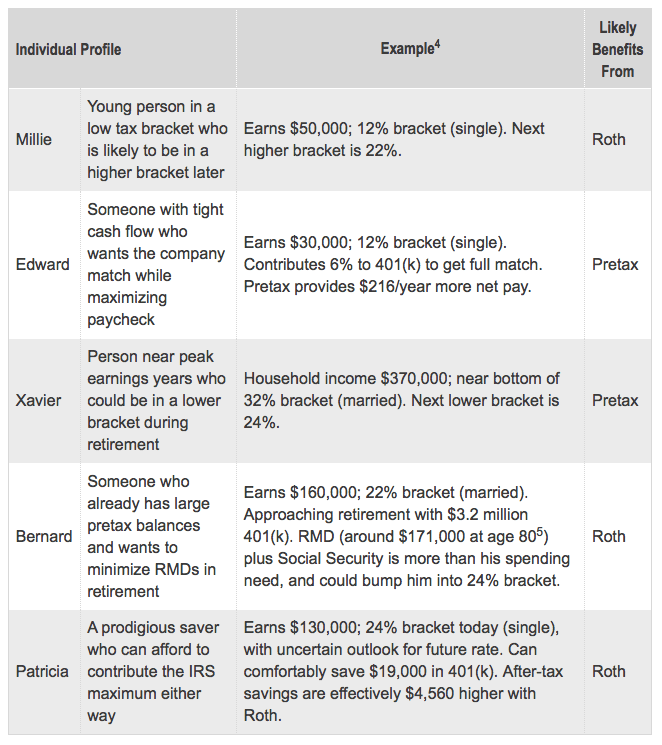

 One of the newer work perks that we took advantage of this year was the Dependent Care Flexible Spending Account (DCFSA). This is separate from the Health Care Flexible Spending Account (HCFSA) and the Health Savings Account (HSA). However, they do work in a similar way in that you can pay for eligible expenses with pre-tax money and thus save money by being exempt from income taxes on that amount. For example, we were able to pay for $5,000 in preschool expenses using your DCFSA in 2018. At a a 30% marginal total tax rate (see below), that was a $1,500 savings.
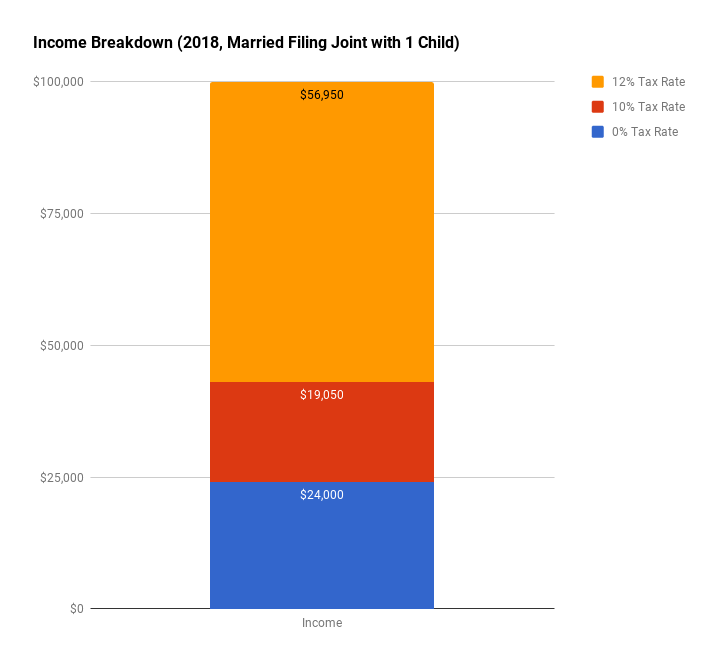
  The Tax Cuts and Jobs Act (TCJA) changed up the personal income tax brackets, exemptions, and deductions. Here is an updated graphical breakdown of a simple scenario for a married filing joint couple with no children in Tax Year 2018. I’ll also try to illustrate the relationship between gross income, taxable income, marginal tax rate, and effective tax rates. See also:



 Updated. Let’s say you are fortunate enough to be able to make a large contribution to a 529 college savings plan, perhaps for your children or grandchildren. You read from multiple sources that you are able to contribute up to $75,000 at once for a single person or up to $150,000 as a married couple (2018), all without triggering any gift taxes or affecting your lifetime gift tax exemptions. (From 2013-2017, these numbers were $70k/$140k). What you are doing is “superfunding” or “front-loading” with 5 years of contributions, with no further contributions the next four years.



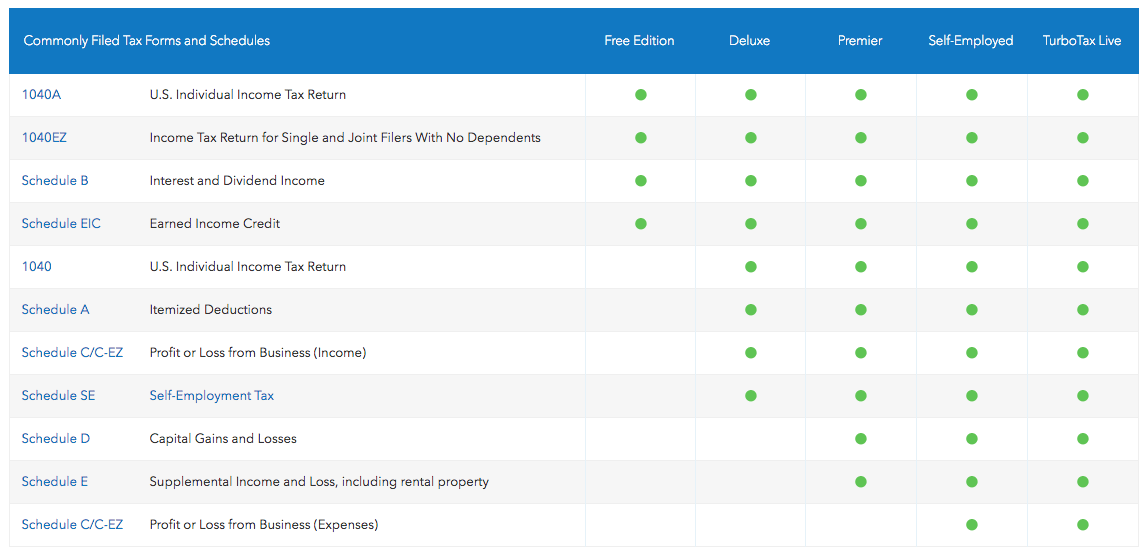
 The new tax bill that takes effect in 2018 raises the standard deduction and caps certain itemized deductions. Therefore, if you will itemize your deduction in 2017, you may want to grab whatever you can this year to get the full value of those deductions. (This assumes you are not subject to AMT.) Here’s a brief summary of your options.
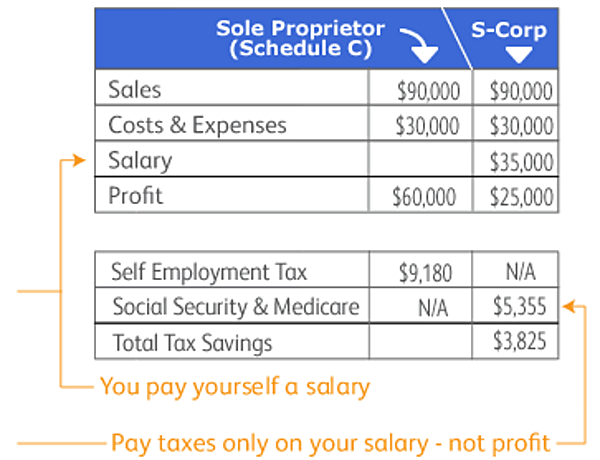
 The wealth management group Del Monte published a

 The Best Credit Card Bonus Offers – 2026
 Big List of Free Stocks from Brokerage Apps
 Best Interest Rates on Cash - 2026
 Free Credit Scores x 3 + Free Credit Monitoring
 Best No Fee 0% APR Balance Transfer Offers
 Little-Known Cellular Data Plans That Can Save Big Money
 How To Haggle Your Cable or Direct TV Bill
 Big List of Free Consumer Data Reports (Credit, Rent, Work)