In addition to data on underfunded state pension funds, Bloomberg also has an infographic on private pensions: S&P 500’s Biggest Pension Plans Face $382 Billion Funding Gap. There are at least 20 large corporations that have put aside less than 70% of what they need to pay out their estimated pension obligations. This is even worse than many state governments, which at least have the ability to increase taxes. Here’s the full list along with their specific funding ratios:

United Airlines was the largest private pension default in US history. I must admit, I don’t really understand the laws behind private pension obligations. In 2002, United Airlines filed for Chapter 11 bankruptcy. In 2005, a federal bankruptcy judge ruled that United Airlines could default their pension obligations and turn the management of pensions over to the Pension Benefit Guaranty Corporation (PBGC). According to this NYT article, the total shortfall was estimated to be $9.8 billion. Even after the PBGC put up $7.3 billion, this still resulted in a significant cut in promised benefits to many retired workers.
Here’s United’s stock price since emerging from bankruptcy in 2006 (via Google Finance):
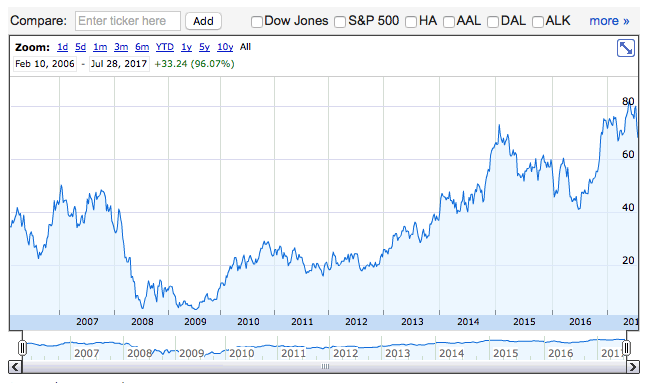
Yet today, I still see United Airlines on this list at 64% funded. I suppose these are Continental Airlines pensions due to their 2010 merger. American Airlines is also on this list at 58% funded (they also tried to dump their pensions back in 2012). I hope these airlines shores up their pension funds while their stock prices are reaching new highs.
The PBGC has never required taxpayer money and is normally funded by insurance premiums, but it could require a bailout if future pension defaults exhaust PBGC funds. I wonder what kind of future return figures are used in these estimates. If they are too optimistic, the situation could be worse than pictured above.

 Updated with new deal. If you are still looking for downloadable desktop tax software that doesn’t require your Social Security Number and financial details to be stored in the cloud, here’s a limited-time deal on H&R Block Tax Software 2016.


 Allan Roth has a new ETF.com article called
  In a continued attempt to better understand the 2017 federal income tax brackets, here is a graphical breakdown of a simple scenario for a married filing joint couple with no dependents. Again, I’ll try to explore the differences in terms such as gross income, taxable income, marginal tax rate, and effective tax rate. See also:


 If one of your New Year’s Resolutions is to create an estate plan for you and your loved ones, here’s a good starter kit. The American Red Cross has a free Estate Planning Guide and Workbook which comes in both electronic fillable PDF form or a paper workbook format if you give them your address. It is roughly 50 pages and includes blanks to store your asset and beneficiary information, make future edits when needed, and print multiple copies to share with your attorney and family members. The guide will help you to:
 Tax-loss harvesting (TLH) is a common practice used to improve after-tax returns by realizing losses to either offset realized capital gains or to defer capital gains into the future. Many robo-advisors including Betterment and Wealthfront offer automated tax-loss harvesting as a feature. As nearly all of them hold ETFs, they accomplish this by selling the primary ETF for each asset class and replacing it temporarily with an alternative, secondary ETF. DIY investors can perform a similar maneuver as well.


 In a Quora question
 The Best Credit Card Bonus Offers – 2026
 Big List of Free Stocks from Brokerage Apps
 Best Interest Rates on Cash - 2026
 Free Credit Scores x 3 + Free Credit Monitoring
 Best No Fee 0% APR Balance Transfer Offers
 Little-Known Cellular Data Plans That Can Save Big Money
 How To Haggle Your Cable or Direct TV Bill
 Big List of Free Consumer Data Reports (Credit, Rent, Work)