 Over the weekend, I read the NYT Magazine article America’s Professional Elite: Wealthy, Successful and Miserable about the rich and unhappy, which included a man who earned $1.2 million a year in Manhattan and hated his job:
“I feel like I’m wasting my life,” he told me. “When I die, is anyone going to care that I earned an extra percentage point of return? My work feels totally meaningless.” He recognized the incredible privilege of his pay and status, but his anguish seemed genuine. “If you spend 12 hours a day doing work you hate, at some point it doesn’t matter what your paycheck says,” he told me. There’s no magic salary at which a bad job becomes good. He had received an offer at a start-up, and he would have loved to take it, but it paid half as much, and he felt locked into a lifestyle that made this pay cut impossible. “My wife laughed when I told her about it,” he said.
Based on a short conversation in a class reunion, it’s easy to extrapolate endless stressful hours at work, a huge mortgage, fancy private school tuition, expensive vacations, and a high-maintenance spouse. Such a picture makes all of us not earning $1.2 million a year feel better about ourselves. But is he really that miserable?
I suspect it is more like the same situation a lot of people are in. They aren’t happy, but things aren’t bad enough to keep them from still doing the same thing. It’s easy to just say OMY (One More Year) because change is scary. I’d certainly rather be in that position while earning a million bucks a year, rather than earning $40k. He has a lot more optionality than most.
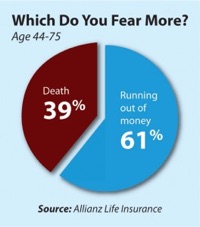
Ever since my post on Retirement Nest Egg Calculators: Running Out of Money vs. Running Out of Time, this following statistic has been stuck in my mind:
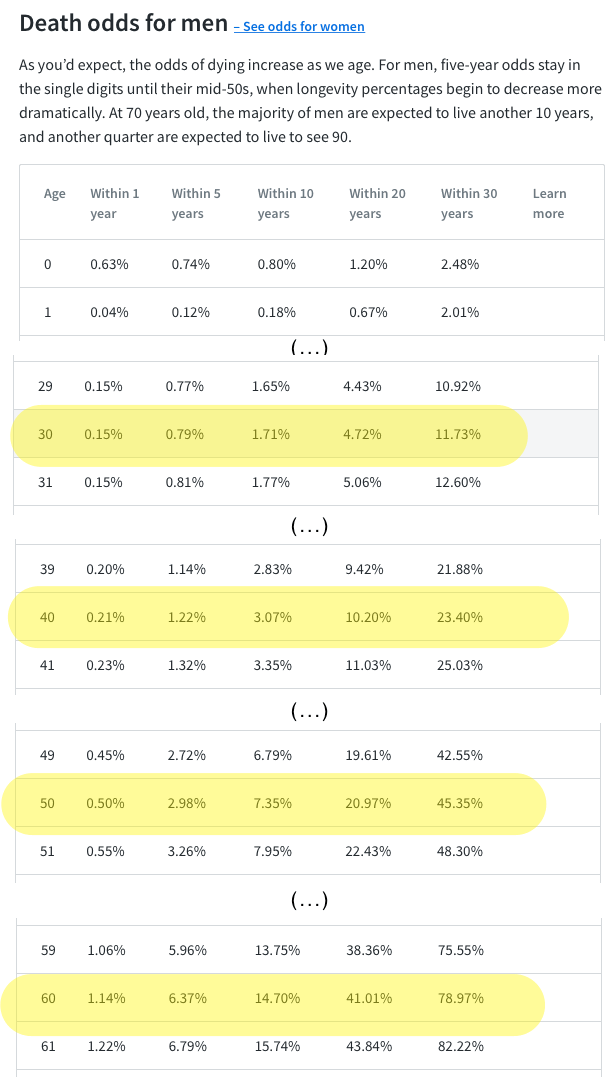
If you’re 40, you have a 10% chance of dying before even reaching 65.
What is your likelihood of dying within the next 20 years? Here are mortality tables based on Social Security actuarial data for US citizens, sorted by age and gender. Below are the rough numbers, along with an edited screenshot of the source at the very bottom.
- A male, age 30 has a 1 in 20 chance of dying in the next 20 years (age 50).
- A male, age 40 has a 1 in 10 chance of dying in the next 20 years (age 60).
- A male, age 50 has a 1 in 5 chance of dying in the next 20 years (age 70).
- A female, age 30 has a 1 in 35 chance of dying in the next 20 years (age 50).
- A female, age 40 has a 1 in 15 chance of dying in the next 20 years (age 60).
- A female, age 50 has a 1 in 7 chance of dying in the next 20 years (age 70).
I try to use these numbers to motivate myself and create a sense of urgency. I’m 40 years old now. There is a 1 in 10 chance that I won’t be old enough to see my daughters even finish college. The person profiled in this article is also probably around 40 years old (15-year reunion of business school). I’m sure there are plenty of 60-year-olds who say “60 isn’t old!” and it isn’t, but that is literally survivorship bias. We all know people who didn’t make it to 60, and these are the overall odds.
Time is your most precious resource. It doesn’t matter what your income is, you only have so much time. Therefore, you should spend it in a way that aligns with your values. Look for ways to get closer to that. If you can’t quit, do the same job with a better employer. Keep working, but switch to a different job within that field/skillset with more personal meaning. Saving more can mean you can get by working fewer hours. If you think you can retire but just can’t seem to pull the trigger, you need to directly confront those last few worries.
Are you unhappy with your situation and still in the same spot as a year ago? Try to find something psychological that will create a sense of urgency. I tell myself “Why am still wasting my time with [insert task]? 1 in 10.”
 Individual Retirement Arrangements (IRAs) are way to save money towards retirement that also saves on taxes. For 2019, the annual contribution limit for either Traditional or Roth IRAs increased to $6,000 (it is roughly indexed to inflation). The additional catch-up contribution allowed for those age 50+ stays at $1,000 (for a total of $7,000). You can’t contribute more than your taxable compensation for the year, although a spouse can contribute with no income if the other person has enough income.
 Employer-based retirement plans like the 401(k), 403(b), and Thrift Savings Plan are not perfect, but they are often the best available option to save money in a tax-advantaged manner. For 2019, the employee elective deferral (contribution) limit for these plans increased to $19,000 (it is indexed to inflation). The additional catch-up contribution allowed for those age 50+ stays at $6,000 (for a total of $25,000).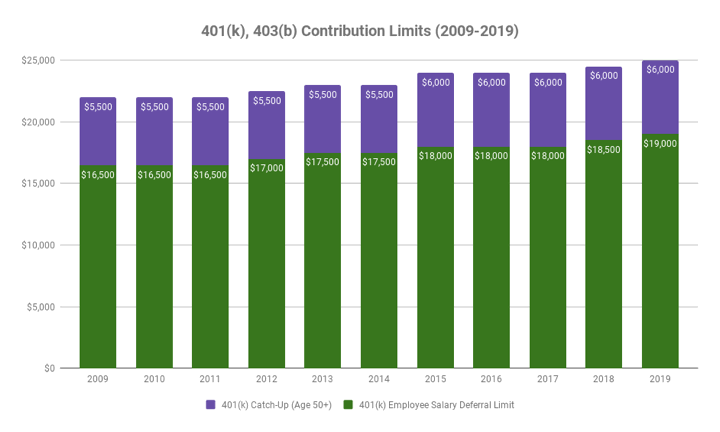
 Instead of just looking at one year of returns, I prefer taking a longer view. Most successful savers invest money each year over a long period of time, these days often into a target-date fund (TDF). Don’t get caught up in the daily news reporting the recent performance of the Dow or S&P 500.

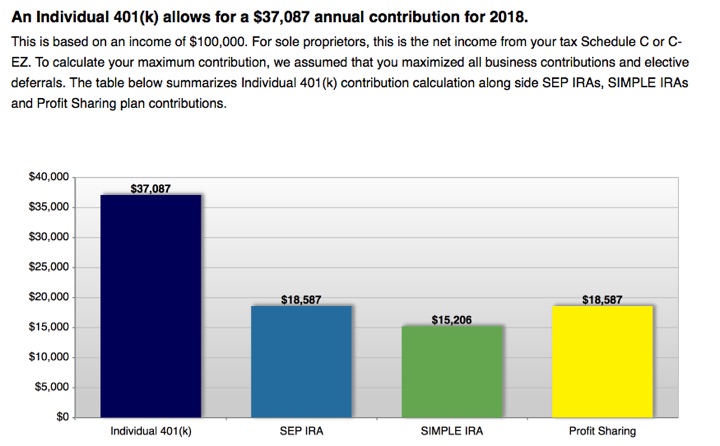
 Each December, I run the numbers to see how much more I can contribute to my Self-Employed 401k plan, aka Solo 401k or Individual 401k.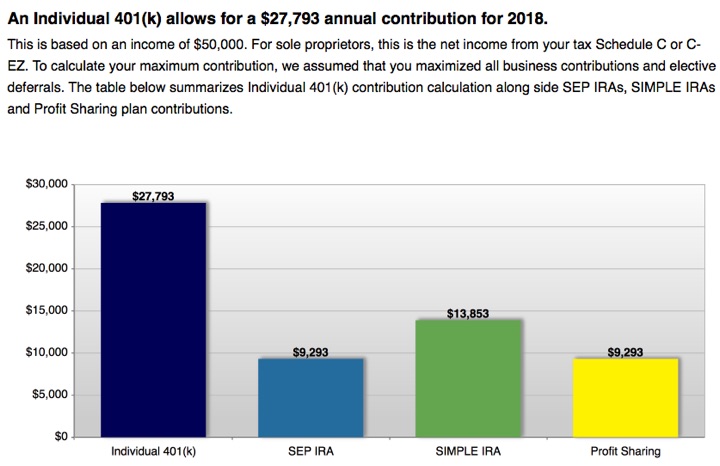




 This is not a happy post, but it’s also the reality for a lot of people so I think it is a valid discussion. The Early Retirement forums had a thread recently titled
  Here’s a refreshingly blunt quote from Scott Galloway’s article
  I was surprised to read the NY Times article
 The Best Credit Card Bonus Offers – 2026
 Big List of Free Stocks from Brokerage Apps
 Best Interest Rates on Cash - 2026
 Free Credit Scores x 3 + Free Credit Monitoring
 Best No Fee 0% APR Balance Transfer Offers
 Little-Known Cellular Data Plans That Can Save Big Money
 How To Haggle Your Cable or Direct TV Bill
 Big List of Free Consumer Data Reports (Credit, Rent, Work)